
XP-era Windows shows error on London DLR, Limehouse still runs XP too long
A Windows XP or Server 2003 relic is appearing on London’s Docklands Light Railway, raising security and ops questions.
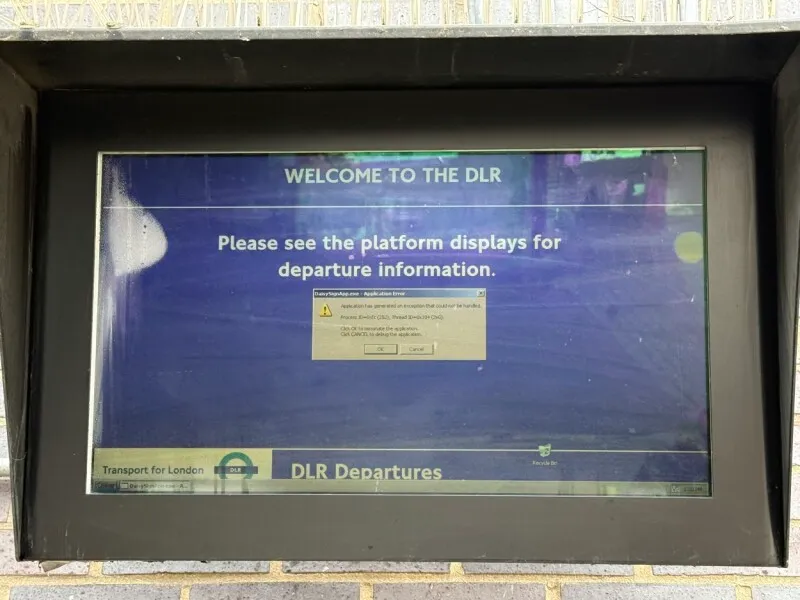
Windows XP-era UI appears on London’s Docklands Light Railway, with a failed app named DaisySignApp.exe spotted by Register reader Tim Hayward. For decision-makers, the real issue is not nostalgia, it is unmanaged legacy exposure on a safety-adjacent, public-facing system.
A Windows XP-era interface is showing up on London’s Docklands Light Railway at Limehouse, and it is throwing application errors in public view. Register reader Tim Hayward spotted the issue, attributed to DaisySignApp.exe, which “thrown up an application error” while commuters ride past. The telltales are classic: even if the Windows shell looks stripped down, the Recycle Bin icon hints at XP’s origins.
The bigger punchline is the age. XP was sunset in 2014, and support for Windows Server 2003 ended in 2015. The item suggests the system could be either XP or Windows Server 2003. In other words, the DLR display is using technology that has been out of supported orbit for years, even if the rest of the railway experience around Limehouse connects to modern UK National Rail services.
So what does that mean in practice, beyond “retro computing”? It highlights how legacy operating systems can quietly linger in embedded or display ecosystems, where the hardware might be unchanged and the software might be just good enough to keep running. The article frames it as an IT administrator reality: if something is not broken, there is often no operational incentive to fix it, even if Microsoft encourages upgrades. That is a very specific kind of risk for boards and operators. It is not the flashy breach story. It is the steady accumulation of unsupported platforms, unpatched vulnerabilities, and vendor or platform gaps.
And it is not hard to see why this can happen in rail and transit networks. Limehouse is one of the first DLR stations and predates the borked operating system by more than a decade. The DLR itself opened in 1987, at a time when Microsoft was preparing to inflict Windows 2.0 on the world. The article notes that many underpinnings for the line hark back to an earlier era, such as formerly disused railway viaducts. That mix of old infrastructure and newer overlays is how public transport systems evolve in the real world: you replace what you must, you patch what you can, and you do not necessarily rip and replace every component that looks like it “works,” even when it is dated at the OS level.
There is also a subtle operational angle: the source argues that it is “unlikely that the operating system is at fault,” and instead points to DaisySignApp.exe misbehaving. That matters because it shifts the conversation from blame to design. Even if the OS is not the root cause of a specific exception, running an unsupported platform still changes the risk posture. When something goes wrong in the application layer, the system often has fewer safe update options. You may be forced into fragile workarounds, or you may have to accept that emergency patching is harder because the underlying OS is no longer supported.
For decision-makers, the second-order implications are where the boardroom sweat starts. A driverless railway is not only about trains moving. It is about systems that keep information consistent for passengers and staff, and about controls that do not surprise you at peak hours. Public-facing screens, signage, and display endpoints are part of the user experience, and errors do not just frustrate riders. They can degrade trust and increase the volume of operational escalations. In the source’s words, the app should be “dealing with its own dirty laundry rather than throwing an exception in commuters’ faces.” When that boundary fails, the organization has to answer: who owns the fault, who owns the patch path, and who owns the risk acceptance.
There is also a governance angle tied to platform lifecycle reality. The DLR display being tied to XP-era software is a reminder that end-of-life dates are not theoretical. XP sunset in 2014, Windows Server 2003 support ended in 2015. When those timelines pass, the operational burden shifts. The organization needs a plan: either prove the platform is irrelevant to security outcomes and isolate it aggressively, or modernize it so it can be patched. Boards increasingly want evidence here, not reassurance.
Ultimately, this is not just a quirky “blast from the past.” It is a live case study in how unsupported operating systems can surface on critical, public, and safety-adjacent infrastructure. For executives and investors with exposure to infrastructure, transit tech, or any mission-critical display and signage stack, the strategic stake is clear: legacy drift does not always announce itself with a headline breach. Sometimes it shows up as an “application error” at Limehouse, years after it should have been retired.
This story's Key Insights and Take-aways are locked.
Create a free account to unlock Executive Actions for one credit.
Register to UnlockAlways free for Executives Club members. Join the Club
More in Technology

OpenAI says 10,000 agents cracked a 90-year math problem in 88 hours
The company's claim is audacious, but one mathematician is pushing back. Here's what it means for AI-driven discovery.
Meta still serves child sexual abuse ads on Instagram in India - BBC report
A new report following the BBC Eye investigation says the ads are still there - what it signals for every platform with a self-serve ad engine.
White House yanks 'Build the Wall' game after Tetris Company copyright warning
The administration's arcade game vanished in hours - and the takedown playbook every brand can learn from.