
ZDNet’s privacy checklist for AI chatbots: tighten settings before you hit send
A practical guide to reduce exposure risk across major AI chatbots, with clear steps decision-makers can enforce.
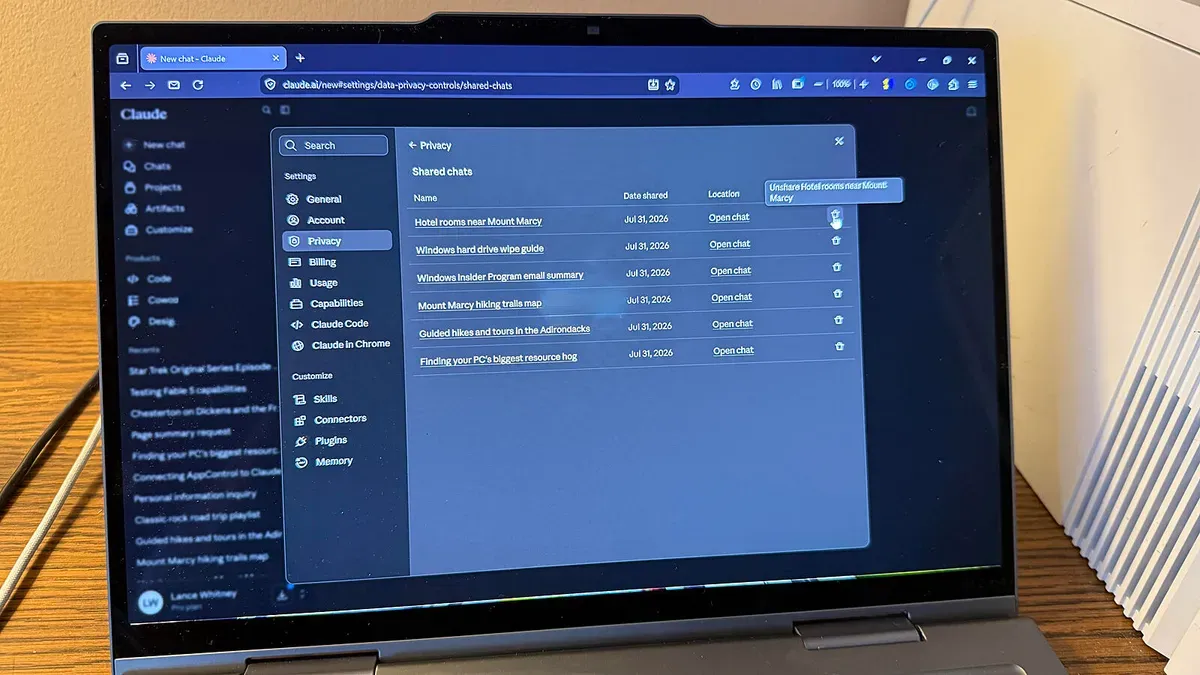
ZDNet lays out how to keep personal AI conversations as private as possible by tightening privacy settings across several major chatbots. For decision-makers, the consequence is straightforward: fewer chats can mean less sensitive data leaking through default settings.
If you use AI chatbots for work or personal life, the uncomfortable question is not “can data leak?” It is “how much are you already handing over without realizing it?” ZDNet’s answer is a focused privacy checklist: you can tighten how major chatbots handle your conversations, reducing the chance your personal AI chats are exposed.
The core idea from ZDNet is simple, and you can apply it across multiple popular chatbot experiences: revisit your privacy controls, then adjust them so your chats are treated with more caution. The article is explicitly aimed at people who are worried about personal AI chats being exposed, and it walks through steps to tighten privacy across several major chatbots, so you are not relying on default settings that may not match your comfort level.
Why this matters now is that AI chat systems have become the front door for lots of everyday tasks. They draft emails, summarize research, brainstorm ideas, and answer questions in seconds. That convenience is powered by how these systems capture prompts and outputs, store or process them, and sometimes use conversation data for improving services or safety. Even when providers have legitimate reasons to collect some information, executives and operators should assume users will paste more than they intend: account details, project context, client names, health or HR-adjacent data, internal notes, and anything else that feels “harmless” in the moment.
Regulation and enforcement pressure are part of the backdrop. Across many jurisdictions, regulators have been converging on the same direction: data minimization, clear transparency, and stronger controls over how personal data is used. For organizations, that translates to a governance question: if employees can chat with AI tools that retain conversations, do you have practical guardrails that reduce exposure? ZDNet’s approach, which emphasizes tightening settings across major chatbots, fits directly into that compliance mindset. Instead of treating privacy as a legal attachment, it becomes an operational habit.
There is also a board-level angle. When a privacy issue happens, the damage rarely stays in the “privacy team” lane. It can become a customer trust problem, a vendor risk problem, and sometimes a security incident story, depending on what was exposed. Boards care about whether privacy is engineered and enforced, not just promised. Checklists and settings are not sexy, but they are often where outcomes get made, because they determine what data flows and what gets retained.
The second-order implication for decision-makers is that “tightening privacy” is not a one-time action. People change settings less often than they change behavior. New product features can alter defaults. Individuals can switch between personal and work accounts. Teams can adopt different chatbot platforms depending on what is available in their browser or via mobile. That means a privacy posture needs ongoing review: you tighten the settings, you document the approved configuration, and you periodically confirm that people are actually using it.
ZDNet’s framing is also useful because it treats privacy as configurable, not mystical. If your worry is specifically that personal AI chats could be exposed, the most practical path is to reduce what gets collected, make sure conversation histories are handled conservatively, and ensure the chatbot experience reflects your preferences. The article is built for users who want concrete steps across several major chatbots, so you do not have to guess at which lever matters most.
Strategically, executives who care about privacy should think of this as part of broader AI risk management: you are aligning how staff use AI tools with the organization’s tolerance for data exposure. ZDNet’s guidance gives a starting point, and it is the kind of operational step that scales better than training alone, because it changes the environment in which users act. In a world where AI feels effortless and data consequences can be anything but, those settings are your first line of defense.
This story's Key Insights and Take-aways are locked.
Create a free account to unlock Executive Actions for one credit.
Register to UnlockAlways free for Executives Club members. Join the Club
More in Technology

Google quietly links your phone number to every Android account on your SIM
Adding a SIM now ties your phone number to all Google accounts - and future accounts inherit it. Here's the security and privacy stakes.

Hijacker AI 'Skynet mode' runs 100,000 attack steps against exposed models
Symantec caught a criminal AI agent that borrows other models, steals data, and mines crypto; the only relief is no confirmed victims yet.

Nvidia's AI-financier shift faces its first big test as neoclouds stumble
A rout in neocloud stocks is forcing investors to weigh Nvidia's hidden exposure as both supplier and lender to the AI buildout.