
Afterpay Arena reopens July 23 with Square tap-to-pay and Pay in 4 for every fan
A five-year naming deal is now backed by payments built into tickets, food, merch, and tech at scale.
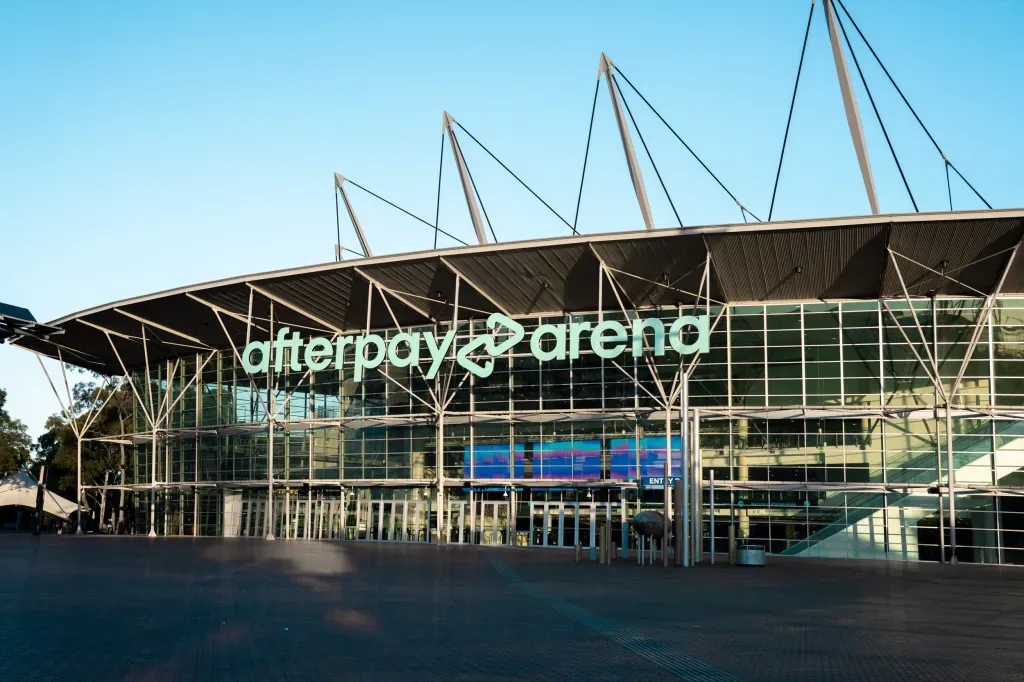
Afterpay Arena, Sydney's former Qudos Bank Arena, officially reopened Thursday (July 23) after a full overhaul tied to Afterpay's five-year naming rights partnership. The upgrade turns payment flexibility into physical experience, with Afterpay Pay in 4 and Square tap-to-pay across the venue.
Afterpay Arena officially reopened in Sydney on Thursday (July 23), completing the physical overhaul of the venue formerly known as Qudos Bank Arena and formally launching Afterpay's five-year naming rights partnership first announced in May. The launch ceremony in the arena bowl was attended by Afterpay co-founder Anthony Eisen, Afterpay VP APAC Mike Ryan, Legends Global COO for Asia Pacific and Middle East Peter Loxton, and Federal Shadow Assistant Minister for the Digital Economy Simon Kennedy, marking the first time the fully transformed venue was presented under its new name.
And the promise is not just branding. Afterpay says the venue is the first major entertainment destination in Australia designed to offer payment flexibility across the entire fan experience, including the ability to split ticket purchases into four interest-free instalments via Afterpay Pay in 4. Inside the building, attendees can also use tap-to-pay for food, beverage and merchandise, powered by 150 Square Registers and 65 Square Handheld devices, which the companies describe as the first full Square commerce integration at a venue of this scale in Australia. In other words: the payment story starts before fans enter, and it keeps going until the last song of the night.
The ceremony framed the deal as a “physical” partnership, not signage. Eisen said, “Afterpay now has a permanent home in the place where fans come for the moments that matter most to them.” He added that they built the venue “around keeping fans in the moment - from the way they buy their ticket to the last song of the night.” Loxton similarly positioned the partnership as more than a name on a building, saying, “This partnership isn't just a name on a building... That's exactly the kind of engaged partner we want beside us for the next five years.” Translation for decision-makers: the operator and venue partner are treating payments as infrastructure, and infrastructure as an attendance and spending lever.
The physical transformation backs that intent. The venue rollout includes a foyer uplift, two redesigned hospitality spaces, venue-wide wayfinding, and what the companies describe as one of the world’s largest transparent holographic LED installations. That matters because payment flexibility is only half the pitch. If the experience is confusing, or if lines and friction stack up, the “buy now” benefit becomes “wait, annoy, leave.” By coupling payments with redesign, the partnership is trying to remove the typical friction points that make fans abandon a night out mid-journey.
The numbers behind the urgency are not theoretical. The venue draws approximately 1.1 million attendees annually and was named to Billboard's Top 5 Live Music Venues in 2025. Operated by Ticketek Entertainment Group and managed by Legends Global, the arena sits in a category where small changes in conversion and spend can ripple across revenue streams: tickets, concessions, merchandise, and even how often fans return. Afterpay’s research, cited by the company, found that 94% of cost-affected event-goers have missed live events due to upfront payment barriers. It also found that 74% said they would spend more at venues offering payment choice. For boards and finance teams, those figures are a direct challenge to “we already capture demand” thinking. If a large share of would-be attendees are being priced out at the checkout moment, then changing payment terms can function like demand expansion, not just a billing method.
Regulatory and public-policy framing also enters the room. Simon Kennedy, Federal Shadow Assistant Minister for the Digital Economy, attended the launch ceremony, a signal that buy-now-pay-later moving into mainstream entertainment is now part of the broader digital economy conversation. In practice, regulators tend to care about consumer impact, transparency, and affordability in ways that matter when payment tools become embedded in essential daily behaviors like retail purchases. Here, Afterpay is positioning itself as a route to “engaged” fan commerce while making the mechanics visible: Pay in 4 at ticket purchase, then tap-to-pay inside the venue.
The strategic implication for peers is hard to miss: the naming rights play is being paired with operational integration. This is part of a broader push by buy-now-pay-later operators into live entertainment, where promoters and venues increasingly position payment flexibility as a lever for driving attendance and per-head spend. If this model scales across other large venues, the competitive boundary shifts from marketing to systems. It's no longer only about who can buy the loudest billboard. It's about who can integrate payments into the physical journey with enough reliability that fans do not feel the seams.
Among the first acts scheduled to play the transformed venue are Tame Impala, J. Cole, Khalid, Laufey, Robyn, Olivia Dean, Zara Larsson and Hilary Duff. That booking list is a reminder that the arena’s success will be measured in cash registers, not just ribbon-cuttings. For the executives making deals, the test is whether payment choice translates into fewer missed events for cost-affected fans, higher on-site spend for those who arrive, and better utilization for the operator over the five-year partnership through 2031.
This story's Key Insights and Take-aways are locked.
Create a free account to unlock Executive Actions for one credit.
Register to UnlockAlways free for Executives Club members. Join the Club
More in Business

Anthropic’s Levant Alpöge cracks the Jacobian conjecture after 87 years
A Harvard valedictorian used Claude to hit a 1939 breakthrough, but the missing “why” is the real problem.

Uber buys Delivery Hero for nearly $15B, vaulting to top food delivery outside China
The deal doubles Uber's dual-services footprint and pushes a ride-and-eats bundling play into 50 more markets.

Epic and Google drop settlement bid, forcing rival Android app stores by July 22
Google told the court it is ready to carry third-party app stores starting Wednesday, July 22.