
Airbnb CEO Brian Chesky writes one email a week, if that. He says texting is superior
Chesky ranks email dead last among communication tools and texts his 8,200 staffers instead. What that means for your inbox culture.
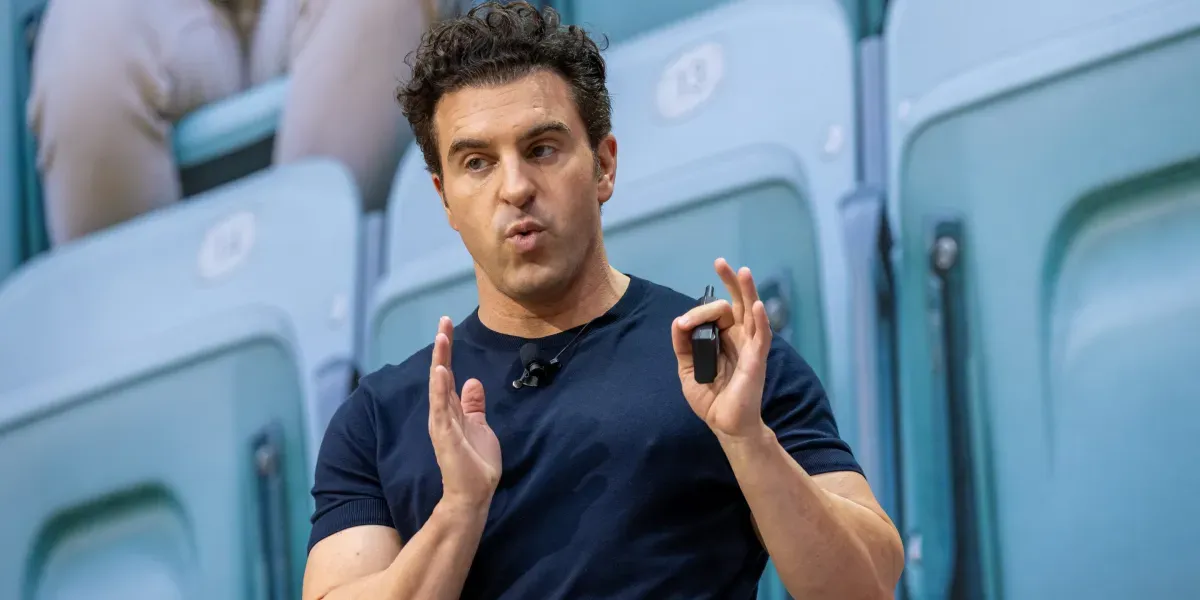
Airbnb CEO Brian Chesky told Time he rarely drafts emails, calling the format inferior to texting and ranking it fourth among communication tools. His preference signals a shift in executive communication norms that could reshape expectations for responsiveness and work-life boundaries.
Airbnb CEO Brian Chesky can barely remember the last email he wrote. In an interview with Time, the billionaire boss said, "I don't know if I write an email a week," adding that while he responds to inbound messages daily, drafting an original email is now a rarity. His reasoning is blunt: "I just find it inferior to almost every other form of communication." Email, he argues, is subject-based, while text is person-based, faster, and more contextual. "When you get a text message, it doesn't feel like work to respond," he said, whereas email "feels like work." For a CEO overseeing roughly 8,200 staffers, that distinction matters: he believes texting is more likely to reach employees because notifications pop up directly on their phones. His personal ranking puts in-person first, Zoom second, text third, and email dead last at number four.
Chesky's philosophy is not just a personal quirk; it is a management signal. He told Time that his general approach to a problem is to "call someone, text them, meet them in person," and he has applied that logic at scale across Airbnb's workforce. The company, which went through a dramatic pandemic-era reset and returned to profitability, has become a case study in lean operations, and Chesky's communication style fits that ethos: faster loops, fewer formal artifacts, more direct contact. For executives watching from other industries, the takeaway is not that email is obsolete, but that the CEO of a major public company is publicly deprioritizing it. That carries weight in a business environment where response time is increasingly treated as a competitive metric.
Chesky is not alone in blurring the line between work and personal time. Farmer J founder and CEO Jonathan Recanati told Fortune he has never turned on his out-of-office auto-reply, even during his honeymoon. Anna Lundstrom, CEO of Nespresso's U.K. and Ireland business, said her workforce can reach her on Teams, email, WhatsApp, and LinkedIn at any hour, explaining, "I think I'd always rather know something than not." Uber CEO Dara Khosrowshahi has gone further, calling weekend emails "part of working hard" and describing a follow-up system: if he does not get a response on Saturday, he sends another email on Sunday with a question mark. These executives are effectively normalizing a 24/7 responsiveness standard, even as their own employees may be pushing in the opposite direction.
The tension is real. Research from recruitment platform Reed found that a quarter of millennial workers would quit if their boss contacted them outside work hours, and 59% of 18- to 34-year-olds say they would leave to protect their work-life balance. That creates a paradox at the heart of modern management: the same leaders who champion flexibility and trust are also the ones most likely to text at 9 p.m. Chesky acknowledges the friction, saying he tries "not to text people when I think they're with their family unless there's a crisis," but he also admits his own work-life balance is "blended" more than the average person's. For a generation that increasingly treats after-hours messages as a boundary violation, the medium may not matter as much as the timing.
What makes Chesky's stance notable is not just the preference for text, but the public framing of email as inferior. He is not saying email is inefficient; he is saying it is a worse way to communicate, period. That is a strong point of view from a CEO whose company depends on millions of hosts and guests coordinating across time zones. Airbnb's own platform is built on asynchronous, app-based messaging, so Chesky's bias toward text aligns with the product he sells. But for leaders in more traditional industries, the lesson is more nuanced: communication tools are not neutral. The choice of channel signals what you value, whether that is speed, formality, or personal connection.
For boards and CEOs, the strategic question is not whether to ban email, but whether your communication culture matches your talent strategy. If your top performers are millennials and Gen Z, the data suggests they will tolerate less after-hours intrusion, regardless of whether it arrives by email or text. Chesky's approach works for him because he has built a company culture that accepts his blended style, but he also concedes that everyone has "a right to run their company how they want." The risk for other executives is copying the tactic without the context: texting your team at midnight only works if you have already established trust and boundaries. Otherwise, you are just another boss making work feel inescapable.
The broader implication is that email's decline as a primary communication tool is accelerating at the highest levels of business. If a CEO of a $100 billion company says he barely writes email, that sends a signal to every vendor, partner, and employee who interacts with him: text is the way in. For decision-makers, the practical move is to audit your own communication stack. Are you defaulting to email because it is formal, or because it is easy? Are you texting because it is faster, or because it is more human? Chesky's answer is clear, but his context is unique. The best leaders will borrow his clarity without inheriting his blind spots, and they will remember that the medium is not the message; the boundary is.
This story's Key Insights and Take-aways are locked.
Create a free account to unlock Executive Actions for one credit.
Register to UnlockAlways free for Executives Club members. Join the Club
More in Business

Elon Musk unveils a flying car, and SpaceX helped build it
The Tesla CEO's showcase at a SpaceX facility signals a future where road and rocket engineering converge.

Apple's $2,000 iPhone Duo opens preorders, taking on Samsung and Google
Apple's first foldable hits the market at a premium price, reshaping a category Samsung and Google have led.

Pope Leo XIV, first American pope, diagnosed with lung cancer
The 71-year-old Chicago-born pontiff underwent successful surgery on his right lung, and his diagnosis raises new questions about his AI-focused papacy and the Vatican's future.