
Astronomers spot a rare double supernova in the Jellyfish Nebula for the first time
Two sibling stars exploded separately, giving researchers a fresh, unusually clear look at how supernovas unfold.
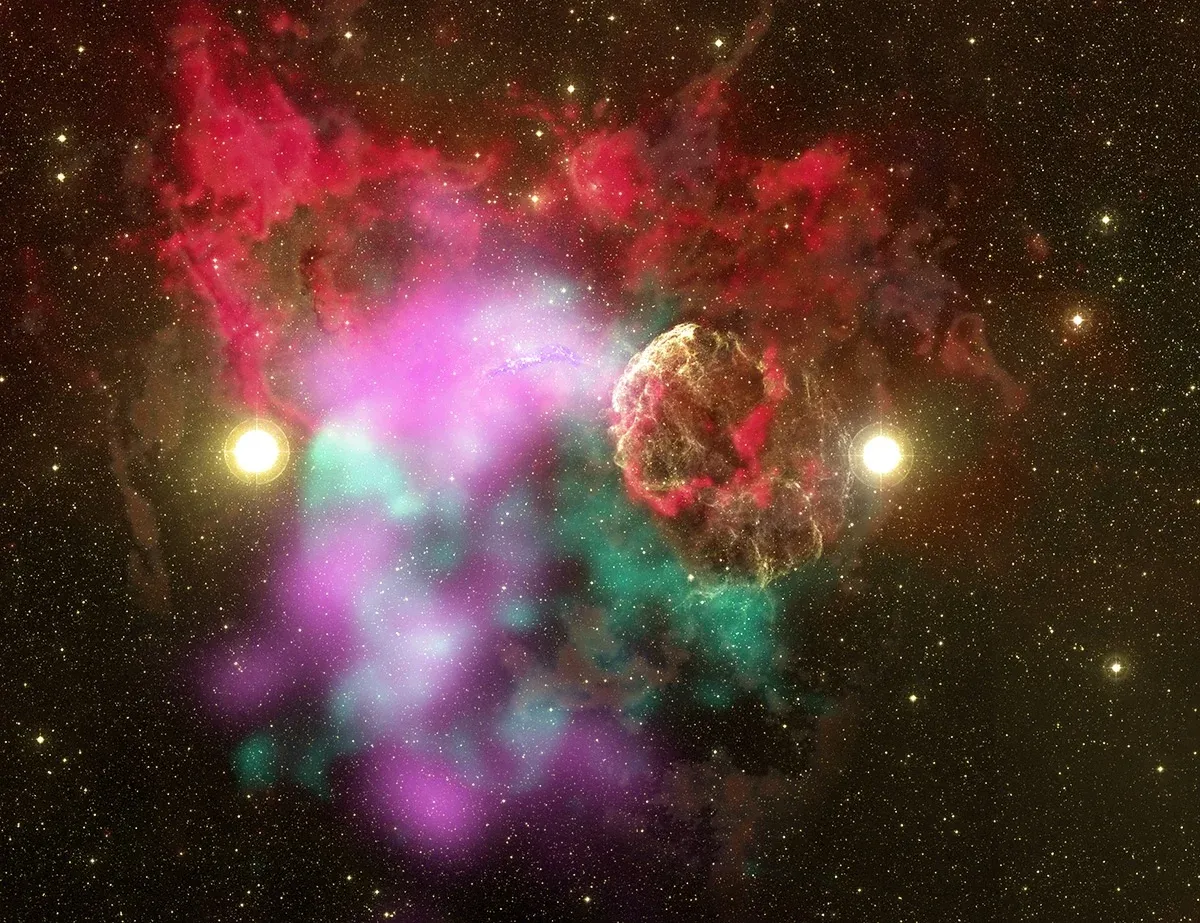
Astronomers report the first-ever discovery of two sibling stars in the Jellyfish Nebula, each exploding as a supernova. For decision-makers in research and science-adjacent industries, the payoff is a new “natural experiment” that can sharpen models and future mission planning.
For the first time ever, astronomers have found two sibling stars that each exploded as a supernova. The discovery is hiding in plain sight in the Jellyfish Nebula, and it matters because supernovas are not just dramatic endings. They are major drivers of how galaxies evolve, how heavy elements spread, and how future stars get seeded.
This is a double event, not a single one, and that uniqueness is the whole point. When two related stars blow up as supernovas, researchers get an unusually clean comparison: same general neighborhood, same kind of shared origin, but separate explosions. That gives scientists a new view of these epochal cosmic cataclysms, instead of relying on one-off events that are harder to contextualize.
Zoom out for a second. A “supernova” is the violent death of a star, and astronomers care about them for reasons that ripple outward. The shockwaves help shape the surrounding interstellar medium, and the debris enriches space with elements that later become part of planets and, eventually, life-friendly chemistry. But modeling supernovas is hard because the details vary. Star mass, composition, and the immediate environment all influence what a supernova looks like and how it behaves. In practice, that means researchers often stitch together understanding from many separate observations. The Jellyfish Nebula discovery offers something rarer: sibling explosions that give a more apples-to-apples lens.
Why do executives and board-level leaders in science-adjacent sectors care? Because the industry of discovery is increasingly about data quality and timing. Whether you are funding telescope time, building instrumentation, underwriting science missions, or allocating budgets across R&D pipelines, the value of a breakthrough is often less about spectacle and more about what it reduces in uncertainty. A rare configuration like a “double supernova” can help tighten assumptions that propagate through the whole ecosystem: from observing strategies to interpretive models.
There is also a subtler incentive story underneath the astronomy. Discoveries like this can influence what observatories prioritize next. When researchers identify an event that is both rare and information-dense, it changes how teams compete for follow-up observations, including multi-wavelength campaigns. That can cascade into decisions around scheduling, instrument allocation, and collaboration structures, especially because different parts of the electromagnetic spectrum can reveal different aspects of an explosion. In other words, one surprising sky event can rearrange a lot of planning behind the scenes.
Now connect it to the broader “regulatory background” of how science gets done, even when regulators are not the main characters. Astronomy organizations, research funders, and institutions typically operate inside frameworks that govern compliance, data policies, and safety for facilities and operations. While this particular report is about what astronomers observed in the sky, the second-order effect is about downstream governance: how data is shared, how observations are archived, and how quickly the community can verify and extend findings. When a result is described as the first ever, it raises the stakes for reproducibility and careful analysis, because it becomes a reference point for future work.
So what are the strategic stakes for peers? If you are leading a research institution, managing a science program, or steering an organization that depends on credible scientific inputs, this kind of discovery is a reminder that nature sometimes hands over controlled experiments disguised as cosmic accidents. Two sibling stars exploding as supernovas, discovered for the first time, means researchers can compare outcomes more directly than usual. That can improve how astronomers interpret explosion mechanisms and refine models that guide future observation plans.
And for everyone watching where the next wave of discovery comes from, the Jellyfish Nebula double event is a signal: the universe still delivers “once in a lifetime” configurations, but only to the teams with the tools and workflows to spot them quickly. In the world of decision-making, that is the real win. You do not just get a headline. You get a clearer pathway to better predictions and smarter follow-up, because the data is unusually well-structured by the stars themselves.
This story's Key Insights and Take-aways are locked.
Create a free account to unlock Executive Actions for one credit.
Register to UnlockAlways free for Executives Club members. Join the Club
More in Science

NASA-backed engineers shrink high-fidelity energetic particle sensing into CubeSats
A compact, multiview particle-detection instrument could turn CubeSats into near-Earth science platforms without sacrificing data quality.

Stage 4 lung cancer at 44: a never-smoker’s ALK story that beat the odds
Summer Farmen turned an ALK-positive diagnosis into a six-year survival case study on targeted therapy and patient power.
Zoo elephants live longer now: study shows steady life expectancy gains since the 1960s
A multi-institution study in Scientific Reports finds modern zoo care is extending elephant lifespans, decade by decade.