
Blue Origin adds 2 New Glenn pads to chase 150 launches a year
Blue Origin's Florida buildout targets 150 launches a year, a bet that could reshape the launch market.
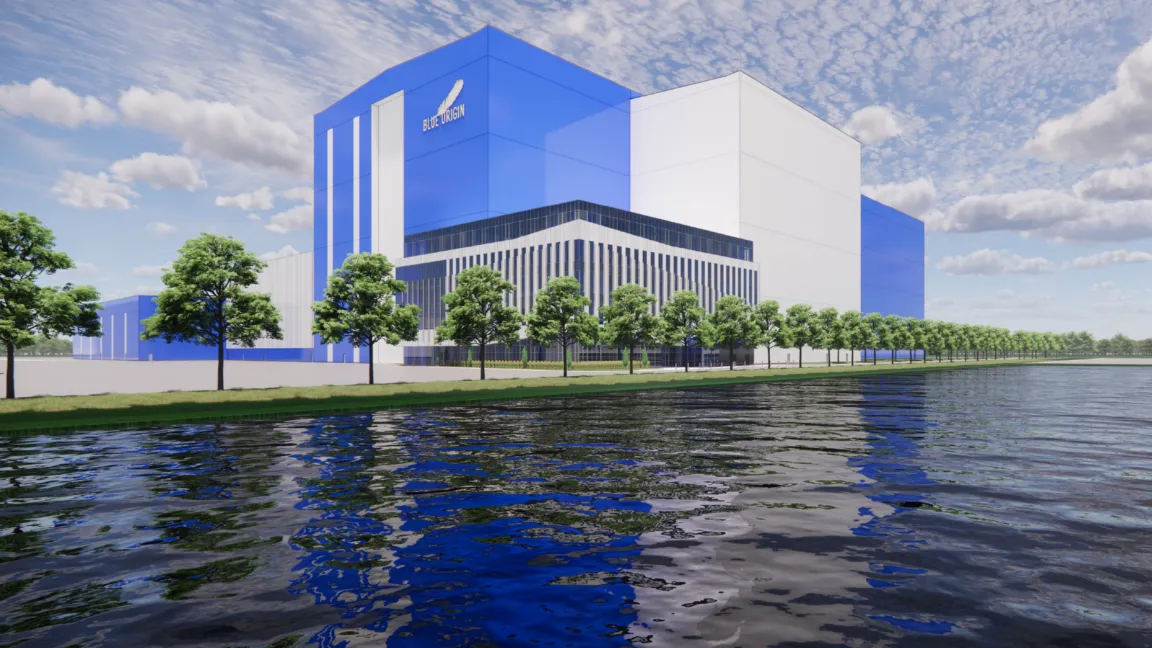
Blue Origin announced Friday it will add two New Glenn launch pads, a new upper-stage factory, and two more landing ships to support up to 150 launches a year from Florida. The expansion signals a major capital commitment to reusable rockets and a faster cadence that rivals will have to answer.
Blue Origin is going all in on New Glenn. On Friday morning, the company announced it will add two additional launch pads for the rocket at Cape Canaveral, joining two already under construction, with the stated goal of eventually flying 150 rockets a year from its Florida facilities. That headline number is the clearest signal yet that Blue Origin intends to turn New Glenn from a development program into a high-cadence commercial workhorse.
The expansion doesn't stop at pads. Blue Origin also said it is investing heavily in a new manufacturing facility that will produce up to 150 upper stages for a larger variant of New Glenn, and it plans to procure two additional landing ships to catch and return the rocket's first stage. The company currently has one such ship, named Jacklyn. Add a new customer integration facility built with the US Space Force, featuring four payload bays to process multiple missions at once, and the picture is of a company building an end-to-end launch pipeline.
The 150-launch target is a massive step up from Blue Origin's current cadence. New Glenn has yet to reach orbit on a regular operational basis, and the company has been slower than rivals to move from testing to routine flights. But the infrastructure buildout suggests Blue Origin is betting that demand for heavy-lift launch will keep growing, driven by commercial constellations, national security missions, and deep-space payloads. For context, the global launch industry has seen a surge in demand from low-Earth-orbit broadband networks, and governments are increasingly looking for redundant access to space.
The decision to build a factory capable of producing up to 150 upper stages for a larger New Glenn variant is particularly telling. It implies Blue Origin is planning for a version of the rocket with more performance, and it signals confidence that the design will mature enough to justify mass production. Upper stages are typically the part of a rocket that gets less attention than boosters, but they are critical for delivering payloads to their final orbits. A production line of that scale would put Blue Origin in a different manufacturing league than most of the industry.
The landing ships are another piece of the puzzle. Blue Origin's approach to reusability involves landing the first stage on a sea-going platform, similar to how SpaceX lands boosters on droneships. The company currently has one ship, Jacklyn, named after Jeff Bezos's mother. Adding two more suggests Blue Origin expects to recover boosters at a much higher rate, which is essential for hitting 150 launches a year while keeping costs down. Reusability is the key economic driver in modern launch, and the ship count is a direct measure of how serious Blue Origin is about that model.
The customer integration facility, built in conjunction with the US Space Force, is a strategic move as well. National security launches are among the most lucrative and stable contracts in the industry, and the Space Force has been actively courting new providers to ensure the US military has multiple options for getting payloads to orbit. By co-developing infrastructure with the Space Force, Blue Origin is positioning itself as a long-term partner for defense and intelligence missions, not just commercial ones. The four payload bays will let the company process multiple missions simultaneously, which is a bottleneck for many launch providers.
For executives and operators watching the launch market, the takeaway is that Blue Origin is no longer content to be a distant second or third player. The company is making a capital-intensive bet that it can scale New Glenn to a cadence that only SpaceX has achieved so far. That will put pressure on other providers, including United Launch Alliance and Rocket Lab's Neutron, to accelerate their own plans. It also raises the stakes for Blue Origin's own execution: building pads, ships, and factories is one thing; actually flying 150 times a year is another. The company will need to demonstrate reliability and demand in equal measure.
The broader implication is that the launch industry is entering a phase of industrial-scale competition. Infrastructure like this is not built on a whim; it requires years of lead time and billions in capital. Blue Origin's announcement is a signal to customers, investors, and rivals that it expects the market to be large enough to support multiple high-cadence providers. For anyone making decisions about satellite constellations, space logistics, or national security payloads, the message is clear: launch capacity is about to become more abundant, and pricing and reliability will be the battleground. The race to 150 launches a year is on.
This story's Key Insights and Take-aways are locked.
Create a free account to unlock Executive Actions for one credit.
Register to UnlockAlways free for Executives Club members. Join the Club
More in Business

Elon Musk unveils a flying car, and SpaceX helped build it
The Tesla CEO's showcase at a SpaceX facility signals a future where road and rocket engineering converge.

Apple's $2,000 iPhone Duo opens preorders, taking on Samsung and Google
Apple's first foldable hits the market at a premium price, reshaping a category Samsung and Google have led.

Pope Leo XIV, first American pope, diagnosed with lung cancer
The 71-year-old Chicago-born pontiff underwent successful surgery on his right lung, and his diagnosis raises new questions about his AI-focused papacy and the Vatican's future.