
Casey Harrell’s ALS BCI decodes speech at 92% daily accuracy, UC Davis says
A UC Davis machine-learning upgrade turns implant-based brain signals into sentences Harrell uses for full-time work.
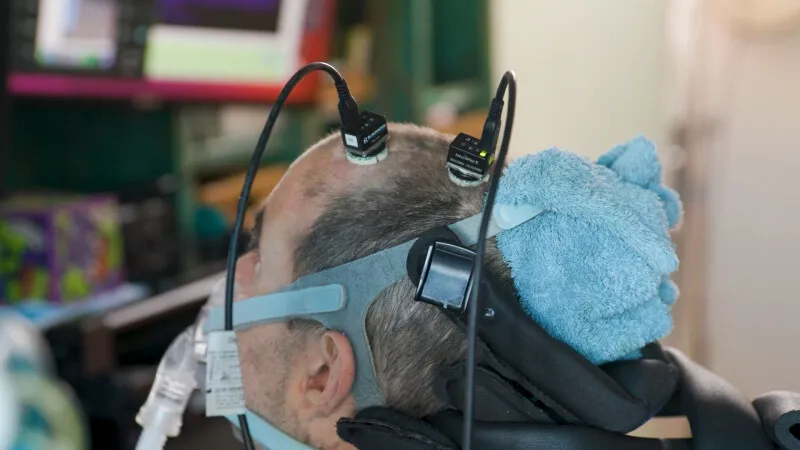
UC Davis researchers, working within the BrainGate consortium, say Casey Harrell's implanted brain-computer interface for ALS has stayed active since 2023 and produces spoken sentences with 99% accuracy in tests and 92% accuracy in daily use. The implication for decision-makers: BCI research is moving from lab-only demos toward deployable, home-based assistive communication.
The headline number is the real story here: UC Davis says a machine-learning driven brain-computer interface can translate an ALS patient’s brain activity into sentences with 99% accuracy in controlled tests, and 92% accuracy during everyday use. That last part matters. High lab performance is common in early-stage tech. Durable, in-the-wild performance that lets someone live their life, including work, is the harder threshold.
In the middle of that achievement is Casey Harrell, the ALS patient whose implanted system has been running since 2023, according to a paper published Monday by a University of California, Davis team. The Davis group, part of the BrainGate coalition with the U.S. Department of Veterans Affairs, reports that Harrell can control a computer cursor with his thoughts and also speak. The study’s co-principal investigator and co-senior author is Davis neurosurgeon David Brandman, who also placed Harrell’s implant, and he frames the result as a “crossing of a threshold” for BCI technology because it has been working well with daily use for years.
If you have ever tried to operationalize something “works in the lab,” you know what usually kills the dream. In earlier BCI efforts, Brandman says researchers either had to be present in the patient’s home when the technology was used, or the patient had to travel to the researchers. The UC Davis approach removes that friction. The system allows Harrell’s home care team to hook him up to the device themselves, and the paper credits that capability with enabling more than 3,800 hours of use over the past few years. Based on the study timeline described in the article, that translates to more than five hours a day on average.
That’s more than a clinical milestone. It is an operational milestone. For executives watching brain-computer interfaces, the core question is not just whether the brain decoding algorithm can output text or phonemes. The question is whether the whole workflow is robust: onboarding, setup, daily reliability, and a level of accuracy that makes communication actually usable. The Davis team argues the practical piece is their machine learning layer, not bespoke hardware.
Brandman says the study did not involve purpose-built hardware. Instead, it uses an existing BCI design produced by Blackrock Neurotech. The Davis innovation is software. The team built its own BCI operating platform called Brain-computer interface for Rapidly Adaptive Neural Decoding, or BRAND, and the paper names Nick Card, a UC Davis postdoctoral fellow, as the person who built the machine learning algorithms. BRAND is now used across the BrainGate consortium, positioning it as a shared “middle layer” that can be reused across deployments rather than starting from scratch each trial.
Here is what the software is doing, in plain terms: according to the paper, BRAND’s AI algorithms translate activity in Harrell’s ventral precentral gyrus, the brain region Brandman points to as controlling motor function in the face, mouth, and jaw. Those neural patterns get mapped into English-language phonemes. Then additional algorithms map phonemes to words, and words into sentences. The result, the article reports, is precise speech synthesis that supports real-world outcomes. Brandman told The Register that Harrell has gone back to work full time and has meaningful conversations with his daughter, who has never heard his voice.
For boards and investors, the market context is obvious: BCI is getting attention from multiple directions at once, and the competitive set is not small. Brandman also has experience evaluating commercial BCI technology from Paradromics and has worked in the BrainGate consortium. In the broader ecosystem, the article names Synchron and Neuralink as other leading companies pursuing similar goals. It is notable that the Davis study objective is not to replace existing hardware vendors overnight. Brandman’s stated job is to “derisk” the technology, and he likens today’s BCI state to early pacemakers in the 1950s, when external wiring and bulky power needs were the norm. His point is that practical adoption happens when you can simplify installation and reliability, not just when you can impress a lab.
Timing also matters. The article notes that the paper published Monday but went into peer review in July 2025, and Harrell’s hours of use were calculated from the time the study was filed. That kind of long-running monitoring is part of what executives should look for in clinical innovation. It signals that the system is not merely demonstrating momentary decode quality, but sustaining performance across daily routines.
Finally, there is the policy and scaling subtext, even if this specific paper is not written like a regulatory filing. BrainGate includes the U.S. Department of Veterans Affairs, and the consortium is explicitly working on projects that range from restoring speech to restoring movement in some cases, plus enabling computer use. Meanwhile, the BCI ecosystem is still negotiating the gap between clinical research and everyday assistive technology. Brandman’s framing, plus Harrell’s reported everyday accuracy, suggests the industry’s next question is commercial viability: can these systems become something people can realistically be prescribed, installed, and supported.
Harrell told UC Davis via his BCI system that he wants to not be “unique or special,” because that would mean his disease is still winning. He also expressed that his life is fuller with dynamic action and communication with friends, family, colleagues, and that it allows him to communicate in a more natural way than any other technology he has experienced. The strategic stake for anyone in product, capital, or clinical leadership is clear: when BCI stops being a laboratory experiment and becomes a repeatable daily tool, the market shifts from “future possibility” to “present deployment,” and all the hard questions move from proof-of-concept to operations, support, and long-term outcomes.
This story's Key Insights and Take-aways are locked.
Create a free account to unlock Executive Actions for one credit.
Register to UnlockAlways free for Executives Club members. Join the Club
More in Business

SpaceX’s first options day breaks U.S. records after a $85B IPO win
Big IPO, bigger options debut: what it means for investors, risk teams, and anyone benchmarking market appetite.

SpaceX valuation surges to $2.6T, briefly overtakes Amazon as shares start trading
The valuation jump of $1T in a single day changes the reference point for risk capital and public-market comps.

SpaceX vaults past Amazon in 3 days, briefly topples Microsoft, and enrages some bulls
Market cap, Musk wealth, and retail mechanics collide with acquisition-driven AI spend and looming investor scrutiny.