
CATL’s sub-6.5-minute charge could reshape EV pricing and grid-scale storage demand
A battery that goes from 10% to 98% in under six-and-a-half minutes, showcased in Beijing, may force competitors to reprice.
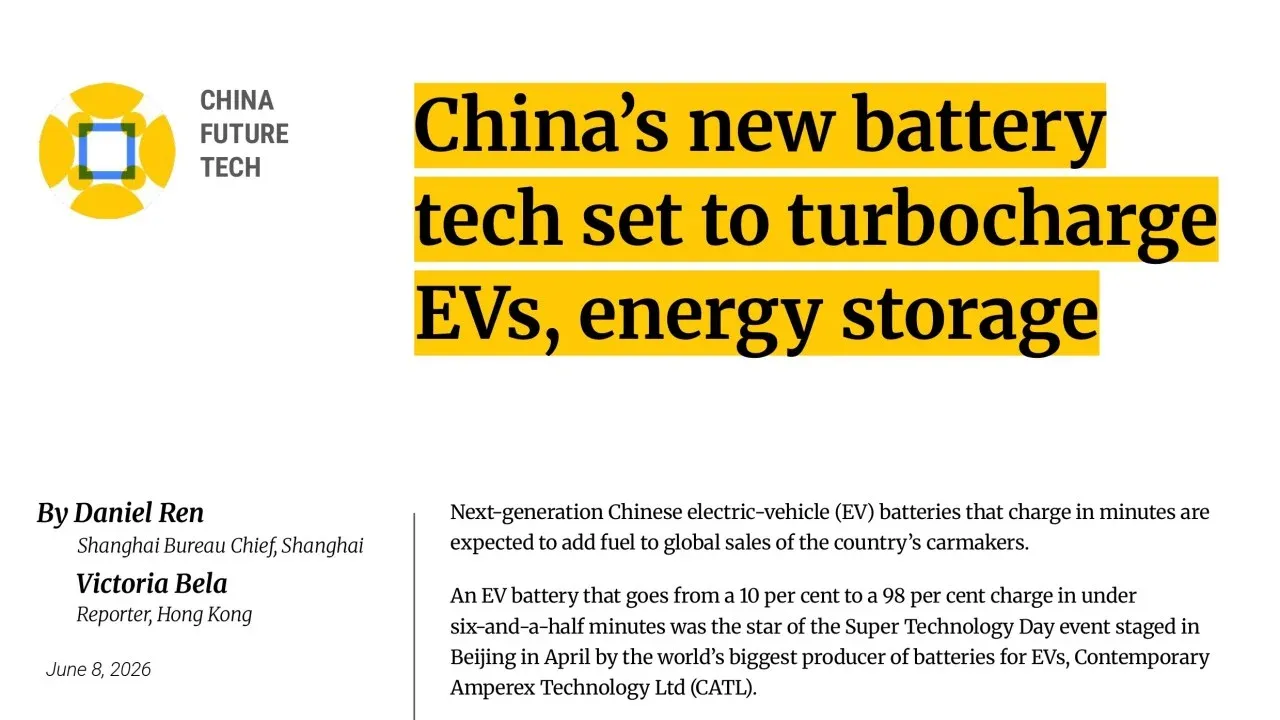
Contemporary Amperex Technology Ltd (CATL) showcased a next-generation EV battery at Super Technology Day in Beijing in April. The ability to charge from 10% to 98% in under six-and-a-half minutes could shift competitive dynamics for Chinese automakers and accelerate demand for energy storage.
The headline number is the whole story: an EV battery that goes from 10% to 98% in under six-and-a-half minutes. It was the star of Super Technology Day in Beijing in April, staged by Contemporary Amperex Technology Ltd (CATL), the world’s biggest producer of batteries for EVs.
If you are an executive trying to forecast demand, that time-to-charge matters because it changes what customers experience. When charging feels like a quick errand instead of a long wait, EV adoption stops being limited by “range anxiety” and starts being limited by inventory, pricing, and installation capacity. CATL is effectively demonstrating a path to faster real-world usability, and the message to the market is straightforward: the next wave of battery performance can turbocharge global sales of China’s carmakers.
Why does CATL get to set the tempo? Because it is not just selling cells, it is shipping a capability that automakers need to make their product narratives stick. The source frames CATL as “the world’s biggest producer of batteries for EVs.” That scale matters when you think about manufacturing ramps, supply contracts, and the leverage battery makers have with car companies that are trying to move volume across multiple regions.
The competitive ripple is immediate. The source also notes that Shenzhen-based BYD, previously the world’s leading EV maker, unveiled a battery earlier. That matters because it signals a race, not a calm product refresh cycle. When both the battery supplier (CATL) and a leading automaker (BYD) are highlighting charging improvements, executives at peers cannot treat “faster charging” as a marketing feature. It becomes a potential performance baseline, and if it becomes a baseline, pricing pressure follows.
There is another layer executives tend to watch closely: energy storage. The source explicitly positions these “next-generation” Chinese battery technologies not only for EVs but also for “energy storage.” That is a big deal because grid-scale storage often competes on cost, speed of deployment, and total system efficiency, not just vehicle metrics. A battery chemistry or engineering approach that can support rapid charging for vehicles may also find a market in storage use cases where utilities and developers want faster response and more flexible operation. The same industrial momentum that benefits EV sales can spill into storage procurement cycles.
And procurement cycles are exactly where decision-makers get stuck. A battery innovation like “10% to 98% in under six-and-a-half minutes” can trigger changes across the stack: engineers want to validate thermal management and cycle life, operations teams want to ensure manufacturing yield, finance teams want to model margins under new bill-of-materials assumptions, and commercial teams want to align incentives with charging infrastructure realities.
Regulation and policy do not appear in the source text directly, but the industry incentives they create are always in the background. Governments have been pushing EV adoption and grid reliability, and battery performance improvements feed into both priorities. For executives, that means faster charging can become a compliance accelerant, and energy storage can become a project pipeline catalyst. When battery improvements shift deployment economics, they can also change what gets funded first.
So what is at stake for executives and boards? The source’s core claim is that these charging-in-minutes batteries “are expected to add fuel to global sales” of China’s carmakers. That expectation turns a technology demo into a strategic threat and opportunity. If CATL’s demonstrated performance spreads through supply chains, rivals that rely on slower charging times may struggle to maintain differentiation. Meanwhile, automakers that can translate the performance into product experience can potentially defend demand even in crowded markets where consumers are comparing total ownership costs.
In short, CATL just put a clock on the competition. The six-and-a-half-minute benchmark is vivid enough to stick in the mind of buyers, and big enough to matter in boardrooms, because it reshapes the competitive conversation from specs to real life. For peers, the question is not whether customers will notice faster charging. It is whether your business model, supply agreements, and pricing power can survive a world where “minutes” becomes the new expectation.
This story's Key Insights and Take-aways are locked.
Create a free account to unlock Executive Actions for one credit.
Register to UnlockAlways free for Executives Club members. Join the Club
More in Business

Anthropic’s Levant Alpöge cracks the Jacobian conjecture after 87 years
A Harvard valedictorian used Claude to hit a 1939 breakthrough, but the missing “why” is the real problem.

Uber buys Delivery Hero for nearly $15B, vaulting to top food delivery outside China
The deal doubles Uber's dual-services footprint and pushes a ride-and-eats bundling play into 50 more markets.

Epic and Google drop settlement bid, forcing rival Android app stores by July 22
Google told the court it is ready to carry third-party app stores starting Wednesday, July 22.