

Gravity-1 completes its 3rd flight, launching 9 satellites from a ship off Shanghai
Orienspace’s solid rocket hits “designated orbits” and signals a bigger play for sea-based liquid launches.
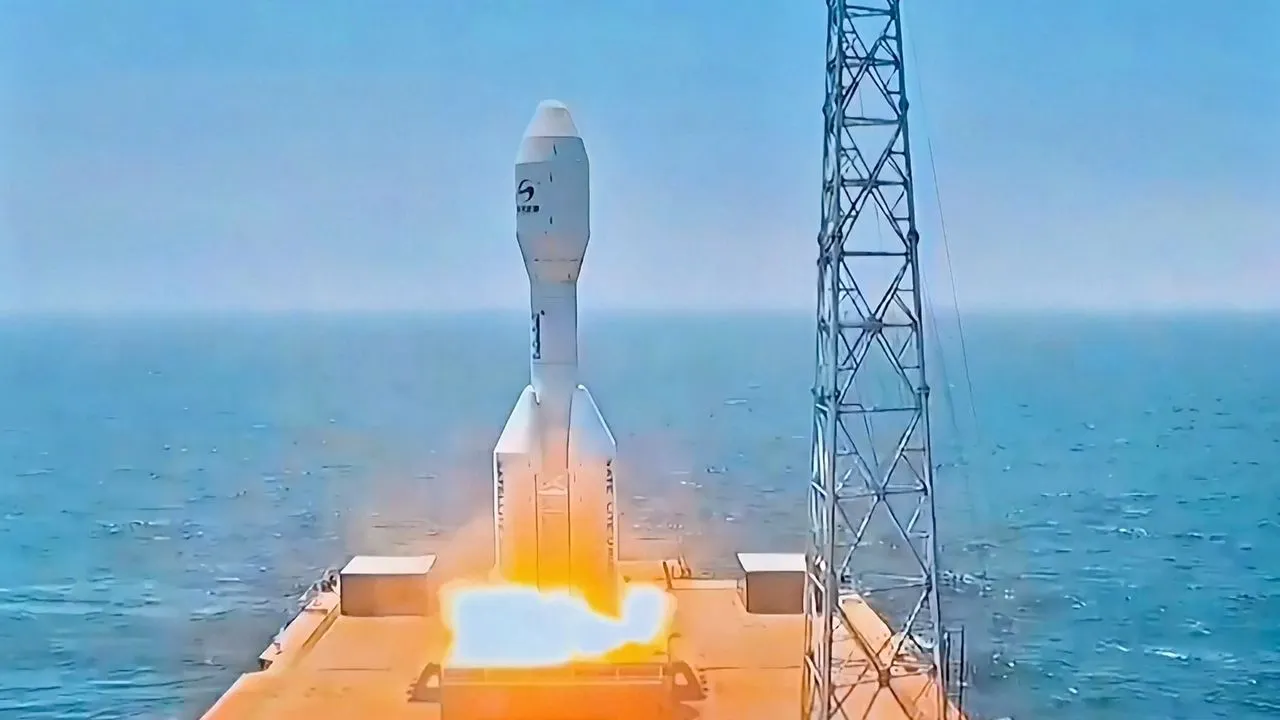
Orienspace’s Gravity-1 completed its third-ever mission on July 21 by launching nine satellites to orbit from a ship near Shanghai. The successful “designated orbits” outcome matters for decision-makers tracking how China is scaling launch cadence and building future sea-launch capability.
Orienspace’s Gravity-1 just proved it can do the hard part repeatedly. On Tuesday night, July 21, the company launched nine satellites from the deck of a ship stationed off the coast of Shanghai, with liftoff at 10:54 p.m. EDT (0254 GMT) and 10:54 a.m. Beijing time on July 22, according to the state-run Chinese outlet Xinhua. Xinhua also reported that all nine satellites reached their designated orbits. That single line, “designated orbits,” is the difference between a spectacle and a product.
This was the rocket’s third-ever mission, and it landed in familiar company: every Gravity-1 flight so far has launched from ships at sea. Gravity-1 is operated by Orienspace, a company based in Shandong province in eastern China. The vehicle itself is described as squat and stubby, standing about 100 feet (30 meters) tall, less than half the height of SpaceX’s Falcon 9. But compact does not mean weak here. Gravity-1 is powered entirely by solid rocket motors across its three core stages and four strap-on boosters, and it can haul up to 14,300 pounds (6,500 kilograms) of payload to low Earth orbit (LEO). That payload ceiling makes it the most powerful solid rocket in the world, at least by the figures provided in the source. For context, the liquid-fueled Falcon 9 can deliver a maximum of 50,265 pounds (22,800 kg) to LEO, a reminder that solid rocket leadership does not eliminate the broader advantage liquid systems can have on raw lift.
So why does this matter to executives outside of rocketry nerd circles? Because the mission is not just about reaching orbit. It is about how you reach orbit, repeatedly, with a launch platform that can move. The fact that Gravity-1 is already on its third flight, and that each launch has been from a ship at sea, signals a manufacturing and operations rhythm that favors scale and routing flexibility. Sea-based launch can help reduce certain constraints that land-based pads face, depending on geography and scheduling. Even when the payloads are not publicly detailed in the source, the operational cadence is still observable.
Orienspace’s early timeline reinforces that point. Gravity-1’s first two flights occurred in January 2024 and October 2025, and now the rocket has a third successful attempt on July 21. The source notes there won’t be a long gap before Gravity-1 flies again if all goes to plan, which implicitly frames this as a transition from proving to producing. That is a key psychological pivot for any launch provider: early investors and customers want to see mission success; later they want to see throughput.
Looking at what comes next, the rocket’s next business line is also hinted at. The state-run outlet CGTN reported that Gravity-1 is expected to launch a batch of Chinese internet satellites in the next few months. The phrase “expected to launch” is doing work here. It is not a contract announcement in the provided text, and details about the nine satellites were not given, but the direction is clear: solid launch capacity is being positioned to support a market that wants more frequent orbital delivery.
And then there is the bigger strategic bet, one that reaches beyond solid rockets. Orienspace is developing Gravity-2 and Gravity-3, larger rockets intended to feature liquid-fueled core stages and solid boosters. CGTN reported Gravity-2 could be ready to fly by the end of the year. If Gravity-2 follows the pattern implied by the source, it will likely also launch from an ocean-based pad, keeping the “sea platform” advantage intact even as the propulsion mix changes from all-solid to a liquid core approach.
This is where the second-order implications show up for decision-makers. In the source, Gravity-1 chief designer Xu Guoguang said, according to CGTN, “Sea launch of solid-propellant rockets paves the way for future launch of liquid rockets at sea,” and also noted Orienspace is considering other methods such as launching from drilling platforms. Translating that: the company is treating each successful sea-based solid launch as operational evidence for harder future work. Liquid rocket development brings its own engineering and logistical complexity, and moving that complexity to sea is a bigger operational gamble than building a liquid rocket that simply launches from land.
For peers watching from the sidelines, the strategic message is simple: Orienspace is not just fielding a rocket, it is building an ecosystem around launch infrastructure at sea. If that continues, it could tighten competition in LEO access and change how satellite operators think about schedule certainty and launch routing. The Gravity-1 success is therefore not only a technical milestone. It is a market signal that solid sea-launch capability is already working, and that the company is preparing to scale into liquid rockets from similar platforms.
This story's Key Insights and Take-aways are locked.
Create a free account to unlock Executive Actions for one credit.
Register to UnlockAlways free for Executives Club members. Join the Club
More in Business

Anthropic’s Levant Alpöge cracks the Jacobian conjecture after 87 years
A Harvard valedictorian used Claude to hit a 1939 breakthrough, but the missing “why” is the real problem.

Uber buys Delivery Hero for nearly $15B, vaulting to top food delivery outside China
The deal doubles Uber's dual-services footprint and pushes a ride-and-eats bundling play into 50 more markets.

Epic and Google drop settlement bid, forcing rival Android app stores by July 22
Google told the court it is ready to carry third-party app stores starting Wednesday, July 22.