
Guinness Makes It Official: Perseverance Rover Set a Mars Distance Record
NASA's Perseverance team receives a Guinness World Record for the rover's Mars distance, thanks to a terrestrial twin that plans every move.
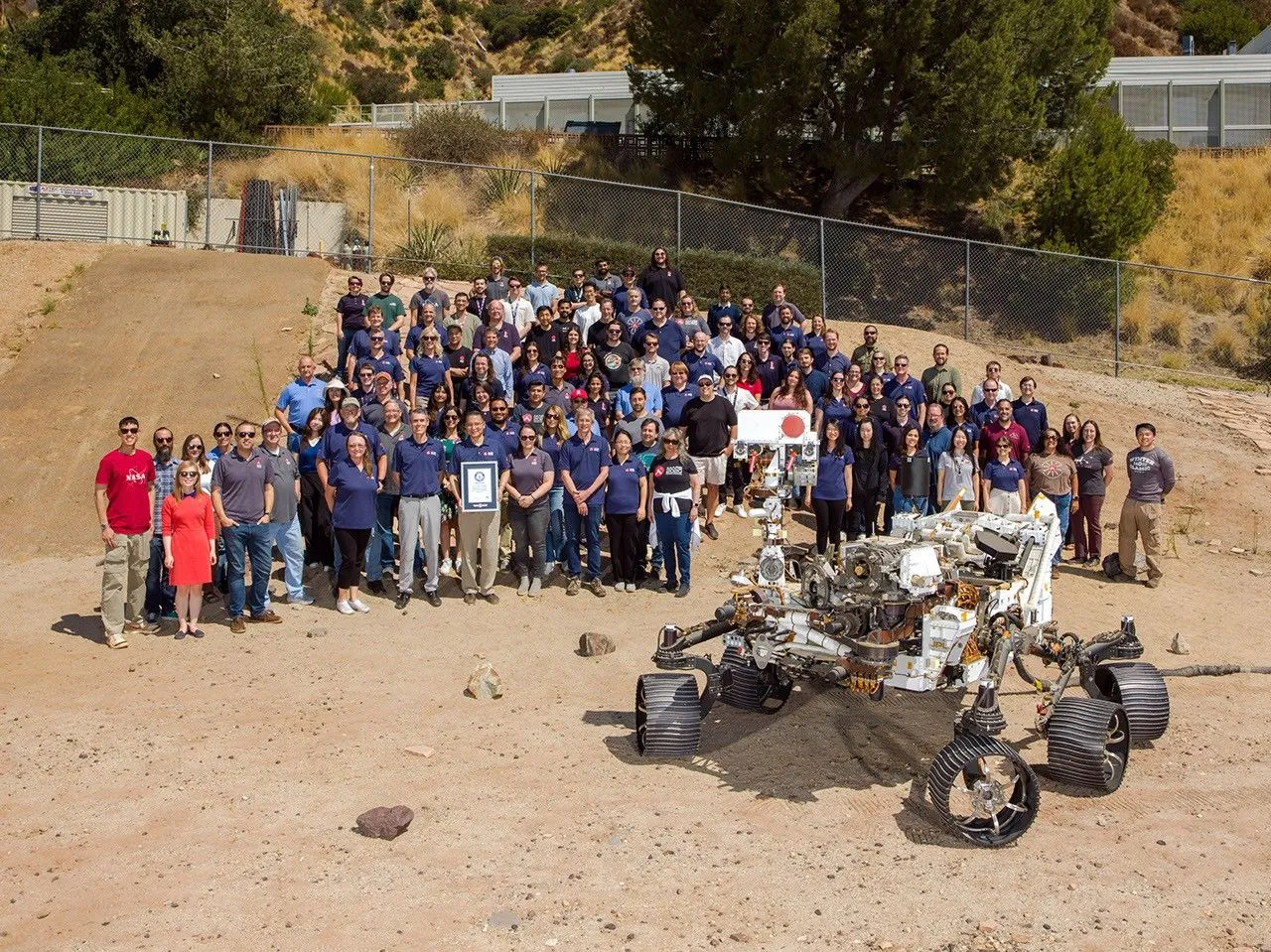
NASA's Perseverance Mars mission team at the Jet Propulsion Laboratory has received a Guinness World Records certificate for the rover's distance record on the Red Planet. The recognition underscores the value of the team's use of OPTIMISM, a full-scale engineering twin on Earth, to plan driving routes and science activities, a model with implications for remote operations in any high-stakes environment.
Guinness World Records has made it official: NASA's Perseverance Mars rover team has earned a certificate for the rover's distance record on the Red Planet. The team gathered in the Mars Yard at the agency's Jet Propulsion Laboratory in Southern California, with the certificate and OPTIMISM, a full-scale engineering model, positioned in front of them.
The recognition is more than a plaque on a wall. It is a testament to the rover's endurance and the team's meticulous planning. Perseverance has been exploring Jezero Crater since its landing in 2021, searching for signs of ancient microbial life and collecting samples for a future return to Earth. The exact distance that earned the record is not disclosed in the announcement, but the milestone places Perseverance among the most traveled machines ever sent to another world. For a mission designed to answer fundamental questions about life beyond Earth, every mile driven is a step toward that goal.
The secret to that distance is a twin on Earth. OPTIMISM, which stands for Operational Perseverance Twin for Integration of Mechanisms and Instruments Sent to Mars, is a full-scale engineering model used to plan the rover's driving routes and science activities. Before any command is sent to Mars, engineers test it on OPTIMISM in the Mars Yard, a simulated Martian surface at JPL. This allows them to anticipate hazards, test maneuvers, and ensure the rover's safety millions of miles away. The Mars Yard is designed to mimic the terrain Perseverance encounters, with rocks, slopes, and sand. Engineers drive OPTIMISM over these obstacles to see how the rover will respond, then adjust the commands accordingly. This process has allowed Perseverance to navigate some of the most challenging terrain ever attempted on Mars.
The achievement is part of a larger program. NASA JPL, which is managed by Caltech, built and manages operations of the Perseverance rover on behalf of the agency's Science Mission Directorate in Washington, as part of NASA's Mars Exploration Program. This program has a long history of robotic exploration, from the early Sojourner to the long-lived Opportunity and the still-active Curiosity. Perseverance is the latest in a lineage that has continuously pushed the boundaries of what is possible on the Red Planet. Each rover has built on the lessons of its predecessors, and Perseverance is no exception, carrying more advanced instruments and a more sophisticated autonomous navigation system than any rover before it.
For business leaders, the Perseverance team's approach offers a powerful lesson: simulation and testing can de-risk operations in remote, high-stakes environments. The twin-based model is similar to approaches used in manufacturing, energy, and autonomous vehicles. By validating every move on Earth before executing it on Mars, the team has extended the rover's operational life and maximized its scientific return. The Guinness record is a tangible proof point that this strategy works. In an era where companies are deploying robots and autonomous systems in everything from warehouses to offshore oil rigs, the ability to test in a simulated environment before real-world deployment is a competitive advantage.
The human element is just as important. The Mars Yard at JPL is where engineers have spent countless hours testing OPTIMISM, simulating Martian terrain, and preparing for the unexpected. The certificate from Guinness World Records is a recognition of that dedication. It also highlights the collaborative nature of space exploration, with NASA and Caltech working together to push the boundaries of human knowledge. The team includes hundreds of engineers and scientists who work in shifts to monitor the rover's health and plan its activities. The Guinness certificate is a rare public acknowledgment of their behind-the-scenes work, which often goes unnoticed.
Looking ahead, the operational knowledge gained from Perseverance will be critical for future missions. As NASA plans for human exploration of Mars, understanding how to navigate the surface, manage a vehicle over long distances, and plan science activities in a harsh environment will be essential. The record also demonstrates that robotic explorers can operate for years beyond their initial design lifetimes, which could change how future missions are budgeted and planned. For commercial space companies eyeing the Moon and Mars, the Perseverance team's approach to remote operations will be a blueprint. The ability to test and simulate before executing is a competitive advantage in any environment where mistakes are costly.
For executives and operators, the Perseverance team's achievement is a case study in operational excellence. It shows the value of investing in simulation, maintaining a skilled team over long timelines, and celebrating milestones that might seem small but represent enormous cumulative effort. The Guinness record is a reminder that world-class performance often comes from the unglamorous work of testing and planning. In a world that rewards speed, the rover's record is a testament to the power of patience. It is a lesson that applies not just to space exploration, but to any ambitious endeavor where the payoff comes from consistent, disciplined execution over time.
This story's Key Insights and Take-aways are locked.
Create a free account to unlock Executive Actions for one credit.
Register to UnlockAlways free for Executives Club members. Join the Club
More in Science

Alaska's 1,580-foot tsunami had warning signs. Scientists just found them.
Rapid glacier retreat, heavy rainfall, and thousands of tiny tremors preceded Alaska's 1,580-foot tsunami, a warning for every coastal community in a warming world.

The rare mutation that lets high-risk brains dodge Alzheimer's
Scientists found a natural defense against protein buildup, opening a new path to preventive treatments.

3,000 steps a day may halve Alzheimer's decline, study finds
New research links a modest daily walk to less tau buildup and nearly half the cognitive and functional decline, even for those with early signs.