
House of the Dragon’s Season 3 premiere uses the Isle of Faces to hint the Green Men
The antlered, goat-legged watcher isn’t a random cameo. It points to a sacred island of pact-making lore.
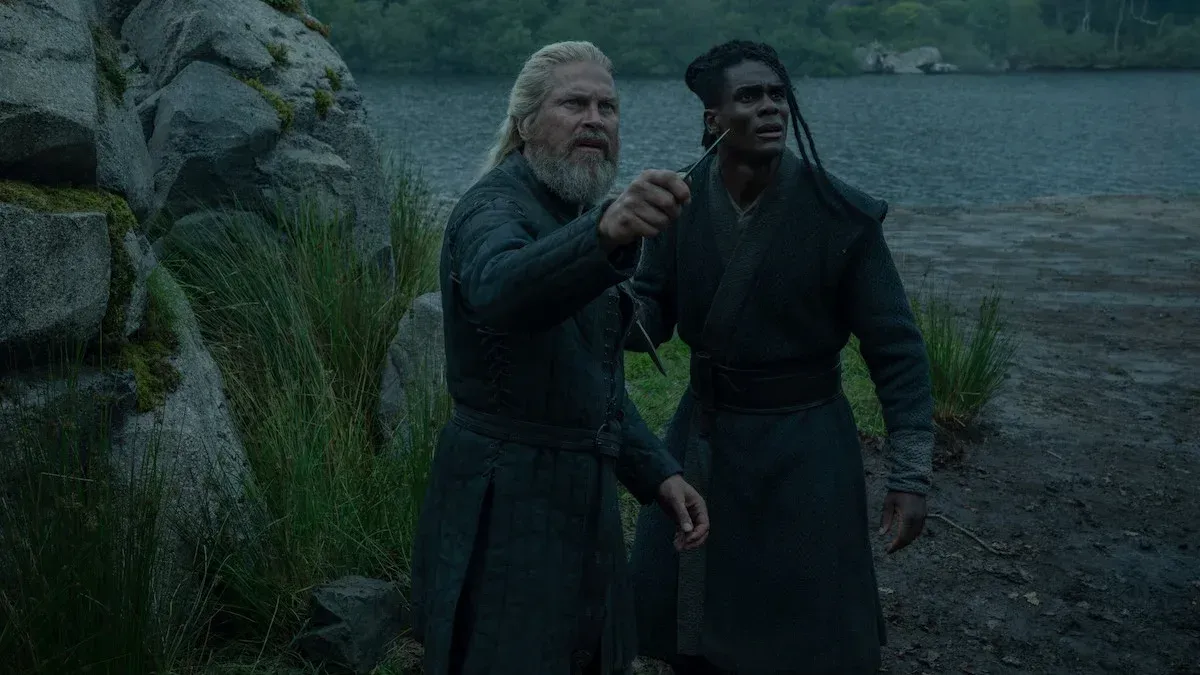
In TheWrap’s breakdown of House of the Dragon Season 3’s premiere, Ulf the White, Hugh Hammer, and Addam of Hull wait on the Isle of Faces near Harrenhal. The episode shows something that looks like a Green Man, reframing why the island matters in Westerosi history.
“House of the Dragon” Season 3’s premiere is already headed for the conversation pipeline thanks to the massive Battle of the Gullet and yet another major character death. But TheWrap points out a quieter, lore-heavy beat that functions like a side door into the show’s mythos: the antlered, goat-legged man watching the dragonseeds on the Isle of Faces.
That moment happens while Ulf the White, Hugh Hammer, and Addam of Hull are ordered to sit in ambush on an island near Harrenhal, waiting for Aemond Targaryen and his massive dragon, Vhagar. The island is the Isle of Faces, and the longer the trio waits, the weirder things get. The episode’s tipping point is Ulf going off alone and running into a black goat, which connects directly to Alys Rivers because Daemon also saw that same kind of goat when he was wandering through Harrenhal. Then Hugh and Addam hear their dragons disturbed, turn a corner, and see a tall man with antlers, with what looks like goat legs, watching them before disappearing.
So who is that antlered man? TheWrap’s explanation lands on the same answer long-time Westeros lore fans have been orbiting: it’s likely one of the Green Men. The Green Men are described as an order created to protect the deeper forests, the trees, and the Children themselves following the war with the First Men. The reason the Isle of Faces is such a big deal is that the island is treated as sacred land, and it is one of the few places in the region where weirwood trees still grow. It sits in the center of the God's Eye lake, a location that becomes important later in House of the Dragon, and yet few people have ever visited it. In other words: this is not just set dressing. It’s a spiritual and biological chokepoint in the world of the story.
What makes the Isle of Faces more than “cool location” is the Dawn Age history attached to it. Long before House of the Dragon, during an ancient conflict known as the War of the First Men and Children of the Forest, the two sides fought for centuries. When the war finally ended, the First Men and the Children signed a peace pact on the island, with the many weirwoods carved with faces so the gods could witness the signing. Afterward, the Children continued to live on the island. That is the core of why the Green Men are such a natural fit for the antlered watcher. If the island is a protected node for the Children and the weirwoods, then seeing a guardian figure there is exactly the kind of myth logic the show tends to reward.
The tricky part is that the exact appearance of the Green Men has never been totally consistent in Westeros storytelling. Some accounts describe them as having dark green skin and antlers. Others suggest they wore green robes and antlered headdresses. The episode’s visual choices reflect that ambiguity without fully locking it down. And TheWrap also ties this to George R.R. Martin’s book Fire and Blood: in one version of that telling, Addam lands on the Isle of Faces alone with Seasmoke and speaks with one of the Green Men. That connection matters because it tells you this is likely not a random “blink and you miss it” moment. It’s the show signaling that it is drawing from specific lore beats, not improvising around them.
If you have watched Game of Thrones rather than only House of the Dragon, there is a second layer of meaning too. The Children of the Forest, who signed that peace pact and resided with the Green Men on the Isle of Faces, appear in Seasons 4 and 6 of Game of Thrones. Bran meets them north of the Wall while searching for the Three-Eyed Raven. The survival of the Children in Thrones supported a long-standing theory: that the Green Men helped protect them from attacks from the Andals when they arrived in Westeros. In that reading, the Isle of Faces and the Green Men are not just “cool fantasy creatures.” They are the mechanism behind why certain ancient groups endure, why certain spaces remain protected, and why the past keeps leaving fingerprints on the present.
Now, zoom out from lore to how this creates leverage for everyone watching. For executives and operators who pay attention to narrative strategy, this is basically worldbuilding as risk management. The premiere simultaneously drives the high-stakes plot engine (Battle of the Gullet, major character death) and plants an interpretive hook (is it a Green Man, and why now?). That dual-track approach matters because it keeps the audience engaged at two speeds: the immediate “what happens?” and the delayed “what does it mean?”
And for peers across entertainment, content platforms, and creator ecosystems, the strategic stake is simple. If a show can make the audience feel rewarded for noticing details, it reduces churn and increases return visits. It turns trivia into retention. Here, TheWrap’s breakdown suggests the antlered man is not just a spooky visual. It’s a reminder that the Isle of Faces is sacred precisely because it sits at the center of one of Westeros’ most foundational peace-and-protection stories. If the episode is using that space to stage a guardian sighting, it is also inviting viewers to connect threads across the broader Westeros timeline, including the Children of the Forest in Game of Thrones.
This story's Key Insights and Take-aways are locked.
Create a free account to unlock Executive Actions for one credit.
Register to UnlockAlways free for Executives Club members. Join the Club
More in Entertainment

Harry Collett survives Jacaerys’ arrows in House of the Dragon season 3 premiere
The real-world stunt behind the biggest shock: a cold-water dive, blue hands, and a death scene filmed safely.

Cape Verde hold Uruguay 2-2 in Miami thriller, turning Uruguay’s Group H edge into a draw
Vozinha ends a perfect run by conceding early, but Cape Verde rally after double shocks to secure a 2-2 World Cup result.

Pixar’s Toy Story 5 isn’t preaching “toys vs. tech” despite the trailers
The “anti-tech” backlash misses what the movie is actually saying about play, imagination, and how parents interpret media.