
Harry Collett survives Jacaerys’ arrows in House of the Dragon season 3 premiere
The real-world stunt behind the biggest shock: a cold-water dive, blue hands, and a death scene filmed safely.

Harry Collett, the actor who plays Jacaerys Velaryon in HBO’s House of the Dragon, had his character murdered at the end of episode one. The scene was shot for two days in 2025 using a motorised saddle and a tank of really cold water, with scuba divers and medical checks close by.
Harry Collett did not just survive Jacaerys Velaryon’s fate in House of the Dragon season three episode one. He survived the stunt that made it look real: two days of being strapped to a motorised saddle, lowered and raised into a tank of “really cold” water from 8am to 7pm, until his character’s “very violent murder” made audiences gasp.
In the packed lobby of Leicester Square’s shiny Odeon cinema, Collett was surrounded by people who seemed genuinely concerned. Some were pointing, most were staring, and a few even offered condolences like “I’m so sorry.” That was not a misunderstanding about press tours or scheduling. It was because, moments earlier, the season three premiere delivered a straight-up Westerosi shock ending: Jacaerys sinks beneath the waves after a naval setpiece at “The Battle Of The Gullet.” He’s sploshed into the sea, struggles to keep his dragon Vermax from drowning, and then four arrows spit out of the fog and bury themselves into his torso.
Collett told NME two weeks later via Zoom that he chose to break the news to his parents about his death only after they were seated at the premiere. He grinned while describing what his family did in the real-time reaction. “My mum made a verbal ‘oh!’ and my dad pulled a face.” He added that when he “died in a show,” it typically might not look as brutal as what viewers just saw. That is the point of this moment: the storytelling hit so hard that it triggered authentic worry in the people closest to him.
Now zoom in on how they pulled off the underwater realism. For two days in 2025, the 22-year-old actor was strapped on a Warner Bros lot at Leavesden Studios, using a motorised saddle that repeatedly raised and lowered him into the massive tank. The challenge, he explained, is biology. “All of the air in your lungs and trapped in your clothes causes you to float quite easily,” which makes it hard to convincingly act like you are being dragged down into the depths. So the crew clipped him to the saddle and physically took him underwater each time. And, crucially, a team of scuba divers stayed nearby, ready to step in if he “stop[ped] breathing.”
But there was a second problem that made the scene genuinely frightening to those operating from the outside. When Collett got out of the water, a medic ran over and told him he needed to go right then. “My hands had turned blue and she thought I had hypothermia.” The explanation is simple and production-friendly, but the effect for everyone else was immediate. His gloves for the role were designed for a fantasy world, not for being submerged. Collett said colored dye ran from Jacaerys’ riding gloves. “For a second, I looked at my hands and thought, ‘Oh no, this is bad. Maybe I’m really dying.’” He also reflected that people are often told skin changing colour is “one of the last stages [of death],” and he believes it “put a lot of panic into people.” Then he deadpanned: “That was one of my funniest moments of filming, actually.”
It is easy to treat all this like behind-the-scenes fluff, but it matters because it illustrates what big TV productions actually optimize for. The goal is not just dramatic impact. It is consistent, repeatable shots that sell the physicality. The Battle Of The Gullet is engineered like a machine: motion, water immersion, timing, fog, and arrows. The actor stunt has to match the camera story. Safety systems, from divers to a medic, then sit underneath the illusion like load-bearing beams you never see. The more realistic the payoff for the audience, the more the production has to work to keep the cast safe when realism gets intense.
Collett’s path also helps explain why he can pull it off. Raised in smalltown Essex, he says he was a “bubbly kid” who “wanted to perform.” He had an early dancing streak, fueled by an obsession with Michael Jackson, and at 10 played a young Michael Bublé in a Canadian Christmas video for a duet with Idina Menzel, “Baby, It’s Cold Outside.” He later booked “regular film and TV work throughout his teens,” often absent from school. “I failed GCSE drama!” he said, laughing at the bluntness of it. When he returned to his alma mater recently to collect his younger sister after class, he confronted a teacher and learned: he failed “cos you were never here.”
House of the Dragon did not arrive until 2020, when Collett was 17. He tried out for a “top-secret HBO series” but had no idea what it was. He had not watched Game of Thrones when it aired because of its “gratuitous sex, swearing and violence” and his age at the time. Even if he knew the world, the audition script changed names and locations. His memory of the casting process includes a scene with Rhaenyra and Lucerys where the production replaced Rhaenyra with Lucerys’ brother, with his character Jacaerys. They were called “Jack and Luke,” and he was telling Luke how he “shouldn’t feel upset about something.”
And then it worked. Six years later, his Jacaerys arc is described as a “slow-burn” transformation from a timid Targaryen scion into a headstrong adolescent warrior. If his story ends “gruesomely” here, Collett is already thinking about what he wants next, telling NME he wants “to try loads of different things,” including a play, and screen roles where you cannot tell “they’re acting.” That ambition is the second-order takeaway for anyone in media, investment, or production-adjacent roles: the people who can sell brutality on cue, survive the physical cost, and still show range are the same people who tend to compound their value.
So yes, tonight’s guests at the premiere looked worried about Collett. They should not have been. But the fact that they reacted as if he had actually died is the strongest proof that the show’s biggest shock was not just written. It was engineered. House of the Dragon season three streams weekly on Mondays on HBO Max.
This story's Key Insights and Take-aways are locked.
Create a free account to unlock Executive Actions for one credit.
Register to UnlockAlways free for Executives Club members. Join the Club
More in Entertainment
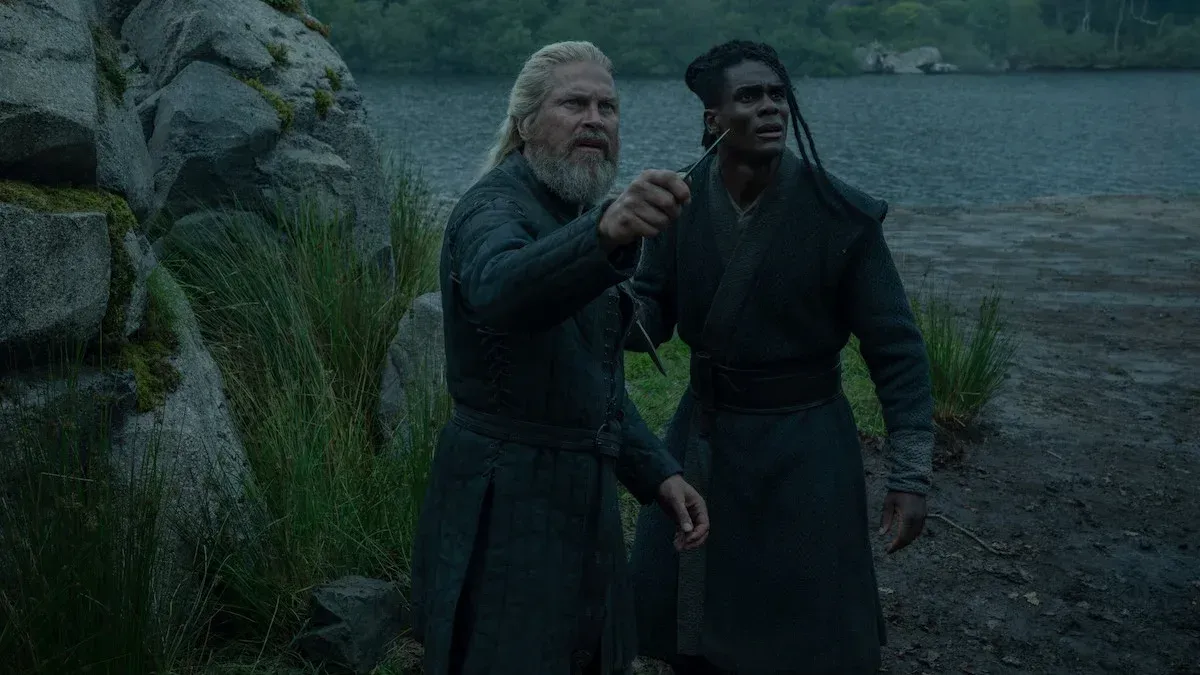
House of the Dragon’s Season 3 premiere uses the Isle of Faces to hint the Green Men
The antlered, goat-legged watcher isn’t a random cameo. It points to a sacred island of pact-making lore.

Cape Verde hold Uruguay 2-2 in Miami thriller, turning Uruguay’s Group H edge into a draw
Vozinha ends a perfect run by conceding early, but Cape Verde rally after double shocks to secure a 2-2 World Cup result.

Pixar’s Toy Story 5 isn’t preaching “toys vs. tech” despite the trailers
The “anti-tech” backlash misses what the movie is actually saying about play, imagination, and how parents interpret media.