
Japan's MMX launches Monday to bring first Mars-moon samples to Earth
The Martian Moons eXploration spacecraft targets Phobos with a 10-gram sample return that could settle whether Mars' moons are captured asteroids or impact debris.
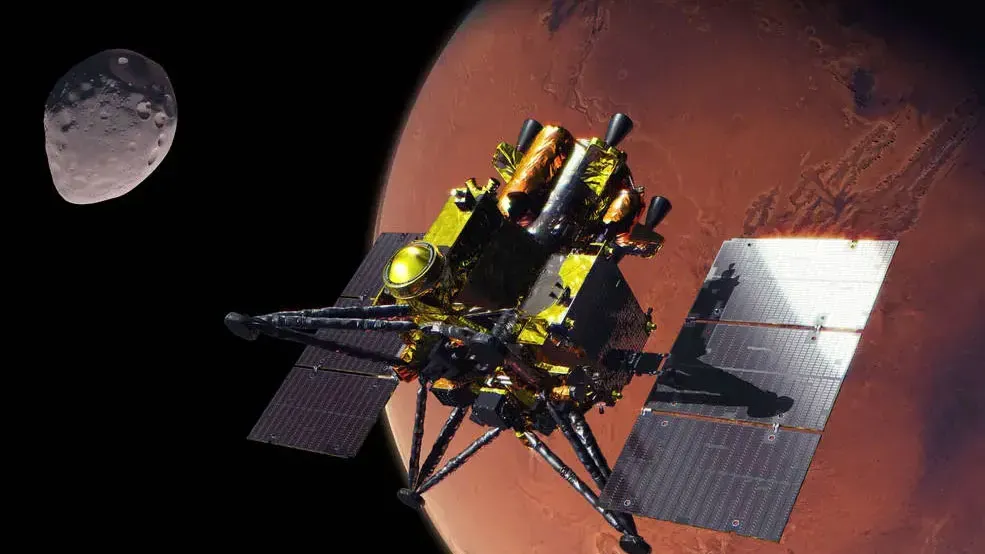
Japan's space agency JAXA is set to launch the Martian Moons eXploration (MMX) mission on Oct. 19, targeting the first sample return from Mars orbit. The mission's Phobos samples could settle a decades-old origin debate and reshape understanding of how Mars and Earth formed.
Japan is about to attempt the first sample-return round trip from Mars orbit. The Martian Moons eXploration (MMX) mission is scheduled to launch Monday, Oct. 19, at 3:41 p.m. EDT (1941 GMT; 4:41 a.m. local time Oct. 20 in Japan) aboard an H3 rocket from Tanegashima Space Center, and if all goes to plan its return capsule lands in Australia in 2031 carrying the first-ever samples from the Red Planet system.
The prize is not just bragging rights. MMX will spend about three years studying Phobos, land on its 14-mile-wide (22-kilometer) surface, collect at least 10 grams (0.35 ounces) of material, deploy a rover, then perform flybys of Deimos before heading home in November 2030. Those samples are expected to settle a decades-old dispute: whether Phobos and Deimos are captured asteroids or debris blasted into orbit by a giant impact on ancient Mars. The answer, scientists say, is a key to the story of both Mars and Earth.
The spacecraft is a three-module stack built by Mitsubishi Electric, with France's CNES and Germany's DLR jointly developing the microwave-size IDEFIX rover. The rover, named for a dog in the 1960s French comic "Asterix," carries cameras, the RAX Raman spectrometer and a miniRAD radiometer to analyze Phobos' surface composition and temperature. The exploration module hosts most instruments, including NASA's MEGANE gamma-ray and neutron spectrometer built by Johns Hopkins APL, France's MIRS infrared spectrometer, Japan's TENGOO and OROCHI cameras, LIDAR and MSA. The return module carries Japan's Circum-Martian Dust Monitor and Interplanetary Radiation Environment Monitor.
The schedule is ambitious. MMX arrives at Mars in August 2027, sheds its propulsion module and enters a quasi-satellite orbit around Phobos. It spends its first months mapping the moon and selecting landing sites. IDEFIX is released in late 2028 or early 2029 during the first of two landing rehearsals, free-falling the final 130 feet (40 meters) and bouncing to a stop in the moon's extremely low gravity. Sample collection could begin as early as December 2028, according to Lindsay Hays, acting director of NASA's Planetary Science Division, who briefed reporters Oct. 15. MMX will attempt two landings using a corer sampler and a pneumatic sampler to collect and stow material.
After about three years at Phobos, MMX transitions into a higher resonant orbit in 2030 to intersect Deimos' path repeatedly for comparison flybys. Near the end of 2030, the exploration module separates and the return module fires out of Mars' gravitational influence, beginning an eight-month journey home. In 2031 the sample-return capsule separates, enters Earth's atmosphere and parachutes to the Woomera region in Australia, where Japan and its mission partners will recover it for laboratory analysis.
Why does that matter beyond the mission patch? Both Phobos and Deimos resemble primitive D-type asteroids, ancient bodies thought to preserve material from the solar system's formation about 4.6 billion years ago. That resemblance supports the capture theory. But their near-circular, equatorially aligned orbits point to a more violent origin: a giant collision with ancient Mars that could have created a debris disk from which the moons coalesced. Tom Statler, MMX program executive and scientist in NASA's Planetary Science Division, put it directly during the Oct. 15 briefing: "Phobos and Deimos are interesting, but not just in their own right. Their presence is a key piece of the larger story of the Mars system."
For executives watching the space economy, MMX is a proof point in the long-cycle race to return samples from deep space. It is also a study in international industrial collaboration: a Japanese launch vehicle and spacecraft, French and German rover hardware, American instruments and an Australian landing zone. The mission's outcome will shape not only planetary science, but also how governments and their contractors weigh investments in Mars exploration, sample-return logistics and the technologies needed to operate in low-gravity environments. If MMX lands its capsule in 2031, Japan will have achieved what no nation has done before, and the 10 grams of Phobos dust will be worth far more than their weight in gold.
This story's Key Insights and Take-aways are locked.
Create a free account to unlock Executive Actions for one credit.
Register to UnlockAlways free for Executives Club members. Join the Club
More in Business

Elon Musk unveils a flying car, and SpaceX helped build it
The Tesla CEO's showcase at a SpaceX facility signals a future where road and rocket engineering converge.

Apple's $2,000 iPhone Duo opens preorders, taking on Samsung and Google
Apple's first foldable hits the market at a premium price, reshaping a category Samsung and Google have led.

Pope Leo XIV, first American pope, diagnosed with lung cancer
The 71-year-old Chicago-born pontiff underwent successful surgery on his right lung, and his diagnosis raises new questions about his AI-focused papacy and the Vatican's future.