
Jim Vena swats down Trump's 15% rail stake as UP's $71.5 billion deal stalls
Union Pacific says it can fund the Norfolk Southern takeover itself, but Trump’s interest and the STB pause raise the political cost of the biggest railroad merger ever.
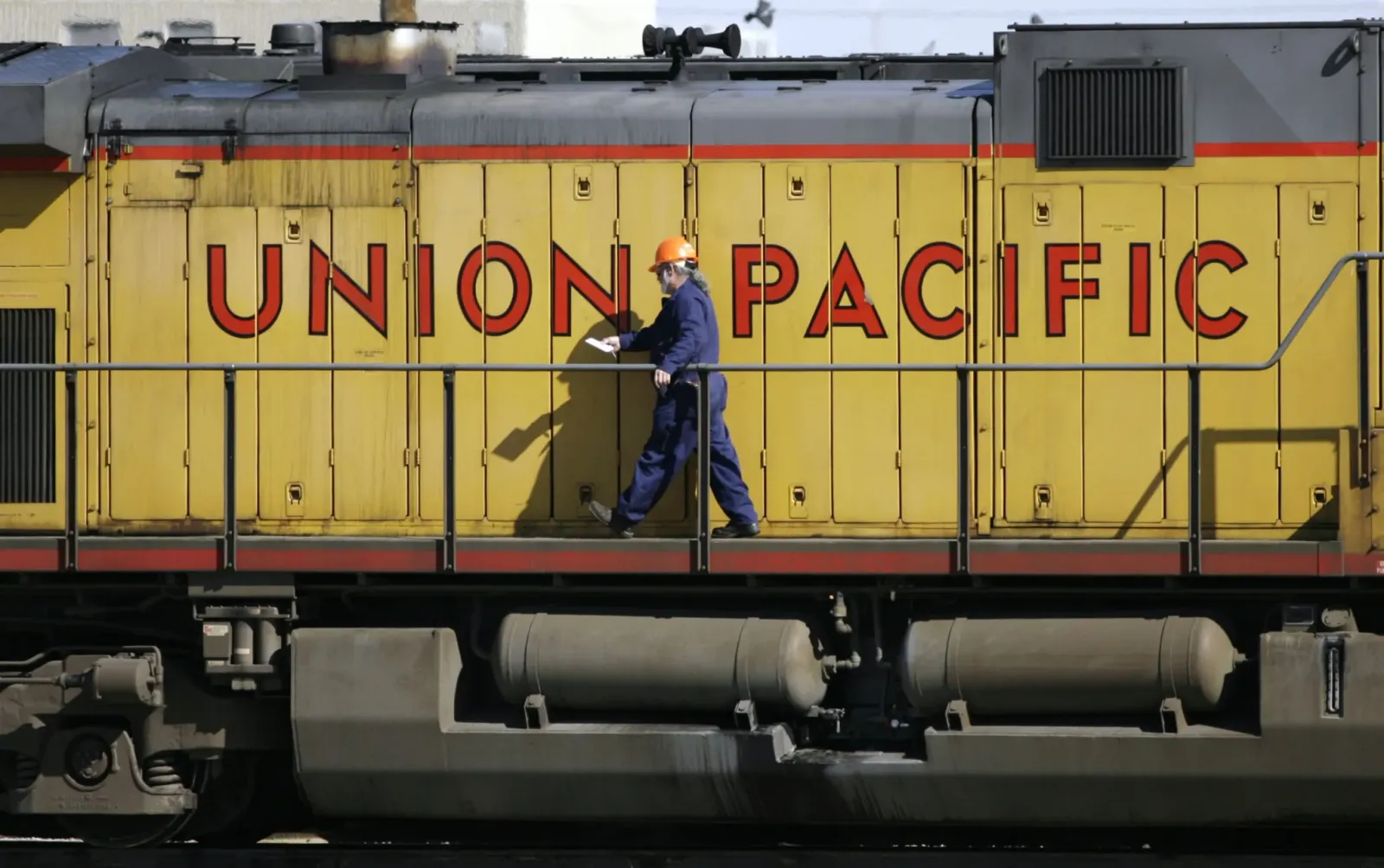
Union Pacific CEO Jim Vena says the company does not need the federal government to take a stake in its proposed $71.5 billion Norfolk Southern acquisition, even after President Trump floated the idea. For executives and boards, the episode shows how a giant industrial merger can become a political object, not just a regulatory one, with financing, timing, and public-interest scrutiny all moving together.
Union Pacific CEO Jim Vena is trying to thread a very specific needle: he says the company does not want the federal government to own part of its planned Norfolk Southern acquisition, but he is also not slamming the door on the topic. The deal at issue is huge, a $71.5 billion transaction, and Trump has publicly said he wants a 15% federal stake in the merger. Vena told CNBC on Thursday that he was complimented by Trump’s interest, but made Union Pacific’s position plain: “We’re a company that can afford to make this deal,” he said. “We’re a company that can afford to handle what the price is for this deal, and we do not need anybody’s help to do this.”
That matters because this is not just any M&A fight. It is the biggest railroad merger ever, and it comes with the kind of baggage that only a once-in-a-generation industrial combination can carry. Vena also said, “I find it comforting that the president of the United States looked at what we're doing and says, ‘Son of a gun, this is a good business, a good business move, strong, and I'd like to invest,’” while adding, “Listen, I have not had any direct communication with the president of the United States to talk about the president and the government specifically coming in and being a partner in this.” In plain English: Union Pacific is signaling confidence in its balance sheet and in the deal itself, while leaving enough room to keep the political temperature down.
The Trump angle is not random, either. In May, Trump told Fortune that he wanted a 15% federal stake in the railroad merger, though he did not specifically name Union Pacific. That comment came just days before the U.S. Surface Transportation Board, the federal regulator overseeing rail mergers, put the mega deal on pause for additional review. Fortune also reported that Trump’s interest was tied to a broader pattern in his second term, which has featured unprecedented federal investments in publicly traded companies, from Intel to rare earths miners and refiners, all in industries deemed critical for national security. Union Pacific has not acknowledged any direct link between Trump’s comments and the regulatory delay, and the source says there is no clear connection between the two. Still, timing is timing, and in Washington and on Wall Street, timing tends to be read as a message whether or not anyone intended one.
That regulatory backdrop is crucial. Freight railroads are one of the few major industries that do not go through the Federal Trade Commission’s standard antitrust review. Congress carved rail out and handed it to the Surface Transportation Board, which applies a broader public-interest standard because railroads are “common carriers” in a concentrated but strategically important industry. That is a very different test. The FTC usually asks whether a deal reduces competition. The STB can also weigh railroad congestion, commodity impacts, pricing, and the broader public interest. In January, the board rejected Union Pacific’s initial application for the cash-and-stock acquisition of Atlanta-based Norfolk Southern, saying it was incomplete and needed a deeper analysis. On May 28, the STB accepted the revised application, which keeps the deal alive, but it also said more review is needed and triggered a temporary pause. The board wrote that several aspects of the revised filing were “unclear or underdeveloped” and needed supplementation so it could thoroughly evaluate, and the public could adequately comment on, whether the deal is in the public interest.
The politics around the board matter almost as much as the filing itself. The STB has had only three members of late. Trump appointed two of them, chairman Patrick Fuchs and Michelle Schultz. Karen Hedlund, the third, served in the Obama administration and was appointed by former President Biden. A fourth member, Republican Richard Kloster, was just confirmed by the Senate and is set to join. That composition does not guarantee any one outcome, but it does mean the merger will be judged by a board where political appointments are very real and very relevant. For companies pursuing regulated consolidation, that is the lesson in neon: when the market is already concentrated, the regulator is not just a technical checkpoint. It is the main event.
The deal itself would create a freight giant on a continental scale. The combined company would have a $250 billion enterprise value, 50,000 miles of rail across 43 states, connections to roughly 100 ports, and reach to “nearly every corner of North America.” Union Pacific argues that scale would give shippers a stronger long-haul alternative to trucking and remove more than 2 million truckloads from roads annually. Opponents see the opposite. The proposed merger has drawn political and industry resistance over fears that an expanded Union Pacific Transcontinental Railroad would tighten monopoly power in freight shipping, raise prices for consumers, and reduce railroad jobs. The Stop the Rail Merger Coalition, formed in late April, includes Union Pacific’s rival BNSF, Canadian Pacific Kansas City, employee unions for both Union Pacific and Norfolk Southern, the Teamsters, and lobbying groups representing petrochemical and agriculture interests.
There is also a softer, stranger layer here. Like many big companies, Union Pacific is a corporate donor to Trump’s ballroom project at the White House. It recently unveiled a commemorative locomotive for the nation’s 250th anniversary, and locomotive No. 4547 references Trump as the 45th and 47th U.S. president. Union Pacific says those gestures are unrelated to the pending acquisition. Last year, Trump spoke highly of UP and Vena. None of that proves a quid pro quo. But in a deal this large, every gesture gets read like one. For executives, the real takeaway is simple: once a merger becomes politically symbolic, the terms of the deal are no longer the only thing that matters. The story becomes capital, regulation, optics, and power all at once, which is exactly why peers watching this process should assume their own next big transaction could face scrutiny far beyond price and synergy.
This story's Key Insights and Take-aways are locked.
Create a free account to unlock Executive Actions for one credit.
Register to UnlockAlways free for Executives Club members. Join the Club
More in Business

Anthropic’s Levant Alpöge cracks the Jacobian conjecture after 87 years
A Harvard valedictorian used Claude to hit a 1939 breakthrough, but the missing “why” is the real problem.

Uber buys Delivery Hero for nearly $15B, vaulting to top food delivery outside China
The deal doubles Uber's dual-services footprint and pushes a ride-and-eats bundling play into 50 more markets.

Epic and Google drop settlement bid, forcing rival Android app stores by July 22
Google told the court it is ready to carry third-party app stores starting Wednesday, July 22.