
July 3 ESCAPADE mission snaps Earth and Moon in visible and thermal infrared
A quick “family portrait” becomes a calibration stress test for Mars-bound cameras at Lagrange Point 2.
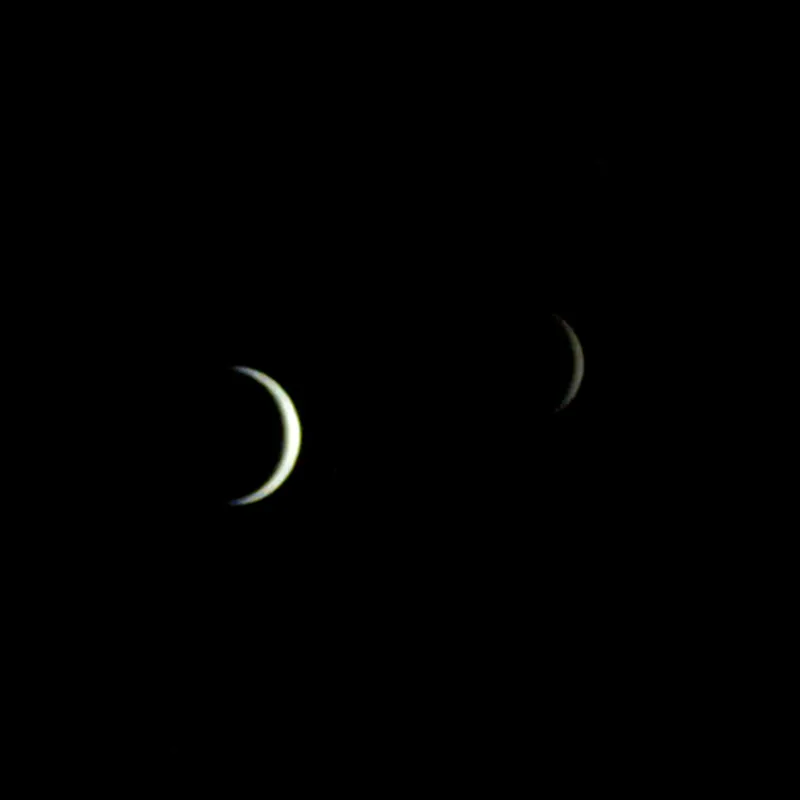
On July 3, one of NASA’s two Mars-destined ESCAPADE spacecraft captured images of Earth and the Moon in visible and thermal infrared light. For decision-makers, it’s a real-world check on camera performance before the mission turns to Mars’ solar wind interactions and atmospheric loss.
On July 3, one of NASA’s two Mars-destined ESCAPADE spacecraft snapped a visible and thermal infrared “family portrait” of Earth and the Moon. At that moment, the spacecraft was 363,250 miles (584,600 kilometers) from Earth and 115,600 miles (186,100 kilometers) from the Moon, a geometry that made the Moon appear relatively large.
The images are not just pretty. In visible light, with the Sun only partly illuminating both Earth and the Moon, the result is crescent-like bodies: only around 8% of each face was sunlit. Flip to the thermal infrared view and the story changes instantly. The shadowed hemisphere of Earth glows from heat stored and transported by its atmosphere and surface, ranging from minus 10 to minus 44 degrees Fahrenheit (250 to 280 kelvins). The Moon’s far side, by contrast, is far colder, around minus 280 degrees Fahrenheit (100 kelvins), because it lacks the insulating blankets of oceans and an atmosphere.
Why should an executive care about crescent Earth versus frigid lunar night? Because ESCAPADE’s whole job is to measure invisible energy flows and translate them into scientific signals. The spacecraft used its Visible and Infrared Observation System cameras, provided by Northern Arizona University in Flagstaff, to capture these images. That matters because the visible-and-thermal pairing is a built-in performance test: can the cameras reliably separate reflected sunlight from emitted heat across targets with dramatically different thermal behavior?
NASA makes the rationale explicit. Rob Lillis, the mission’s principal investigator at the University of California, Berkeley, said NASA is “thrilled” the mission could “accommodate these excellent space-qualified cameras,” which will search for visible Martian aurora and investigate thermal properties of the Martian surface and atmosphere. But Earth and the Moon are also “well-known targets,” and imaging them provides “an important calibration check” for ESCAPADE’s cameras. That is the real stake hiding inside the aesthetic: calibration success reduces uncertainty later, when the spacecraft is much further away and the physics it measures is harder to verify in real time.
There is also a timing and operations dimension that tends to get lost in headlines. ESCAPADE spacecraft are currently in a “loiter” orbit around Lagrange point 2, about a million miles from Earth. In November 2026, the spacecraft will fly by Earth to use the planet’s gravity to slingshot their way to Mars. When they arrive in September 2027, they will study how solar wind, described in the mission materials as a million-mile-per-hour stream of material flowing from the Sun, interacts with the Martian environment, and how that drives atmospheric loss at the Red Planet.
If you are thinking like a board member or operator, this is where the second-order implications kick in. The mission is funded by NASA’s Heliophysics Division and is part of the NASA Small Innovative Missions for Planetary Exploration program. That funding and program positioning usually implies strict attention to risk, timeline, and measurement fidelity. A calibration check using Earth and Moon data is essentially a low-drama, high-signal audit before you bet the scientific narrative on Mars aurora and thermal properties, where you cannot simply “re-take the photo” next week.
On the industrial side, the team stack is also a strategic signal. The ESCAPADE spacecraft were built by Rocket Lab. The UC Berkeley’s Space Sciences Laboratory leads the mission with key partners: NASA’s Goddard Space Flight Center in Greenbelt, Maryland; Embry-Riddle Aeronautical University; Advanced Space; and Blue Origin. For peers tracking space hardware, camera systems, and mission assurance, this reinforces a common pattern: early validation with familiar targets plus a multi-institution integration model, then a long-duration cruise that leaves fewer opportunities for corrective action.
Finally, there is a broader regulatory and measurement credibility angle. NASA is an institutional referee for how space weather and atmospheric escape are studied. ESCAPADE’s thermal infrared imaging across Earth and Moon helps demonstrate the instrument’s ability to translate emitted energy into temperature ranges in a controlled comparative setup. That credibility matters because the downstream goal is not just observing Mars, but understanding how solar wind accelerates atmospheric loss. For decision-makers, the lesson is simple: when future missions depend on translating physics into actionable models, the fastest way to protect scientific and operational outcomes is to stress the instruments against known baselines early, even if the first “baseline test” is framed as a scenic snapshot.
This story's Key Insights and Take-aways are locked.
Create a free account to unlock Executive Actions for one credit.
Register to UnlockAlways free for Executives Club members. Join the Club
More in Science

Scientists put wild marmots on OnlyFans to fund research as budgets get cut
A team of researchers turned adult subscriptions into a stopgap for wildlife science, raising money amid government budget cuts.
Mandarin learners' speech changes with prior language, Taiwan-led study finds
New research shows how what you hear and produce is tuned by your language history, reshaping theories of human communication.
Instagram’s numbers drown stoma education, because attention beats usefulness every time
A single poster story shows how algorithmic incentives can bury high-value health info under higher-engagement photos.