
Maine Democrats replace Graham Platner via 84 delegates voting in Sanford, July 25.
A messy anti-insider fight ends in a fast delegate tally that locals call “that’s democracy.”
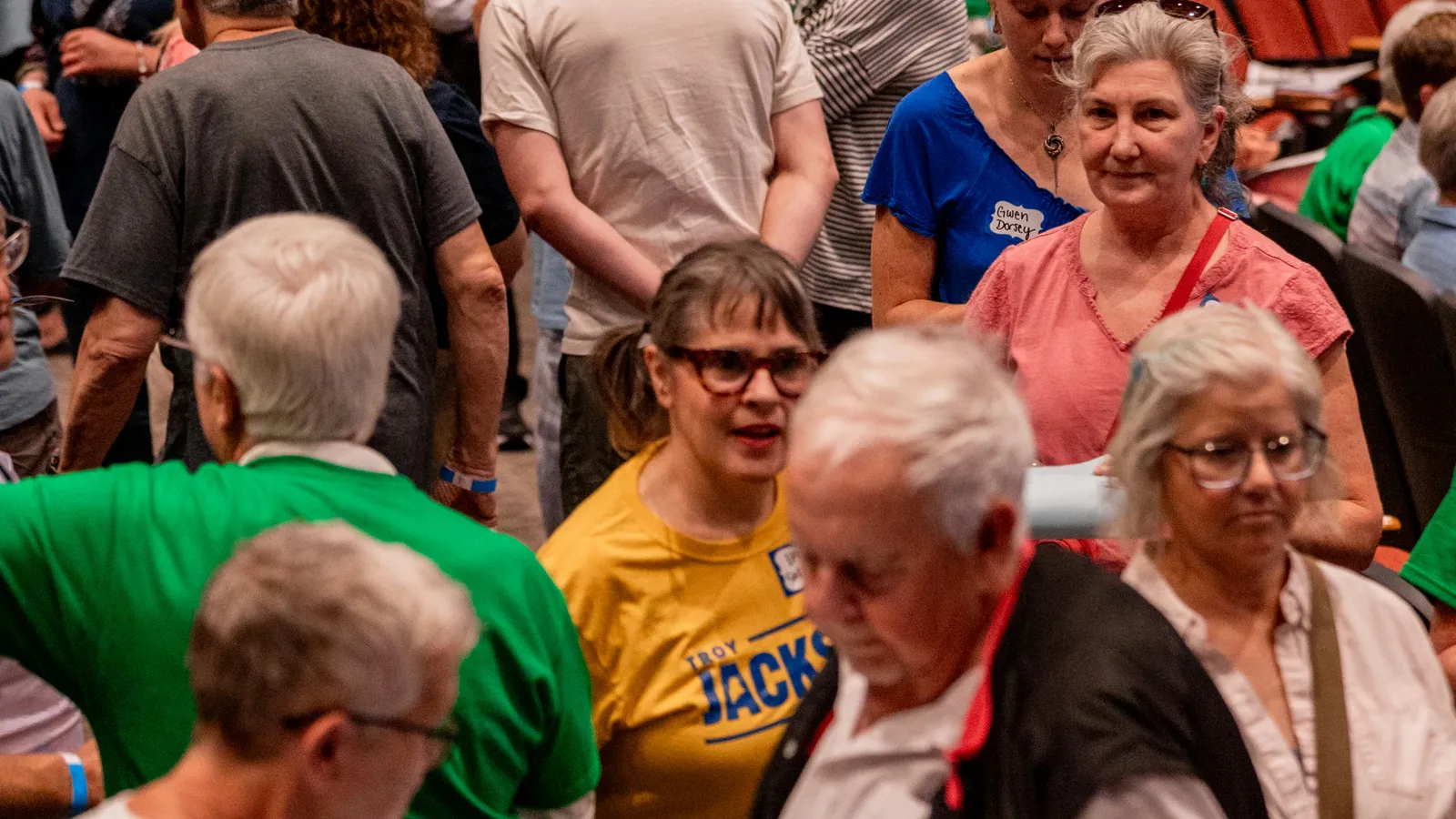
Cathie Purdy, chair of the York County Democratic Committee, helps run the Sanford delegate meeting after Graham Platner drops out of Maine’s Senate race. The replacement process avoids another primary by using county delegate elections and a July 25 convention, producing both frustration and surprising speed.
When Graham Platner dropped out of the Maine Senate race, everyone expected the replacement process to melt down. Instead, in Sanford, Maine, Cathie Purdy and the York County Democratic Committee organized a caucus-type meeting where participants voted for delegates who would, in turn, vote for the replacement nominee. The nightmarish part was never the math. It was the feeling, among Democrats and outsiders, that the rules had been bent in favor of party insiders.
On Sunday, Purdy sat on a stage at the Sanford Performing Arts Center and answered a direct challenge: a voter had texted asking whom “leadership had picked.” Purdy, chair of the York County Democratic Committee, pushed back. “Actually, right now we are conducting the caucus-type meeting in Sanford where the participants vote for a group of delegates,” she told me. She made the mechanism plain: those delegates, selected through the county vote, would be the people “who’ll be voting for your Senate candidate.”
Here is the part that makes this story more than local political theater: the Democrats tried to replace Platner without another primary, because there was no time. But if party leaders simply chose a new nominee, critics worried voters would feel boxed out, especially because much of Platner’s support had come from people frustrated with the “establishment.” The compromise was a convention on July 25, where 601 delegates would choose Platner’s replacement. Before that, each county would hold an election to choose its portion of those delegates.
And yes, the process still managed to produce controlled chaos. The state party urged people to consider voting from home, but in Sanford the room filled anyway. Mainers wanting to be delegates and Mainers coming to meet delegate candidates mixed with campaign volunteers distributing lists of allied delegates. People argued, complained, and ran into practical obstacles, including Wi-Fi struggles. Purdy even made light of a missing-items moment, announcing that they had found a pair of car keys and asking the owner to come to the stage.
Then there was the political heat. Only registered Democrats could participate in selecting the replacement nominee. That gave independents a clear grievance: “As an independent you’re saying my vote doesn’t count now,” one commenter wrote on the York County Democratic Committee Facebook page. Another commenter pressed a deeper authenticity concern: “If you believe primary voters should choose nominees, not party insiders, consider whether your party registration still reflects your values.” Purdy, meanwhile, tried to cool the vibe on social media, writing that she would “really appreciate some respect” and asking people to “Please stop the snark.”
Inside this tension sits the reason the stakes feel personal for anyone watching democracy as a system, not a vibe. Platner’s candidacy had already been surrounded by red flags, including a Nazi tattoo and allegations of volatile behavior from past girlfriends. After an accusation of rape toppled his candidacy, Democrats who had selected him faced a deadline problem: they needed to keep momentum for what they see as a plausible path to take the Senate. Maine Democrats have failed to unseat Susan Collins for nearly three decades, and the article notes strong reasons to believe they could again come up short in three months.
At the same time, the article refuses the lazy conclusion that “the Democrats are once again in disarray.” After hours of arguing and proxy delegate politics, the York County Democrats sat down and voted. Purdy read out the totals quickly: 84 delegates and 17 alternates would go to the party’s nominating convention in Bangor. A lot of attendees were frustrated with the results, and there were complaints about the process itself. Still, the essential function did get performed, and Purdy’s line was blunt: “that’s democracy.”
The morning’s competing narratives came through in the candidates locals supported at the delegate level. Most attendees were pushing for Troy Jackson, a progressive former state legislator and logger who had been Platner-aligned enough that supporters believed he could inherit Platner’s movement. Reed Gordon, a 29-year-old delegate candidate, argued that Democrats “We’ve lost a lot of momentum, and he has the best chance of keeping them engaged.” Others favored Nirav Shah, the former leader of the Maine CDC who had since dropped out of the race, but his supporters argued he was “slightly more moderate” and could be easier for independent and moderate Mainers to buy. There was also a separate rationale offered for Jackson supporters: Platner was described as “too aggressive,” with Paula Busby, a 62-year-old from Lebanon, saying “we have to be measured” even while “stand[ing] up against” President Trump.
A lot of the anger came from how the proxy system worked. Because the county meeting was choosing delegates, not directly choosing the replacement nominee, campaigns circulated lists of allied delegates ahead of time. Delegate selection became, in the article’s words, “a proxy election.” That upset Mainers who had hoped the people going to the convention would be impartial. Julian Rogers, the former vice chair of the Maine Democrats and a delegate candidate, expressed the concern that delegates felt like coronation machinery rather than a true contest.
So what should leaders take away from one Sanford morning? First, when deadlines crush normal pathways, organizations will still run elections, but the legitimacy debate moves from ballots to process design. Second, when voters feel the system is deciding before they act, social media becomes the battlefield, and respect becomes a resource. Third, even in a messy setup, outcomes can be reached fast. Purdy and the York County Democrats managed to produce a slate of delegates for Bangor without a primary, totaling 84 delegates and 17 alternates, and feeding into a July 25 convention with 601 delegates statewide. In other words, chaos can be controlled. The harder part is whether the public experiences the result as participation or selection.
This story's Key Insights and Take-aways are locked.
Create a free account to unlock Executive Actions for one credit.
Register to UnlockAlways free for Executives Club members. Join the Club
More in Politics

Houthi claims hit Saudi tankers, as US strikes Iran and IRGC stops Hormuz crossings
A contested Red Sea and Strait of Hormuz are colliding, with claimed tanker attacks and IRGC stoppages reshaping risk for energy flows.

Amish Shah beats DCCC-backed Marlene Galán-Woods in Arizona 1st District primary
The battleground test flips against the DCCC and tees up Jay Feely for a general-election shot.

Extreme heat turns wildfires deadly across Sicily, France, Spain, killing three firefighters
Thousands were evacuated as rescue teams fought dozens of blazes driven by dry conditions and worsening weather.