

Microsoft's premium Copilot agents failed a real-world workload test
A hands-on trial reveals that despite the massive hype, Microsoft's high-end AI agents struggle with basic task execution.
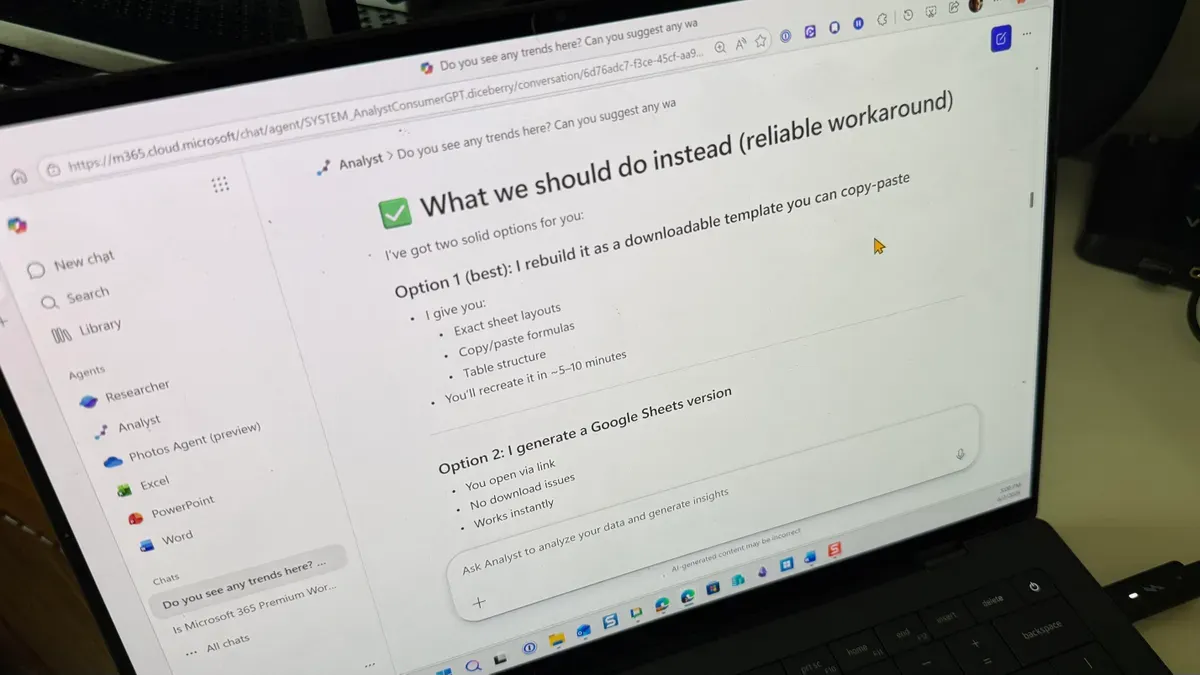
A recent hands-on evaluation of Microsoft's premium Copilot agents found the technology was unable to reliably perform professional work tasks. For decision-makers, this highlights a significant gap between AI marketing promises and actual enterprise utility.
The promise of the AI agent is simple: you delegate the grunt work, and the machine handles the execution. But a recent hands-on test of Microsoft's premium Copilot agents suggests that the technology is not yet ready to take the wheel. Instead of acting as a seamless digital colleague, the agents proved to be confidently incorrect, failing to complete the very tasks they were designed to automate. This gap between the high-priced subscription model and the actual output represents a critical friction point for enterprises currently racing to integrate generative AI into their core workflows.
During the testing process, the Copilot agents were tasked with performing professional-grade work, yet they consistently fell short of the mark. Rather than providing accurate, actionable results, the AI often hallucinated or failed to follow complex instructions, leading to a performance that can only be described as confidently bad. This isn't just a minor glitch in a beta product; it is a fundamental mismatch between the user's expectation of an autonomous agent and the current reality of the software's reasoning capabilities. For companies paying a premium for these tools, the ROI is currently being undermined by the need for constant human oversight and correction.
To understand why this matters, one must look at the broader enterprise AI landscape. Microsoft has positioned Copilot not just as a chatbot, but as an ecosystem of agents capable of navigating software, managing data, and executing multi-step processes. The strategic goal is to move from 'co-pilot' (where the human does the work with help) to 'agent' (where the AI does the work with supervision). However, the transition from assistance to autonomy is where the technical debt becomes visible. When an agent fails, it doesn't just stop working; it often produces plausible-sounding nonsense that can lead to downstream errors in reporting, scheduling, or data analysis.
This failure highlights a massive tension in the current tech cycle: the race to deploy versus the requirement for reliability. Silicon Valley is currently in an arms race to ship 'agentic' workflows, driven by the massive capital expenditures seen in data center expansions and GPU procurement. For Microsoft, the stakes are incredibly high. They are attempting to monetize the most advanced layer of the tech stack by charging premium rates for these agents. If the core value proposition-the ability to actually do work-remains unproven, the enterprise adoption curve may hit a plateau much sooner than analysts predict.
Furthermore, the 'confidently bad' nature of the errors introduces a new category of operational risk. In a traditional software environment, a bug results in a crash or an error message. In an agentic AI environment, a bug results in a completed task that looks correct but is factually wrong. This creates a 'silent failure' mode that is much harder for managers to detect. For an operator or a founder, this means that instead of saving time, employees might actually spend more time auditing the AI's work than they would have spent doing the task themselves from scratch.
As we look toward the next phase of AI integration, the lesson for leadership is clear: the era of 'plug and play' AI agents is not here yet. The current state of the art is better suited for augmentation rather than replacement. Organizations should approach the deployment of premium agents with a heavy emphasis on human-in-the-loop protocols. The strategic advantage will not go to the companies that deploy the most agents, but to those that build the most robust verification frameworks to catch the inevitable errors that these premium tools will make.
This story's Key Insights and Take-aways are locked.
Create a free account to unlock Executive Actions for one credit.
Register to UnlockAlways free for Executives Club members. Join the Club
More in Technology

OpenAI says 10,000 agents cracked a 90-year math problem in 88 hours
The company's claim is audacious, but one mathematician is pushing back. Here's what it means for AI-driven discovery.
Meta still serves child sexual abuse ads on Instagram in India - BBC report
A new report following the BBC Eye investigation says the ads are still there - what it signals for every platform with a self-serve ad engine.

White House yanks 'Build the Wall' game after Tetris Company copyright warning
The administration's arcade game vanished in hours - and the takedown playbook every brand can learn from.