
Musk warns Optimus has no supply chain, every component is new to scale
On Tesla’s Q2 call, Elon Musk sets expectations for Optimus manufacturing: hardest to scale, no existing pipeline.
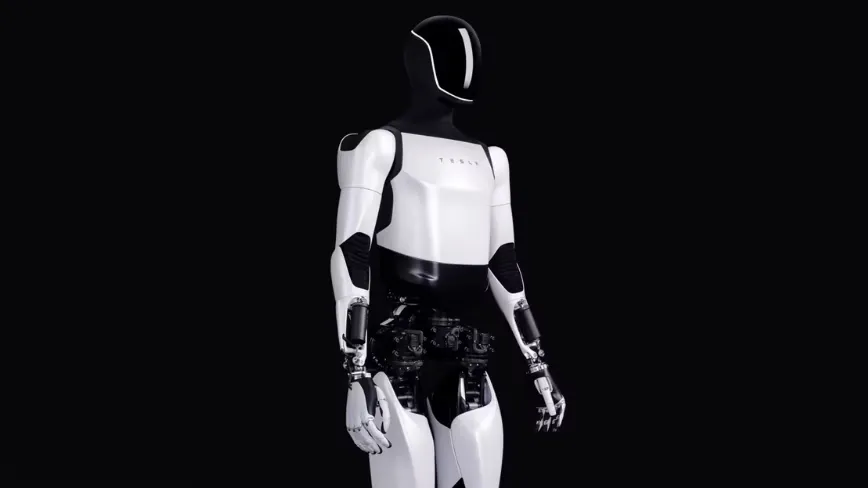
Elon Musk told investors on Tesla’s second-quarter earnings call that Optimus will be “the hardest product to scale manufacturing that we’ve ever made at Tesla.” He said the humanoid robot has no existing supply chain and that every component is new, adding he wants to “calibrate people correctly” on expectations.
On Tesla’s second-quarter earnings call, Elon Musk used blunt manufacturing math to set the tone for Optimus. He told investors that Optimus will be “the hardest product to scale manufacturing that we’ve ever made at Tesla.” The key reason, according to Musk, is that the humanoid robot has no existing supply chain, and “every component is new.”
Musk also framed this as an expectations issue, not just a technical one. He said he wanted to “calibrate people correctly,” effectively warning that the early phase will not look like a normal product ramp where parts and processes already exist. That distinction matters because scaling hardware is rarely about building the prototype, it is about locking down repeatable sourcing, manufacturing tolerances, QA processes, and logistics. If Optimus is starting from a blank component slate, then every factory problem becomes a new supplier problem first.
To understand why Musk’s wording is a big deal, remember what “scaling manufacturing” implies in Tesla-world. Tesla has experience shipping massive volumes of engineered products, and it has built internal capabilities around making complex systems manufacturable. But Musk is explicitly positioning Optimus as different. “The hardest product to scale manufacturing” is not a throwaway phrase. It signals that the bottleneck may not be Tesla’s ability to invent. It may be the industrial ecosystem needed to produce consistent hardware at scale, on schedule, with acceptable yield.
The second-order implication for decision-makers is capital allocation and timeline discipline. When a CEO tells investors a product has no supply chain and every component is new, it is a reminder that time-to-scale depends on vendor formation as much as on engineering. In practice, that often means more iteration, more redesign risk, and potentially longer lead times for procurement and qualification. Boards and CFOs typically care about one thing first: how to underwrite uncertainty without pretending it is lower than it is. Musk’s “calibrate people correctly” suggests he is trying to prevent a mismatch between what stakeholders expect to see and what the realities of early scaling look like.
There is also a governance angle. Earnings calls are not just information dumps. They are moments when management signals how it interprets accountability. By warning that the initial scaling phase will be hard, Musk is creating an interpretive framework: delays or teething issues are not necessarily evidence of failure; they are evidence of starting conditions. That can influence how analysts model the ramp and how internal teams are evaluated. Investors hate surprises. Management can reduce surprise by making the hard parts explicit in advance, which is what Musk appears to be doing here.
Regulation does not drive this specific quote, but it shapes the environment that companies developing humanoid robots will eventually face. Over time, robotics and autonomy intersect with safety requirements, deployment rules, and potentially labor-related policy, depending on where the robots are used. Even if Optimus begins as a manufacturing and engineering challenge, scaled deployment turns into a compliance challenge, too. When a product’s manufacturing is already described as the hardest to scale, the future regulatory ramp becomes another layer of complexity that boards will need to plan for rather than assume will be trivial.
There is also a market signaling effect. Musk’s emphasis on “every component is new” tells the market that Optimus is not a re-skin of existing supply chain modules, even if the components are familiar categories like actuators, sensors, and compute. For competitors and partners, that is a signal that Tesla may be building new relationships and qualifying new production routes. For investors, it reframes the product risk profile: early milestones may depend more on supply and manufacturability than on performance claims. For anyone benchmarking robotics startups or manufacturing-heavy hardware ventures, the headline is a reminder that supply chain maturity is a competitive advantage that takes time to build.
Bottom line: Musk’s message on Tesla’s Q2 call is a forecasting warning delivered as a manufacturing briefing. Optimus is not positioned as a standard product ramp with an existing vendor network. Instead, Musk is telling investors that the humanoid robot has no existing supply chain and every component is new, making it “the hardest product to scale manufacturing” Tesla has ever made. For executives watching from adjacent industries, the strategic stake is clear: the biggest constraint in ambitious hardware is often not invention. It is scaling the industrial base around the invention, and the clock starts when the supply chain has to be invented, too.
This story's Key Insights and Take-aways are locked.
Create a free account to unlock Executive Actions for one credit.
Register to UnlockAlways free for Executives Club members. Join the Club
More in Business

Anthropic’s Levant Alpöge cracks the Jacobian conjecture after 87 years
A Harvard valedictorian used Claude to hit a 1939 breakthrough, but the missing “why” is the real problem.

Uber buys Delivery Hero for nearly $15B, vaulting to top food delivery outside China
The deal doubles Uber's dual-services footprint and pushes a ride-and-eats bundling play into 50 more markets.

Epic and Google drop settlement bid, forcing rival Android app stores by July 22
Google told the court it is ready to carry third-party app stores starting Wednesday, July 22.