

NASA and Blue Origin lock in New Glenn second-stage hot fire at Stennis B-2
Testing targets fall start, using the B-2 stand to advance Artemis Moon missions through 2027 and beyond.
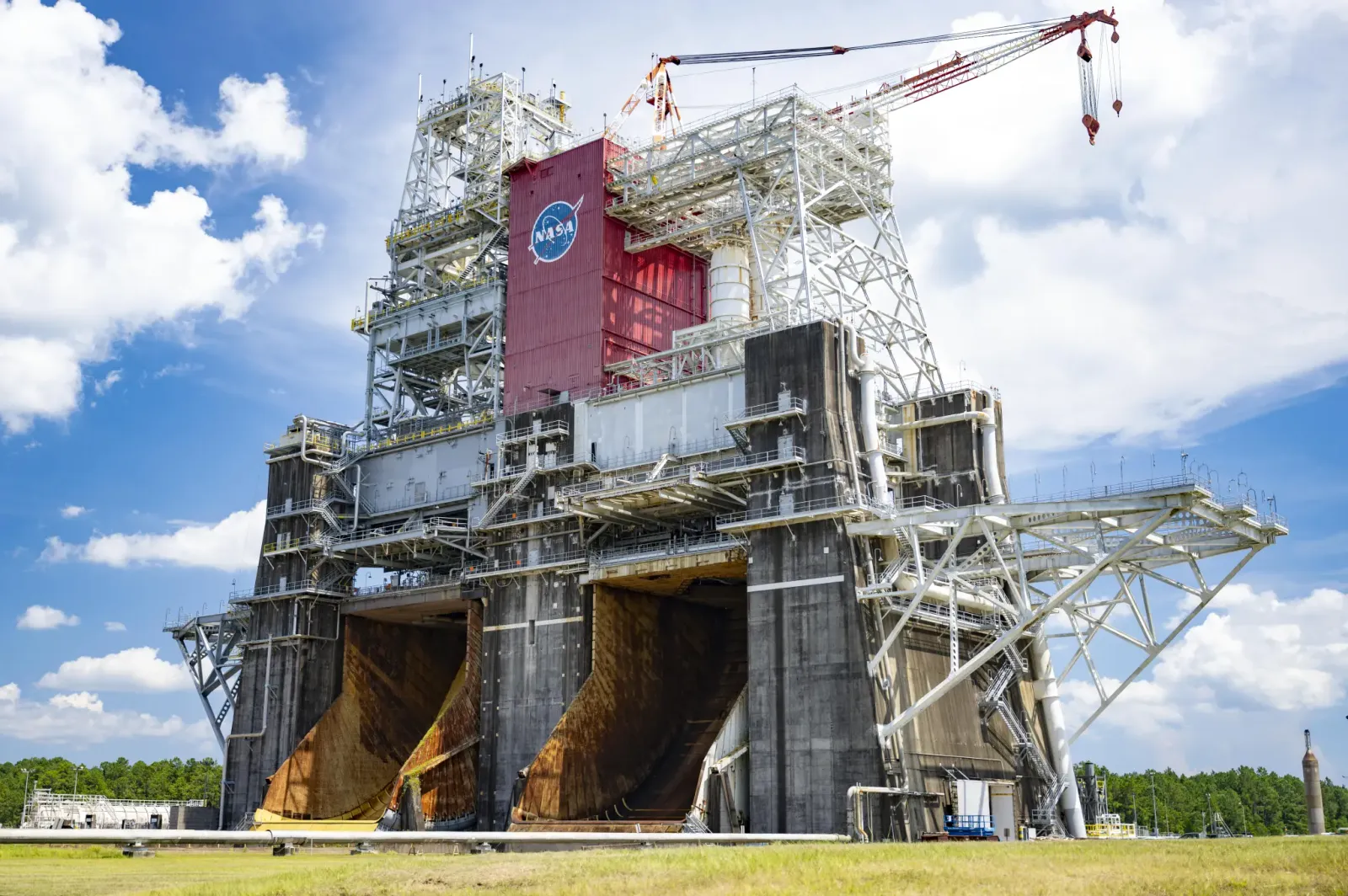
NASA and Blue Origin announced they recently agreed to conduct New Glenn second-stage hot fire testing on the B-2 test stand at NASA’s Stennis Space Center near Bay St. Louis, Mississippi. The deal extends NASA’s commercial partnership push for Artemis missions in 2027 and beyond and feeds rocket development needed for returning American astronauts to the Moon.
NASA and Blue Origin just agreed to run New Glenn second-stage hot fire testing on the B-2 test stand at Stennis Space Center near Bay St. Louis, Mississippi. NASA says the annex to a reimbursable Space Act Agreement, signed earlier this month, underlines how the agency plans to work with commercial partners toward Artemis missions in 2027 and beyond.
This is not a “someday” announcement. NASA says testing is targeted to begin this fall, and it is directly tied to the agency’s goal of landing American astronauts on the Moon and building a Moon Base near the lunar South Pole. Translation: before you can talk about landing schedules, docking plans, and sustained lunar operations, you need hard data from propulsion testing. Stennis’s B-2 stand is built for that.
Here’s why the B-2 matters. Stennis’s dual, vertical firing positions were built in the 1960s to test Saturn V rocket stages used in Apollo, which carried humans to the Moon. The B-1 position is set up for single engine tests, while the B-2 position is designed to test full rocket stages. NASA is essentially handing Blue Origin one of the agency’s most proven “full stage” testing environments for New Glenn’s second stage.
The setup is also specific. NASA will provide engineers, equipment, and building services needed to design, build, and install parts to prepare the B-2 for second-stage testing of the rocket named for the late NASA astronaut John Glenn, the first American to orbit Earth. The second stage is powered by two BE-3 engines that use liquid oxygen and liquid hydrogen propellants, with each engine generating 200,000 pounds of thrust in vacuum. If you want a plain-English takeaway: they are going to light up the actual engine hardware under conditions designed for rocket stage testing, then compare results against development targets.
The agreement also spells out how the two organizations will work day to day. Along with hands-on technical support, NASA will assist Blue Origin’s test operations by providing dedicated workspace and sharing agency expertise and lessons learned from propulsion testing conducted at the test stand. For an executive team, this is the operational version of de-risking. You are compressing the learning curve and increasing the probability that what the company intends to fly is what it can prove on the ground.
NASA’s stated incentive here is bigger than one rocket. NASA Administrator Jared Isaacman frames it as speed plus industrial partnership: “Winning the new space race means moving faster and working alongside a strong commercial industry.” In NASA’s telling, partnerships like this strengthen the industrial base, support the return of astronauts to the Moon, enable a sustained lunar presence, and help prepare for Mars. That aligns with a broader pattern inside Artemis: NASA is coordinating with commercial providers not just for launch, but also for landers and mission-critical systems.
And the Artemis schedule context is important. Building on the successful Artemis II flight from April, NASA says Artemis III is a highly choreographed, multi-launch campaign that will require four astronauts to test rendezvous and docking capabilities of NASA’s Orion spacecraft with commercial human landing systems from Blue Origin and SpaceX in low Earth orbit. Separately, NASA says Blue Origin’s New Glenn will be used to launch missions that will land on the Moon. So the B-2 testing is not just about an engineering milestone. It is about providing confidence for a chain of events: test, refine, integrate, launch, land.
The policy and political subtext is also baked into the announcement. Sen. Roger Wicker said Stennis continues to be a hub for the commercial space industry and praised Mississippi’s welcome of Blue Origin’s return. Sen. Cindy Hyde-Smith pointed to Artemis II’s roots at NASA Stennis and expressed hope that B-2 becomes a long-term arrangement that broadens the state’s contribution to space exploration. Rep. Mike Ezell highlighted world-class capabilities at B-2 and the impact on high-skilled jobs and national leadership in space exploration. Even if you strip out the speeches, the message for decision-makers is clear: major propulsion testing infrastructure is a strategic asset for states, supply chains, and national programs.
Blue Origin CEO Dave Limp also tied the testing move to mission momentum, saying the company is proud to partner with NASA and build on shared commitment to returning America to the Moon and building a road to space for the benefit of Earth. Blue Origin says Stennis helped take Americans to the Moon, and through this partnership, it will help take them back.
Finally, the announcement connects the testing work to near-term lunar plans. In May, NASA announced the first three Moon Base missions to begin building sustained operations, including an award to Blue Origin to launch a robotic mission this fall. Blue Origin’s Blue Moon Mark 1 Endurance lander will deliver NASA payloads to the lunar South Pole’s Shackleton Connecting Ridge, demonstrating capabilities that reduce risk for astronauts to land on the Moon during Artemis IV and V in 2028. For boards and senior operators, the second-order implication is straightforward: hardware validation and mission risk reduction are being scheduled in the same overall runway. Testing capacity at Stennis is becoming a bottleneck or a catalyst, depending on how fast results convert into flight readiness.
If you are an investor or operator watching the space industry’s “commercialization” phase, this is the kind of news that rarely makes headlines, but it changes spreadsheets. When a government agency commits testing infrastructure, hands over dedicated workspace, and shares propulsion testing lessons, it can accelerate development cycles and reduce technical uncertainty. In other words, this is Artemis logistics doing what Artemis needs most: proving physics before proving politics.
This story's Key Insights and Take-aways are locked.
Create a free account to unlock Executive Actions for one credit.
Register to UnlockAlways free for Executives Club members. Join the Club
More in Business

Anthropic’s Levant Alpöge cracks the Jacobian conjecture after 87 years
A Harvard valedictorian used Claude to hit a 1939 breakthrough, but the missing “why” is the real problem.

Uber buys Delivery Hero for nearly $15B, vaulting to top food delivery outside China
The deal doubles Uber's dual-services footprint and pushes a ride-and-eats bundling play into 50 more markets.

Epic and Google drop settlement bid, forcing rival Android app stores by July 22
Google told the court it is ready to carry third-party app stores starting Wednesday, July 22.