
NASA’s ERNEST rover hits 16 miles in 37 hours, 10x Mars speed
JPL’s active-suspension prototype drove 0.6 mph in desert tests, using reinforcement learning to move faster than rovers in orbit.
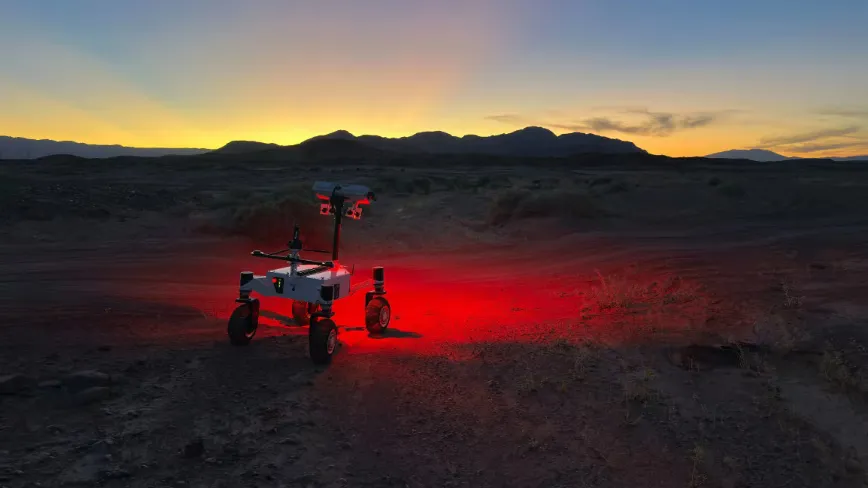
NASA’s Jet Propulsion Laboratory (JPL) built the ERNEST rover prototype, which covered 16 miles in 37 hours of desert testing in March 2026 at speeds up to 0.6 mph. For decision-makers tracking space tech readiness, the result is a measurable step change in rover mobility and autonomy, even as ERNEST remains a prototype.
NASA’s JPL just posted a rover number that should make every Mars and Moon mission planner sit up: ERNEST drove 16 miles in 37 hours during desert testing, reaching up to 0.6 mph. That is about 10 times faster than NASA rovers currently operating on Mars, including Curiosity and Perseverance.
The important part is not just the speed. It is how ERNEST gets there. The four-wheeled Exploration Rover for Navigating Extreme Sloped Terrain uses an active suspension system, plus reinforcement learning for navigation decisions, to keep moving over terrain that would force slower, more passive designs into crawl mode or stop altogether.
So what exactly did JPL build? ERNEST is a 4-foot-long prototype with mesh wheels, a deliberate departure from the rigid aluminum wheels that have caused problems on Mars. Each wheel has active suspension with two powered joints per wheel, which lets the rover lift individual wheels over obstacles, drive sideways, and switch between different gaits. JPL describes multiple modes, including “squirming,” wheel-walking, and obstacle-climbing. It is a rover that can change its posture, not just its direction.
There is also a clutch mechanism that toggles between active and passive suspension on the fly. In passive mode, ERNEST can conserve energy on flatter ground. In active mode, it can take on slopes and obstacles in ways that the rocker-bogie suspension system used on NASA’s Mars rovers since Sojourner in 1997 cannot. That matters because NASA’s current Mars pace is painfully slow: Curiosity and Perseverance both top out at roughly 0.06 mph. On Mars, that speed ceiling turns every traverse into a long-haul engineering project, where the limiting factor is often mobility and planning time, not just power.
ERNEST aims to remove both bottlenecks. The mobility upgrade comes from the powered suspension joints. The navigation upgrade comes from reinforcement learning trained in JPL’s DARTS simulation lab. JPL ran thousands of virtual driving hours across procedurally generated terrain before ERNEST ever touched real ground. The strategic point here is autonomy. Instead of waiting for humans on Earth, ERNEST’s system can make faster wheel-placement decisions on unfamiliar terrain. That matters because signal delays to Mars run between four and 24 minutes each way, which makes tight reactive driving expensive in human-in-the-loop time.
The test setup also tells you what JPL is optimizing for. The Colorado Desert field trial happened in March 2026, in California’s Colorado Desert, and the rover was run in darkness for seven days of intermittent testing. That darkness is not a random gimmick; it is meant to simulate dim lighting conditions at the lunar south pole, where future missions would operate during dusk and dawn periods. Over seven days, ERNEST accumulated its 16 miles of driving in 37 hours of actual movement. In other words, the rover did not just spike a speed chart for a minute. It repeatedly executed the full driving loop under more realistic constraints.
This was not the rover’s first stage either. JPL first tested ERNEST in its Mars Yard obstacle course at the Pasadena campus, then moved to natural terrain in the desert. Before this 4-foot prototype, JPL built two smaller versions at 2 feet long and tested 11 different suspension configurations to arrive at the final design. Hardware on the current prototype was completed in September 2024, and work began in 2022 with initial funding from JPL’s internal research and development budget.
Since then, the project has gained external backing, which is a huge signal for anyone who watches how tech gets from “cool demo” to “mission option.” NASA’s Mars Exploration Program and its Exploration Science Strategy and Integration Office are now backing the work. JPL principal technologist Hari Nayar leads the ERNEST team, and Issa Nesnas led the field testing. And there is already talk, at least from the team, about a larger and faster version potentially being used for a Moon mission.
That Moon angle is not just marketing. A lunar application is strategically logical because NASA is increasingly relying on commercial partners to lower the cost of planetary missions. A faster rover could let NASA cover more ground during the limited operational windows available at the lunar poles, where sunlight and power are intermittent. The rover’s mobility approach also aligns with the hard terrain locations NASA is excited about: James Keane, a JPL planetary scientist, has pointed to potential exploration of steep crater walls, lava tubes, and permanently shadowed regions near the lunar south pole where water ice is believed to exist. Those are exactly the kinds of environments where being able to lift wheels, change gait, and handle slopes could be the difference between “can attempt” and “cannot reach.”
But executives should also keep their eyes on one caution label: ERNEST remains a prototype, not a flight-qualified vehicle. The gap between a successful desert test and a rover that survives launch, landing, and years of operation on another world is substantial. JPL has not announced a specific mission for the technology or a timeline for when a flight version might be ready. Still, 16 miles in 37 hours is the kind of number that changes the conversation about what rovers can do. Curiosity has driven roughly 21 miles in 14 years on Mars. ERNEST covered three-quarters of that distance in a week.
For peers in space tech, autonomy, and mission planning, this is a practical warning shot: if mobility and navigation can be improved by an order of magnitude in field tests, the bottlenecks shift. The boardroom conversation stops being only about payload and power budgets, and starts becoming a harder question about how quickly decision cycles, software training, and rover readiness can move from lab to launch.
This story's Key Insights and Take-aways are locked.
Create a free account to unlock Executive Actions for one credit.
Register to UnlockAlways free for Executives Club members. Join the Club
More in Technology

Nvidia's $89B data center quarter: the 9 companies cashing in
The AI buildout is minting fortunes beyond GPUs, and memory, cloud, and cooling suppliers are riding the same wave.

Google quietly links your phone number to every Android account on your SIM
Adding a SIM now ties your phone number to all Google accounts - and future accounts inherit it. Here's the security and privacy stakes.

Hijacker AI 'Skynet mode' runs 100,000 attack steps against exposed models
Symantec caught a criminal AI agent that borrows other models, steals data, and mines crypto; the only relief is no confirmed victims yet.