
NASA tests Ernest rover that drives faster and lifts wheels to climb obstacles
Footage from NASA shows its Ernest prototype doing speed plus obstacle handling in the same run.
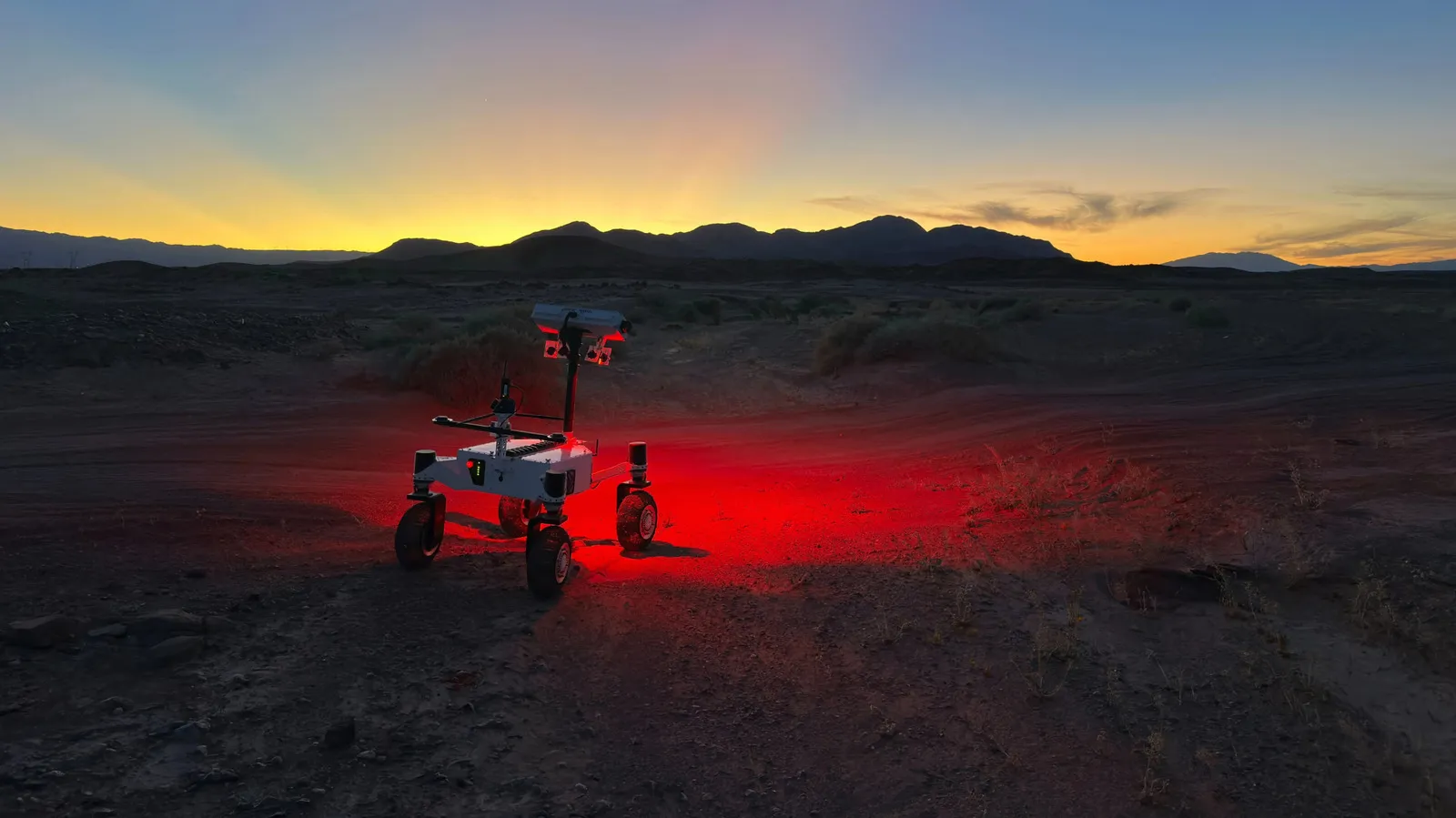
NASA is testing its Ernest prototype rover, and the agency shared footage of the vehicle during trials. For decision-makers, the demo signals where rover design is heading: more mobility performance without sacrificing rugged climbing ability.
NASA just posted footage of a rover test that tackles two pain points at once: speed and obstacle climbing. The agency’s Ernest prototype rover is built to drive faster while also lifting its wheels to get over obstacles, and the shared clips show the two capabilities in action during testing.
That combination matters because rover mobility is not a single problem. It is a bundle of trade-offs between how quickly a rover can cross terrain, how reliably it can recover when it hits something it cannot simply roll over, and how much complexity you are willing to add to make those recoveries happen. Ernest is positioned as a prototype for that balancing act, with the “drive faster” part pushing toward better traversal efficiency and the “lift its wheels” part pushing toward better obstacle negotiation. In other words, NASA is not just proving the rover moves, it is showing it can keep moving when the ground stops being cooperative.
For executives, the strategic angle is that mobility performance is a direct input to mission economics, even when budgets are approved far upstream. More efficient traversal can reduce time spent in one type of environment and increase the number of distinct targets a rover can attempt within mission constraints. At the same time, obstacle handling affects risk. When a rover encounters barriers such as rock outcrops, uneven surfaces, or other terrain irregularities, the failure mode is often not catastrophic, it is procedural. The rover can get stuck, it can waste time attempting maneuvers, or it can require additional planning cycles and slower driving to avoid further entanglement. A design that lifts wheels to climb obstacles is aimed at shrinking that “stuck and wait” portion of the mission timeline.
There is also an engineering and program management subtext here. Prototypes like Ernest are how agencies reduce unknowns before committing to flight hardware. Rover subsystems have to survive dust, temperature swings, power constraints, and mechanical stresses, and mobility mechanisms can introduce new failure points. Wheel lifting adds mechanical and control complexity, which means it must earn its keep through repeatable performance under test conditions. NASA’s decision to publish test footage suggests it views the demonstration as meaningful evidence, not just a one-off curiosity.
If you zoom out, the rover competition is increasingly about autonomy-friendly reliability. Missions generally want rovers to travel farther, do more science, and operate with less human intervention. Mobility that can handle obstacles on the fly is the physical foundation for that software ambition. Faster driving without the ability to climb means you may simply get to the obstacle sooner. Conversely, obstacle climbing without speed may improve robustness but slow down the overall pace of exploration. Ernest’s design philosophy, at least as reflected in the tests NASA shared, tries to avoid that trade-off by improving both simultaneously.
Decision-makers in adjacent areas, including robotics and space-adjacent mobility suppliers, should also note what this says about where technical validation is happening. When NASA shows footage from testing rather than only describing design intent, it pushes expectations toward measurable traversal outcomes, not only concepts. That affects procurement thinking for companies supplying components, actuators, sensors, or control systems to space programs. If rover prime contractors and agencies are converging on prototypes that demonstrate speed plus obstacle climbing, the market will likely reward teams that can support those performance targets consistently.
Finally, there is a second-order implication for boards and portfolio operators who track deep tech timelines: prototypes are where narratives get stress-tested. Early mobility demonstrations can influence internal decisions on follow-on iterations, subsystem budgets, and integration priorities. They can also influence the credibility of roadmaps for partner organizations watching from the sidelines. With Ernest, NASA is effectively saying the rover development path is not only about making it move, it is about making it move productively across real terrain challenges, starting with how the vehicle handles obstacles while maintaining higher driving performance.
In short: NASA’s Ernest prototype rover test footage shows a rover designed to drive faster and lift its wheels to climb obstacles, and the agency is treating that as a core capability worth demonstrating in public. If you are running a space tech program, building robots for harsh environments, or funding autonomy and mobility platforms, this is the kind of proof point that can reshape what “performance” means in the next generation of off-road machines.
This story's Key Insights and Take-aways are locked.
Create a free account to unlock Executive Actions for one credit.
Register to UnlockAlways free for Executives Club members. Join the Club
More in Technology

Nvidia's $89B data center quarter: the 9 companies cashing in
The AI buildout is minting fortunes beyond GPUs, and memory, cloud, and cooling suppliers are riding the same wave.

Google quietly links your phone number to every Android account on your SIM
Adding a SIM now ties your phone number to all Google accounts - and future accounts inherit it. Here's the security and privacy stakes.

Hijacker AI 'Skynet mode' runs 100,000 attack steps against exposed models
Symantec caught a criminal AI agent that borrows other models, steals data, and mines crypto; the only relief is no confirmed victims yet.