
Scientists confirm a habitable-zone, rocky exoplanet atmosphere like Earth’s
A new Earth-like discovery sharpens the roadmap for future telescopes, funding, and standards for what “habitable” really means.
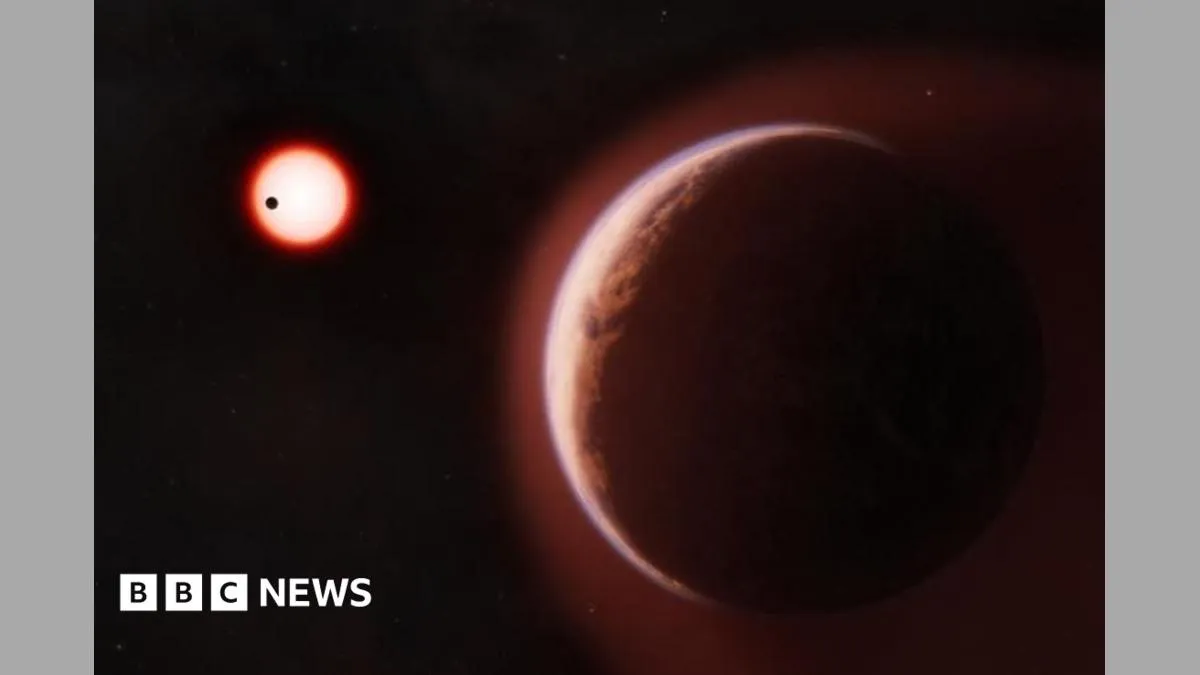
Researchers have found an Earth-like, rocky planet orbiting within the habitable zone of a distant star, and they report an atmosphere. For decision-makers, it raises both the urgency and the scrutiny around how the next wave of instruments and budgets will chase, verify, and interpret life-supporting conditions.
Researchers have found an Earth-like, rocky planet orbiting within the habitable zone of a distant star, with an atmosphere. That single combination matters because it stacks three historically hard problems into one target: rocky planet size, location where liquid water could exist, and atmospheric detection.
In practical terms, this discovery upgrades “possible habitability” to “something measurable.” An atmosphere is not just a poetic detail. Atmospheres can absorb, scatter, and re-emit light in specific ways that telescopes can, in theory, analyze. The breakthrough headline is therefore not only about where the planet sits, but about the fact that it offers an observational handle that earlier searches could miss.
If you are an executive tracking science and space budgets, the signal is straightforward: detection capability now has a clearer payoff structure. Historically, the search for habitable exoplanets looked like a funnel with many bottlenecks. Planets have to be found first. Then they have to be shown to be Earth-like in composition or characteristics. Then, if you want to move from “habitable zone” to “what could this atmosphere mean,” you need enough data quality to infer atmospheric presence rather than just assume it. This study hits a key step in that chain, which tends to change how funders, boards, and programs think about risk and ROI, even if the underlying science is still at an early stage.
There is also a regulatory-adjacent angle, even though this is not a product release. In many tech ecosystems, standards decide what counts as a claim. Space science and astronomy have their own version of that reality: credibility, reproducibility, and data transparency. When a team announces an atmosphere around an Earth-like rocky planet, follow-up expectations rise. Peer review, independent analysis, and instrument verification become part of the “market access” for scientific consensus. That means the same discovery will likely drive more demand for open data pipelines, consistent analysis methods, and clear reporting of uncertainty, because that is what determines whether the broader community can safely build on it.
Zoom out one layer, and you can see the second-order implications for procurement and platform strategy. Instruments that can characterize atmospheres are expensive and schedule-constrained. When targets multiply, mission designers and telescope allocation committees face harder choices: which planets to prioritize for follow-up, which wavelengths to observe, and how to interpret signatures that can overlap with non-biological processes. A planet that is both rocky and in the habitable zone with an atmosphere becomes a magnet for future observing time, which can shift funding toward spectroscopy, calibration systems, and data reduction pipelines that reduce bias.
Now consider incentives inside the research ecosystem. Teams want to demonstrate that their methods can deliver the next tier of evidence. A discovery like this changes the bar. Not because every exoplanet with an atmosphere becomes life, but because it narrows the set of plausible candidates for deeper study. That affects how proposals are written, how collaborations are formed, and how boards evaluating science programs interpret milestones. When the evidence includes atmosphere detection, it can move a project from exploratory to mission-critical, because it suggests the observational pipeline is working.
For decision-makers in adjacent industries, the strategic stakes are less about declaring “we found life” and more about understanding how the story of “habitable worlds” will be told. Once atmospheres become routinely detectable on Earth-like rocky planets in habitable zones, claims will increasingly hinge on interpretation. That interpretation will influence what gets funded, what gets marketed in educational channels, and how public trust is maintained when uncertainty remains. The smart move is to treat this as a capability win, not a verdict, and to demand clear uncertainty bounds and rigorous replication as the field accelerates.
Bottom line: researchers have reported an Earth-like, rocky planet in a star’s habitable zone with an atmosphere. That is a meaningful upgrade in what astronomers can measure, and it raises the urgency for the next steps: confirmation, atmospheric characterization, and careful interpretation. If you lead a team funding telescope technology, data platforms, or space science programs, this is the kind of milestone that can reshape priorities fast because it turns a distant “maybe” into a measurable target for follow-up.
This story's Key Insights and Take-aways are locked.
Create a free account to unlock Executive Actions for one credit.
Register to UnlockAlways free for Executives Club members. Join the Club
More in Science

Alaska's 1,580-foot tsunami had warning signs. Scientists just found them.
Rapid glacier retreat, heavy rainfall, and thousands of tiny tremors preceded Alaska's 1,580-foot tsunami, a warning for every coastal community in a warming world.

The rare mutation that lets high-risk brains dodge Alzheimer's
Scientists found a natural defense against protein buildup, opening a new path to preventive treatments.

3,000 steps a day may halve Alzheimer's decline, study finds
New research links a modest daily walk to less tau buildup and nearly half the cognitive and functional decline, even for those with early signs.