
SpaceX hits $2.97tn, passing Amazon days after the Cursor deal was agreed
A new space-and-software valuation sprint raises a practical question for boards: what happens when AI tools become capital targets?
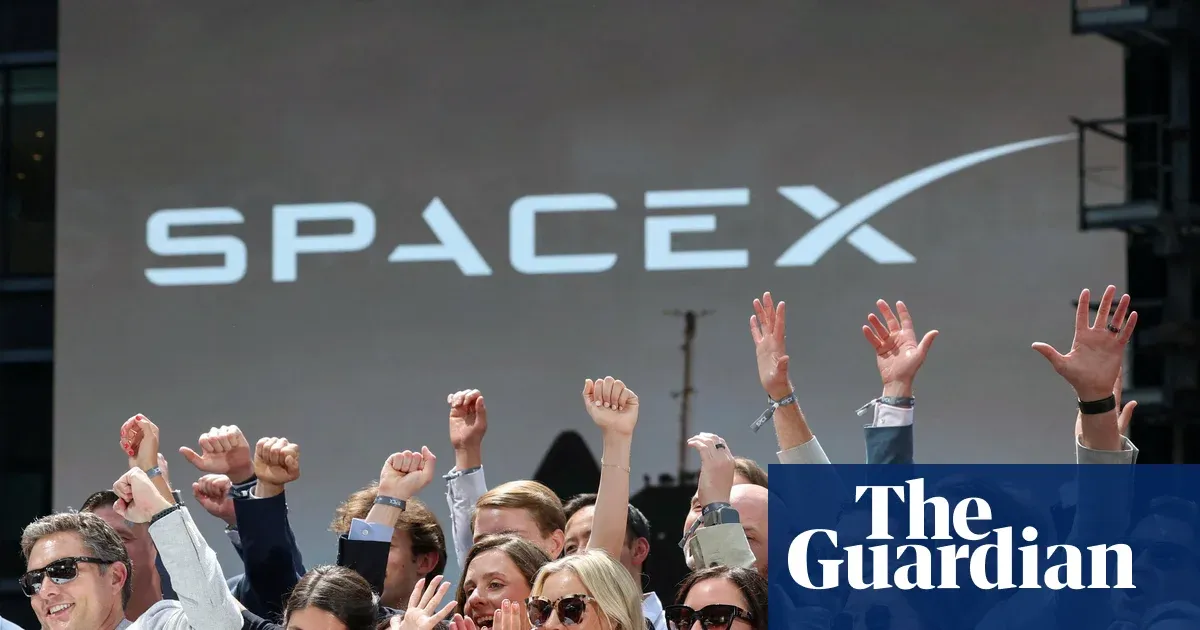
Elon Musk’s SpaceX briefly reached a $2.97tn valuation just days after its IPO, overtaking Amazon to become the world’s fifth most valuable company. The move coincided with SpaceX agreeing to buy the startup behind the AI-powered coding app Cursor for $60bn.
SpaceX briefly reached a $2.97tn valuation days after its IPO, and in the process it overtook Amazon to become the world’s fifth most valuable company. That is the kind of headline number that usually needs a longer explanation. Here, the explanation is baked into the timing: the valuation spike came days after SpaceX agreed to buy the startup behind Cursor, an AI-powered coding app, for $60bn, or about 44bn pounds.
So the plot is not just “rocket company gets rich.” It is “rocket company gets rich while buying an AI coding tool at a size that looks more like a mega-merger than an experiment.” SpaceX’s briefly achieved valuation peak at $2.97tn happened as markets digested both its public-market debut and the market signal embedded in the Cursor acquisition. The Cursor deal is explicitly framed as an attempt to capitalize on the coding app’s success as a tool for building software. In other words, the valuation is not merely financial. It is strategic, and the market is reacting to the idea that SpaceX thinks AI software capability can be a serious lever, not a side project.
To understand why investors and boards are paying attention, you have to look at how valuations behave around public debuts and big acquisitions. IPOs can create an initial trading burst, because public-market investors suddenly get a way to price the company with liquidity and benchmark multiples. But acquisitions, especially large ones, are the second ingredient. They can reframe the company’s long-term revenue pathways, asset mix, and competitive posture. When a newly public company also announces a massive deal, it turns the IPO day story from “will it list at a premium” into “what does it want to become?” That dual narrative is exactly where SpaceX landed.
The Cursor deal matters for another reason: it is an AI tooling purchase, not a typical vertical integration move. Cursor is an AI-powered coding app, and the source describes SpaceX’s reasoning as capitalizing on its success as a coding tool. That is relevant beyond software hobbyists. Coding tools are increasingly upstream in the development pipeline. They can accelerate iteration cycles and reduce friction for developers. When a company buys the startup behind such a tool, it is not only buying a product. It is buying access to talent, systems, and a workflow that could become deeply embedded in how software gets built. The second-order implication for boards at other AI-adjacent companies is straightforward: the definition of “strategic buyer” can expand quickly from tech firms to companies outside the usual software universe.
There is also a capital and governance angle hiding under the hype. When a company with a huge new public-market valuation engages in a $60bn acquisition, decision-making, financing structure, and risk tolerance become central. Even though the source only states that SpaceX agreed to buy the Cursor startup, boards elsewhere will immediately ask what this type of deal signals about management priorities. Is management willing to deploy massive capital into AI to change the company’s trajectory? Is the deal sized to be durable despite market volatility? For executives, the answer is less important than the question, because the market is already pricing the behavior.
Regulatory framing is less about the immediate headline and more about what usually follows when an acquisition hits that scale. Deals of this magnitude typically attract scrutiny around competition, data handling, and market power. Even if the source does not detail regulators in this specific story, the ecosystem reality is that a $60bn transaction will be reviewed as a potential consolidation of capabilities and market influence. For SpaceX, which operates across aerospace and now appears to be reaching into AI coding infrastructure, regulators may focus on whether the acquisition could limit access for competitors or change how AI software is distributed. For other large acquirers, the lesson is that AI deals are not exempt from the classic merger playbook. Scale does not remove oversight. It often increases attention.
Finally, the competitive optics of overtaking Amazon are not subtle. Amazon is a giant in consumer commerce, logistics, and cloud services. For SpaceX to become the world’s fifth most valuable company, briefly no less, signals how markets can reward narrative convergence: capital markets, technology ambition, and acquisition timing. The underlying stake for decision-makers in similar roles is simple and immediate. If AI coding tools are becoming assets worth $60bn, then every board should assume the strategic frontier is moving. Not in a vague “AI is important” way, but in a very concrete, valuation-driven way that changes who gets bought, who gets copied, and how quickly companies reallocate capital.
In short: SpaceX’s $2.97tn valuation moment is a stock-market story, but it is also an AI acquisition story. And the combination tells boards and executives something they will not be able to ignore tomorrow: AI tools can pull even the most traditional industry actors into the center of global capital allocation, fast.
This story's Key Insights and Take-aways are locked.
Create a free account to unlock Executive Actions for one credit.
Register to UnlockAlways free for Executives Club members. Join the Club
More in Business

Anthropic’s Levant Alpöge cracks the Jacobian conjecture after 87 years
A Harvard valedictorian used Claude to hit a 1939 breakthrough, but the missing “why” is the real problem.

Uber buys Delivery Hero for nearly $15B, vaulting to top food delivery outside China
The deal doubles Uber's dual-services footprint and pushes a ride-and-eats bundling play into 50 more markets.

Epic and Google drop settlement bid, forcing rival Android app stores by July 22
Google told the court it is ready to carry third-party app stores starting Wednesday, July 22.