
SpaceX's first surviving Starship returns to Starbase after 24-day sea ordeal
Ship 40's intact splashdown gives SpaceX a rare chance to study flown hardware and could shape the next launch and the first upper-stage catch attempt.
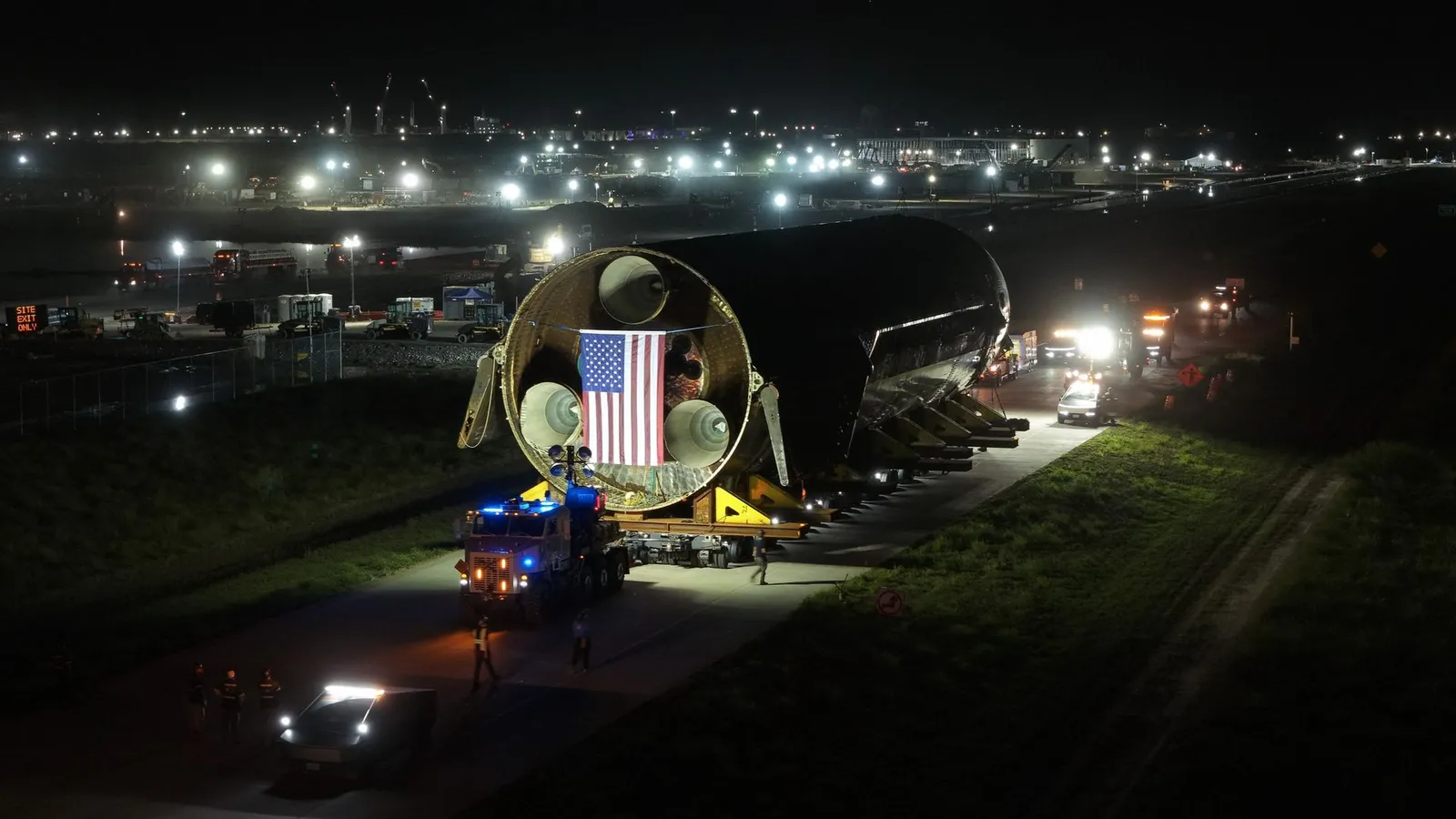
SpaceX has returned Ship 40, the first Starship upper stage to survive an ocean splashdown, to its Starbase facility in Texas. Engineers will now study the flown heatshield, Raptor engines, and avionics to inform future reusability and the next flight attempt.
Nearly three months after it left the ground, SpaceX's Ship 40 is home. The Starship upper stage, the first to survive a launch to space and an ocean splashdown, has been moved upright inside Starbase's Megabay in South Texas, alongside three sister ships still under assembly. The spacecraft arrived at the Port of Brownsville on Oct. 7 aboard the semi-submersible transport ship Forte, wrapping up the longest leg of a journey that crossed air, space, and sea. Its return gives SpaceX engineers an unprecedented piece of hardware to study: a flown Starship heatshield, Raptor engines, and avionics that endured the brutal conditions of atmospheric reentry.
The milestone was anything but guaranteed. Ship 40 launched on July 24 atop Super Heavy Booster 20 on the vehicle's 13th flight test, completing a suborbital trajectory that ended in a controlled splashdown in the Indian Ocean. Previous Ship upper stages had exploded after tipping over in the water. This one stayed largely intact and afloat, an unexpected survival that prompted SpaceX to attempt an ambitious recovery. The company towed the 171-foot stage through rough seas for 24 days to reach the calmer waters off Australia's Christmas Island, where engineers inspected the vehicle and collected heat shield samples. Even SpaceX CEO Elon Musk expressed doubts the recovery would succeed. From Christmas Island, Forte carried Ship 40 across the ocean to Texas, and the stage was then transported over land and lifted vertical outside the Megabay before being moved inside.
Why does a single recovered upper stage matter? Because Starship is designed to be fully and rapidly reusable, and the upper stage has been the hard part. SpaceX has already caught three Super Heavy boosters with the mechanical arms of its Starbase launch tower, but no Starship upper stage has ever returned to its launch site under its own power. Ship 40's return is a chance to study, top to bottom, the hardware that actually survived reentry and splashdown. That data will feed directly into the design of future vehicles and recovery operations, helping SpaceX fine-tune the systems needed to bring an upper stage back to the tower, not just the ocean.
The timing is tight. Ship 40's immediate successor, Ship 41, launched on Flight 14 before Ship 40 made it back to Starbase. Flight 14 marked Starship's first orbital flight and successfully deployed 26 next-generation Starlink V3 satellites, but Ship 41 did not survive its splashdown in the Pacific Ocean. Musk has said Flight 15 could feature the first attempt to catch the Ship upper stage using the same chopstick-like arms on the launch tower, provided the spacecraft meets the conditions for a safe return. SpaceX has not announced an official launch date, but based on testing progress, the next flight is likely within the next month or so.
For executives watching from outside the aerospace bubble, the takeaway is about the economics of iteration. SpaceX is treating each flight as a data-gathering experiment, and the recovery of Ship 40 is a direct payoff of that approach. Every intact component is a lesson in what survives the most extreme environment in the industry. That translates into faster design cycles, lower per-launch costs, and a widening gap between SpaceX and competitors still working to make their first reusable stages routine. For customers, from satellite operators to government agencies, the implication is a launch market with more capacity and, eventually, lower prices.
The broader context: Starship is not just a rocket; it is the backbone of SpaceX's plans for heavy payloads, megaconstellations, and deep-space missions. The ability to recover and reuse the upper stage is the missing piece in a fully reusable system. Ship 40's homecoming is a quiet but significant step toward that goal, and the data it yields will shape not only Flight 15 but every flight after it. For peers in aerospace and adjacent industries, the lesson is simple: the companies that build feedback loops between real-world failures and engineering changes are the ones that compound progress fastest.
This story's Key Insights and Take-aways are locked.
Create a free account to unlock Executive Actions for one credit.
Register to UnlockAlways free for Executives Club members. Join the Club
More in Business

Elon Musk unveils a flying car, and SpaceX helped build it
The Tesla CEO's showcase at a SpaceX facility signals a future where road and rocket engineering converge.

Apple's $2,000 iPhone Duo opens preorders, taking on Samsung and Google
Apple's first foldable hits the market at a premium price, reshaping a category Samsung and Google have led.

Pope Leo XIV, first American pope, diagnosed with lung cancer
The 71-year-old Chicago-born pontiff underwent successful surgery on his right lung, and his diagnosis raises new questions about his AI-focused papacy and the Vatican's future.