
Spain become first to hold men’s and women’s World Cups together, and dominance looks intentional
A rare double crown explains how one nation built depth across squads, not just one tournament peak.
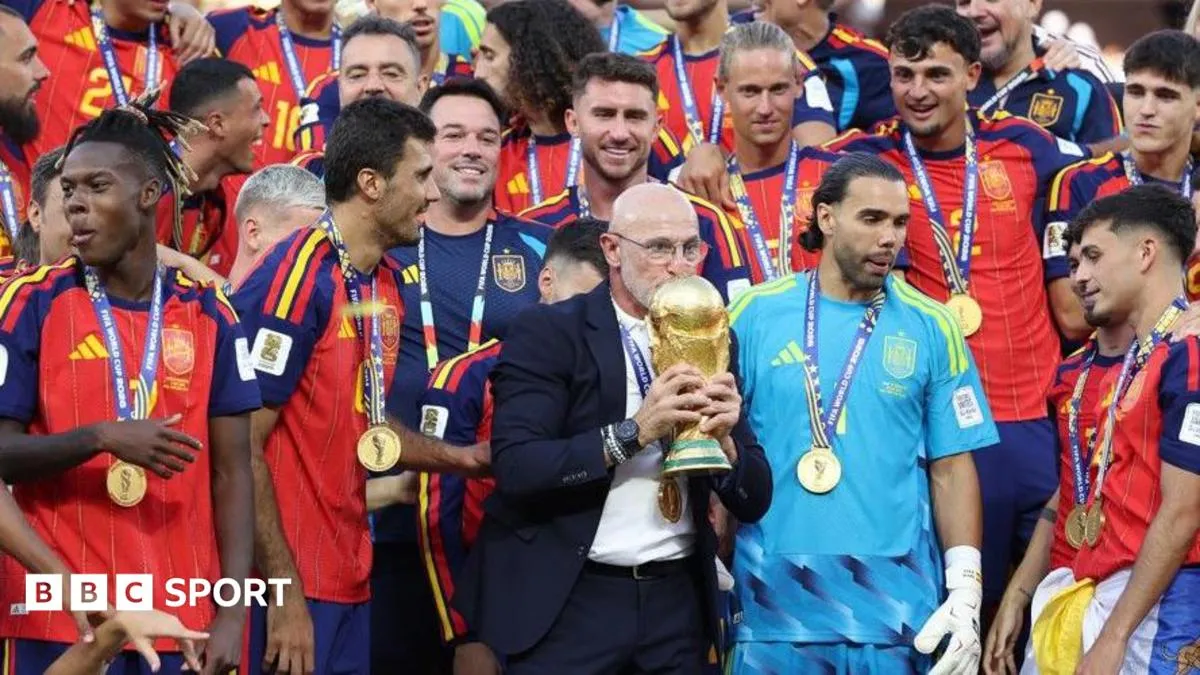
Spain have become the first nation to be men’s and women’s World Cup champions at the same time. The development matters because it turns “talent pipelines” from a feel-good slogan into an operating system other football executives will want to understand.
Spain have done something that is almost designed to be a stress test for the usual explanations. They are the first nation to be men’s and women’s World Cup champions at the same time, and the BBC Sport focus is on what sits behind that kind of dominance.
The key point for decision-makers is that this is not presented as a lucky timing coincidence. The story is framed as “sixteen titles in five years” and “why Spain are a dominant force,” which implies a pattern across competitions and across both the men’s and women’s game. When one country can win at the top of the sport in two categories at the same time, it signals something structural: coaching continuity, player development depth, and the ability to scale performance rather than spike it.
To understand why this matters, you have to translate tournament football into an operations problem. Teams do not just select a squad for a single run. They build systems that keep producing players who can survive pressure, change game states quickly, and execute under different refereeing interpretations, tactical matchups, and physical demands. When Spain show up simultaneously at the highest men’s level and the highest women’s level, the implication is that their model is not confined to one pathway. It has to work across age groups, across leagues, across coaching appointments, and across talent identification.
This is where the “dominant force” framing becomes relevant beyond fandom. Many football conversations get stuck in either culture talk (the vibe, the mentality) or star talk (one generational talent). A double World Cup moment pushes the argument back toward management. It suggests that Spain have built repeatable inputs: recruiting and scouting routines, a consistent technical identity, and development environments that produce players who fit the national team’s demands.
There is also a governance angle. Modern football operates inside a regulatory and commercial ecosystem that rewards measurable output. UEFA and FIFA competition structures create calendars that can compress or stretch competitive advantage depending on how federations manage playing time and youth investment. In that context, dominating in both men’s and women’s football at the same time is not only a sporting achievement. It is a credibility event for any boardroom tasked with deciding where to allocate resources, how to structure academies, and what success metrics to prioritize.
The BBC Sport storyline does not spell out specific internal decisions in the excerpt, but the way it is described still has strategic meaning. It explicitly connects Spain’s dominance to the idea of sustained winning, not one-off brilliance. “Sixteen titles in five years” reads like an output dashboard, and “dominant force” is the performance conclusion. When you see that combination with both genders represented at World Cup champion level simultaneously, you are looking at a system that can manage variance. Tournaments are chaotic. Injuries happen. Form changes. Opponents adjust. To win repeatedly across that volatility, you need resilience in selection and preparation.
Second-order implications follow fast. For executives across football clubs and federations, Spain offer a template to benchmark. Not copy, not replicate overnight, but benchmark. The question shifts from “How do we find the next star?” to “How do we build a pipeline that supplies match-ready talent year after year, in both pathways?” It also changes how leaders think about coaching education and staff stability. A successful model often requires people who understand the same principles deeply, and that means hiring and development practices that keep doctrine intact even when staff changes.
There is one more strategic layer: the market optics of a dual crown. Winning at the highest level drives sponsorship interest, youth participation, media attention, and brand power. That can reinforce the development loop. If more girls and boys see a clear route to elite performance, the talent base widens. Boards then face a feedback cycle where investment can translate into credibility, and credibility can translate into investment. Spain’s first-ever simultaneous men’s and women’s World Cup championship is, in that sense, both a sporting milestone and a capital narrative.
For other countries and organizations, the stakes are straightforward. If Spain’s dominance is rooted in repeatable systems, then rivals cannot rely on “finding form at the right time.” They have to build structures capable of scaling performance across competitions and across genders. In a sport where time is always running and budgets are always contested, a country that can win both titles at once forces everyone else to revisit their assumptions about development, governance, and the operational mechanics of excellence.
This story's Key Insights and Take-aways are locked.
Create a free account to unlock Executive Actions for one credit.
Register to UnlockAlways free for Executives Club members. Join the Club
More in Entertainment

12TB Steam 'teraleak' goes beyond Valve: GTA 3, Mafia 2 prototypes exposed
A 12-terabyte dump of Steam data reveals prototypes and builds of third-party classics like GTA 3 and Mafia 2, plus unreleased Valve content, rewriting game history.

LinkedIn's romance problem: 1 in 4 workers say dating on it is fair game
A new survey shows a quarter of U.S. employees treat the professional network as fair game for romance, even as LinkedIn bans it and removes hundreds of thousands of offending posts.

Enhypen's first No. 1 album breaks K-pop's Billboard 200 streak
The K-pop group's 98,000-unit debut tops the chart while Dolly Parton's catalog reentry shows how death reshapes streaming.