

Tesla Autopilot swerves into garage door in Redmond, Washington; police investigate Monday
A driver says self-driving malfunctioned before the crash. Here is what it signals for liability, safety claims, and oversight.
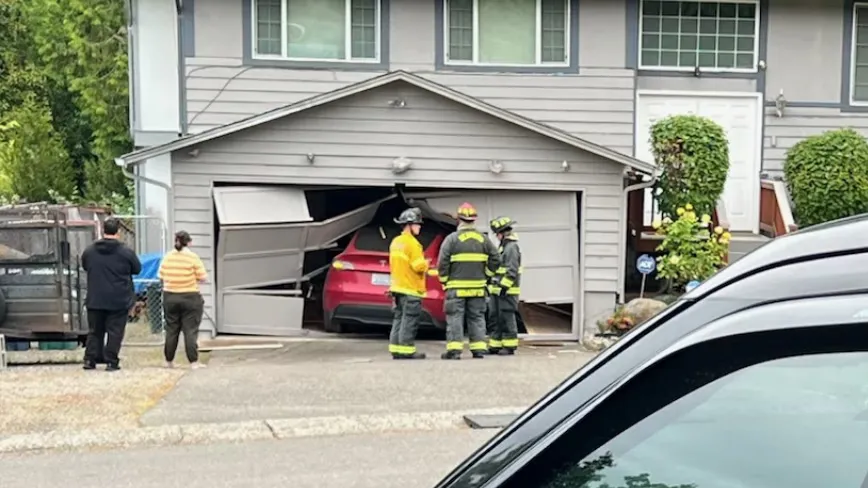
A Tesla driver in Redmond, Washington says the car's self-driving mode malfunctioned before it swerved into a residential garage door on Monday. Police responded around 11 AM and are investigating, with no injuries and no indications of impairment reported.
A Tesla driver in Redmond, Washington claims the car's self-driving mode malfunctioned before it swerved into a residential garage door on Monday. Police responded around 11 AM, and investigators are working the case now, not later.
The crash was loud and expensive even before the paperwork started. The car smashed the door open and ended up lodged inside the garage, according to the report, and no injuries were reported. The driver also reported no indications of impairment, meaning investigators do not currently have signs suggesting the driver was intoxicated or otherwise impaired.
That combination, a claimed Autopilot or self-driving malfunction with no injury and no impairment signals, is exactly the kind of scenario that tends to push conversations from “cool demo” into “who bears responsibility.” In the real world, when an advanced driver assistance feature is involved, the key questions are not abstract. Was the system engaged? What did it do immediately before the incident? Did the driver follow the system's prompts? And most importantly, did the system behave in a way the manufacturer would expect under those conditions?
For executives and boards, the risk here is not only the garage door. It is the operational and legal chain reaction that follows an incident involving automated driving. Even when there is no injury, a physical crash can trigger a broader review. Regulators and plaintiff lawyers tend to look for patterns, and incident reports become raw material for future scrutiny of how safety claims are framed, how software behavior is monitored, and how incident narratives are documented.
There is also a market-side implication: every such incident becomes part of the public mental model around driver assistance. Investors and enterprise buyers often treat safety as a leading indicator. Not because one crash equals a product failure, but because repeated incidents shape perception, policies, and underwriting assumptions. If customers believe a system can “just fail” at the wrong moment, adoption slows. If lawmakers believe companies are unclear or inconsistent about responsibility, oversight tightens. Both outcomes hit business outcomes, not just headlines.
In the background is how these systems are positioned legally and commercially. Features like Autopilot are marketed as driver assistance or partial automation, but they also blur the boundary between driver tasks and vehicle control in the public imagination. That is why the wording of incidents matters. The report says the driver claims the self-driving mode malfunctioned. Even if that claim is disputed or later corrected by investigators, it sets up the central tension: customers want the benefit of automation. Regulators and courts often want clarity on what level of control the vehicle has, and what level of responsibility remains with the driver.
There is another second-order effect that boards should care about: incident response discipline. When a crash occurs, the speed and quality of internal logging, data preservation, and communications determine how messy the investigation becomes. Police are already investigating. The company will likely need to align technical understanding with facts that emerge from the scene and the driver statement. If narratives diverge, the case becomes harder to manage and easier to politicize.
Finally, this is a reminder that the “edge cases” of real roads show up in residential places, not only test tracks. A residential garage door is a blunt object lesson about the consequences of misjudged control at low to moderate complexity environments. For peers building or operating advanced driver assistance systems, the stakes are the same even if the headlines differ: how quickly software is improved, how transparently incidents are handled, and how well safety practices hold up when something goes wrong.
This story's Key Insights and Take-aways are locked.
Create a free account to unlock Executive Actions for one credit.
Register to UnlockAlways free for Executives Club members. Join the Club
More in Technology

OpenAI says 10,000 agents cracked a 90-year math problem in 88 hours
The company's claim is audacious, but one mathematician is pushing back. Here's what it means for AI-driven discovery.

Meta still serves child sexual abuse ads on Instagram in India - BBC report
A new report following the BBC Eye investigation says the ads are still there - what it signals for every platform with a self-serve ad engine.
White House yanks 'Build the Wall' game after Tetris Company copyright warning
The administration's arcade game vanished in hours - and the takedown playbook every brand can learn from.