

The 378-pixel implant that restores sight in macular degeneration
Approved in Europe, awaiting FDA clearance, this implant restores sight without a battery.
Science Corporation's Prima system, with medical director Frank Brodie, an ophthalmologist at UCSF, has won European approval and awaits FDA clearance for restoring vision in AMD patients. For decision-makers, it is the first treatment to restore sight in a condition affecting more than 5 million people, signaling a new category in ophthalmic devices.
The 378 pixels in Science Corporation's Prima implant are tiny, but they just did something no treatment has ever done: restore sight for people with age-related macular degeneration (AMD), a condition that blinds more than 5 million people worldwide. The system, approved in Europe in July and awaiting FDA clearance in the US, replaces the photoreceptors that die off in advanced AMD, giving patients a way to read, do crosswords, and use their phones again. After training sessions, more than 80% of recipients could do exactly that.
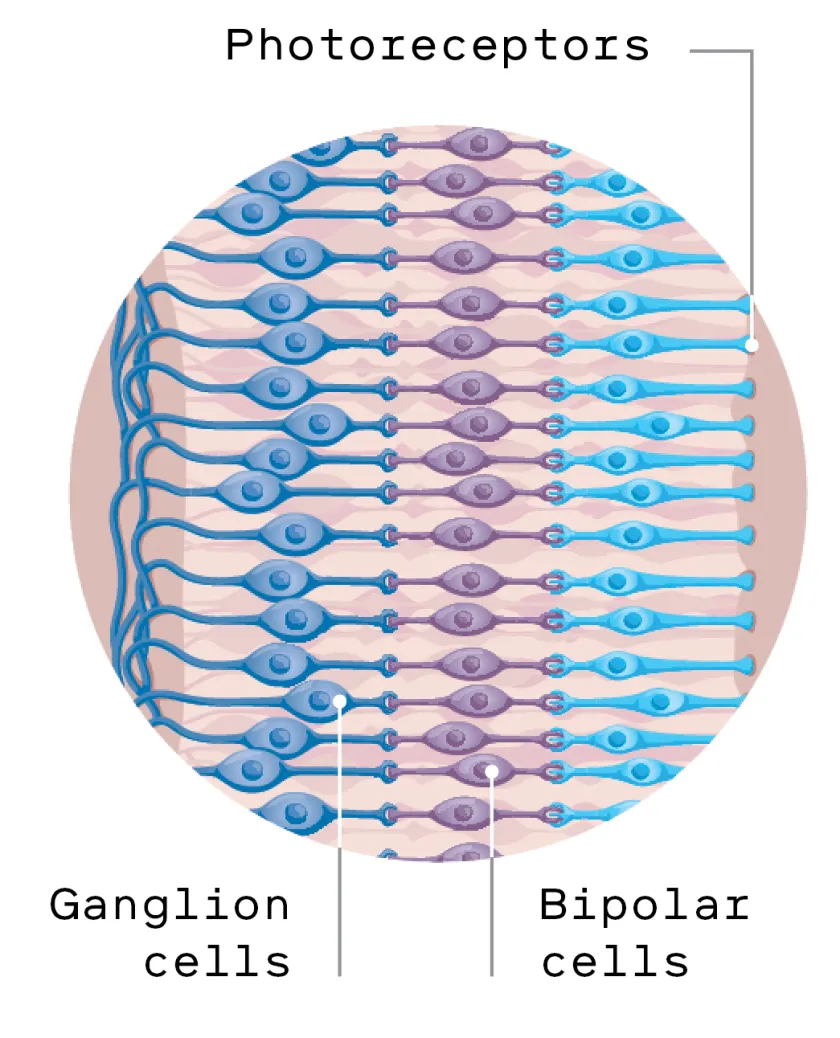
The retina normally processes light in three layers: photoreceptors convert light into electricity, bipolar cells process that signal, and ganglion cells transmit it to the optic nerve and brain. AMD destroys only the first layer, the photoreceptors. Prima exploits that quirk. Its implant mimics photoreceptors and sends visual information directly to the healthy bipolar and ganglion cells, which carry it to the brain. "We're leveraging all of the body's own natural functions to process and transmit the information," says Frank Brodie, an ophthalmologist at the University of California, San Francisco, and medical director for Prima.
The hardware is a two-part system. A pair of glasses carries a miniature front-facing camera that captures what the wearer sees in real time, roughly five megapixels at 30 frames per second, similar to TV. The video travels through a fiber-optic cable to a small handheld processor that can sit on a table or in a pocket. That processor converts the feed into infrared light signals and routes them back to the glasses, where a laser projector shines pulses of near-infrared light at 880 nanometers, an invisible wavelength, through the pupil and onto the implant.
The implant itself is a 378-pixel chip, each pixel with an electrode and two photovoltaic cells. Those cells do double duty: they convert the incoming light into an electrical current that healthy retinal circuitry passes to the brain, and they act as solar cells to power the chip. No battery is needed. The wearer can adjust contrast, brightness, and zoom with physical buttons on the processor.
The clinical results are the headline. More than 80% of recipients, after training, could read, do crosswords, and use their phones. That is a meaningful functional gain, not just a measurable improvement on a vision chart. For a condition that has had no treatment capable of restoring vision, this is a step change.
The regulatory path matters as much as the technology. European approval in July gives Science Corporation a beachhead, and FDA clearance in the US would open the world's largest device market. For executives in medtech, the playbook is familiar: get a first-mover advantage in a large, aging patient population, then build a franchise around it. AMD is one of the most common causes of vision loss in older adults, and with more than 5 million people already affected globally, the addressable population is only growing as populations age.
The design choices also signal where the industry is heading. By eliminating the battery and using the body's own circuitry, Prima reduces the complexity and risk that have historically weighed on implantable devices. That could lower the barrier to adoption and make the device more attractive to health systems and payers. For competitors, the bar has just been raised.
For executives watching from the sidelines, the lesson is about timing and focus. Science Corporation targeted a specific, well-understood pathology, the death of photoreceptors, and built a device that works with the body rather than replacing it. That is a template for any company developing implants for the eye, the ear, or the brain. The first mover in a category with no existing treatment doesn't just win market share; it defines the standard of care.
This story's Key Insights and Take-aways are locked.
Create a free account to unlock Executive Actions for one credit.
Register to UnlockAlways free for Executives Club members. Join the Club
More in Business

Elon Musk unveils a flying car, and SpaceX helped build it
The Tesla CEO's showcase at a SpaceX facility signals a future where road and rocket engineering converge.

Apple's $2,000 iPhone Duo opens preorders, taking on Samsung and Google
Apple's first foldable hits the market at a premium price, reshaping a category Samsung and Google have led.

Pope Leo XIV, first American pope, diagnosed with lung cancer
The 71-year-old Chicago-born pontiff underwent successful surgery on his right lung, and his diagnosis raises new questions about his AI-focused papacy and the Vatican's future.