

Titanoboa may have a rival: a 50-foot snake from ancient India
Vasuki indicus, a 47-million-year-old predator, could match the legendary Titanoboa and rewrite what we know about giant snakes.
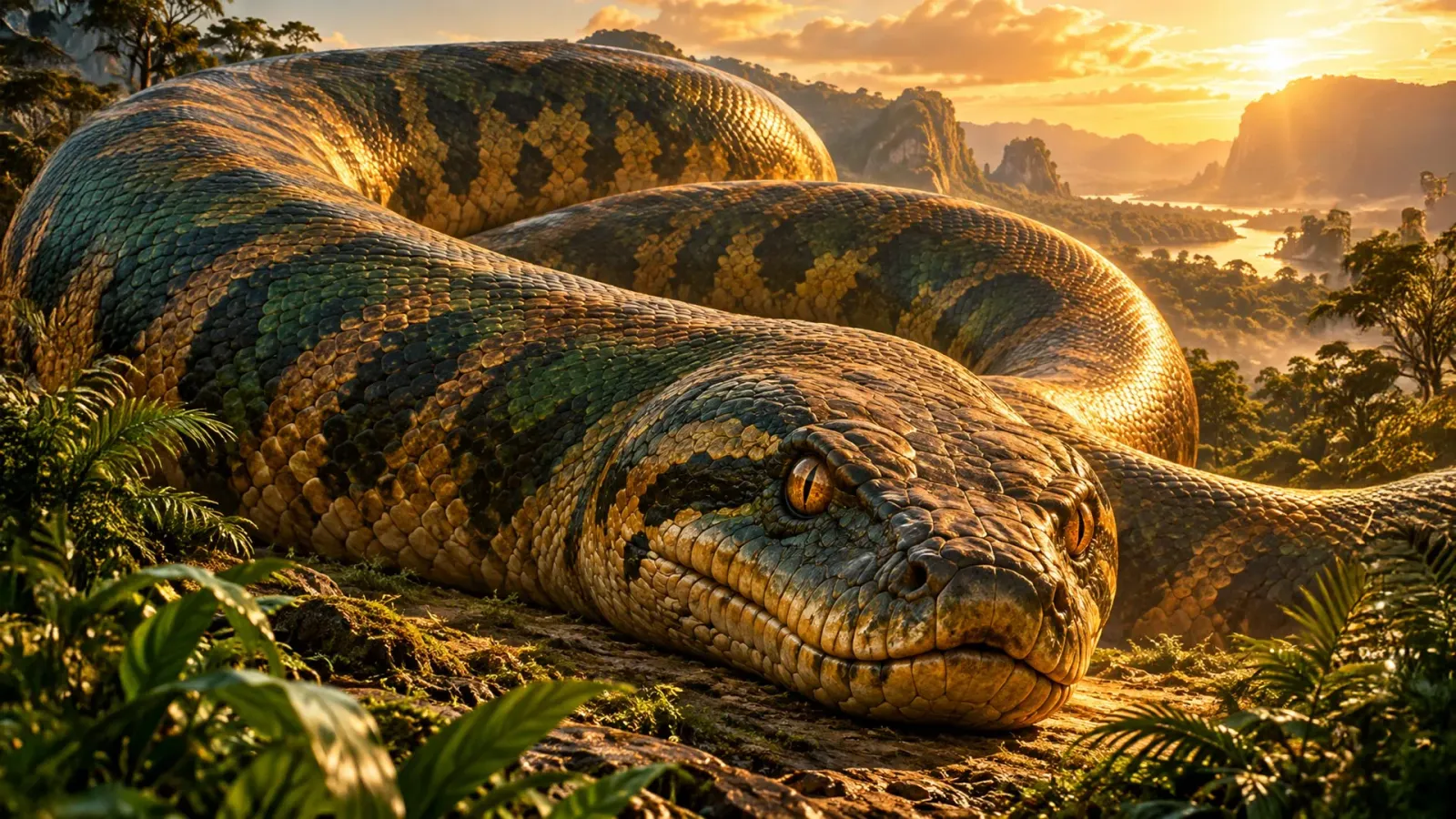
Paleontologists have identified Vasuki indicus, a 47-million-year-old snake from India that may have reached up to 50 feet, placing it in the same size class as Titanoboa, long considered the largest snake ever known. The discovery challenges the assumption that giant snakes were a South American phenomenon and signals that ancient India's ecosystems could support apex predators on a scale previously unimagined.
Titanoboa may finally have company. Paleontologists have identified Vasuki indicus, a 47-million-year-old snake from India that could have reached up to 50 feet long, placing it in the same weight class as the legendary Titanoboa, long considered the largest snake ever known. The name comes from Hindu mythology, where Vasuki is the serpent king who coils around the neck of the god Shiva. It is a fitting name for a predator that may have been the undisputed king of its ecosystem. The discovery, based on fossil evidence analyzed by scientists, is the kind of find that forces a rewrite of the natural history books.
To put 50 feet in perspective: that is roughly the length of a bowling lane, or about three cars parked end to end. Titanoboa, discovered in Colombia and typically dated to around 58 to 60 million years ago, has held the title of largest snake ever for years, with most estimates landing in the 40-to-50-foot range. Vasuki indicus now gives Titanoboa genuine competition, and it shifts the geography of giant snakes from South America to South Asia.
How do scientists know how long a snake that died 47 million years ago could get? Paleontologists typically estimate the size of extinct snakes by measuring fossilized vertebrae and comparing them to living species, then extrapolating total length. The estimates for Vasuki indicus place it squarely in Titanoboa territory, though the source notes it could have reached up to 50 feet, a range rather than a certainty. Even a conservative reading leaves a snake far larger than any living today.
The more intriguing part is how this giant likely lived. Scientists believe Vasuki indicus was a slow-moving ambush predator, not a fast chaser. Think of a modern anaconda lying in wait rather than a snake that runs down its prey. Its enormous body would have made speed impractical, so it likely relied on surprise and constriction, ambushing animals that wandered within striking range. Modern green anacondas, which can reach 20 to 30 feet, use the same playbook today, hunting from the water and crushing prey before swallowing it whole. That strategy has clearly stood the test of time.
The find also says something about the world Vasuki indicus inhabited. The Eocene epoch, roughly 56 to 34 million years ago, was one of the warmest intervals in Earth's history, and paleontologists have long noted that giant snakes tend to appear in warm climates. Reptiles are cold-blooded, and sustained heat allows them to grow larger. A 50-foot predator in ancient India implies a landscape with abundant prey and a climate warm enough to sustain an animal of that size. For context, the Indian subcontinent was colliding with Asia around this time, a tectonic collision that would eventually raise the Himalayas. The discovery hints that this landmass, even as it collided with Asia, hosted giants of its own. It is a useful reminder that ecosystems, like markets, are shaped by their underlying conditions.
For executives and operators, the discovery is a reminder that the record books in any field are provisional. Titanoboa's crown lasted for years; one well-preserved fossil can overturn it. The same logic applies to market assumptions, competitive moats, and technological roadmaps. The thing everyone 'knows' is true is often one data point away from being wrong. The companies that stay curious about the evidence that might contradict them are the ones that survive the rewrites.
The deeper lesson is about how knowledge compounds. Paleontology is a slow, often underfunded science. Fossils take years to excavate, prepare, and analyze, yet the field keeps producing findings that reshape our understanding of life on Earth. The same is true of long-horizon research in business. The projects that look like they are going nowhere can be the ones that redefine a field a decade later. Vasuki indicus was buried for 47 million years before anyone noticed. Some of the most valuable insights in your industry may be buried in data you have not looked at yet.
Vasuki indicus may or may not hold the record when the final measurements are in. Paleontologists will keep debating the estimates, and future discoveries could push it down the list. But the discovery has already accomplished something more important. It proved that the largest snake ever known may have had company, and that the next record-breaking find could be hiding anywhere. In India, in a museum drawer, or in the assumptions your organization stopped questioning years ago.
This story's Key Insights and Take-aways are locked.
Create a free account to unlock Executive Actions for one credit.
Register to UnlockAlways free for Executives Club members. Join the Club
More in Science

Alaska's 1,580-foot tsunami had warning signs. Scientists just found them.
Rapid glacier retreat, heavy rainfall, and thousands of tiny tremors preceded Alaska's 1,580-foot tsunami, a warning for every coastal community in a warming world.

The rare mutation that lets high-risk brains dodge Alzheimer's
Scientists found a natural defense against protein buildup, opening a new path to preventive treatments.

3,000 steps a day may halve Alzheimer's decline, study finds
New research links a modest daily walk to less tau buildup and nearly half the cognitive and functional decline, even for those with early signs.