
Apple’s Siri orb on visionOS makes interfaces visible, unlike Copilot and Gemini buttons
A glowing, light-casting Siri UI on Vision Pro underscores how AI UX can either guide users or annoy them.
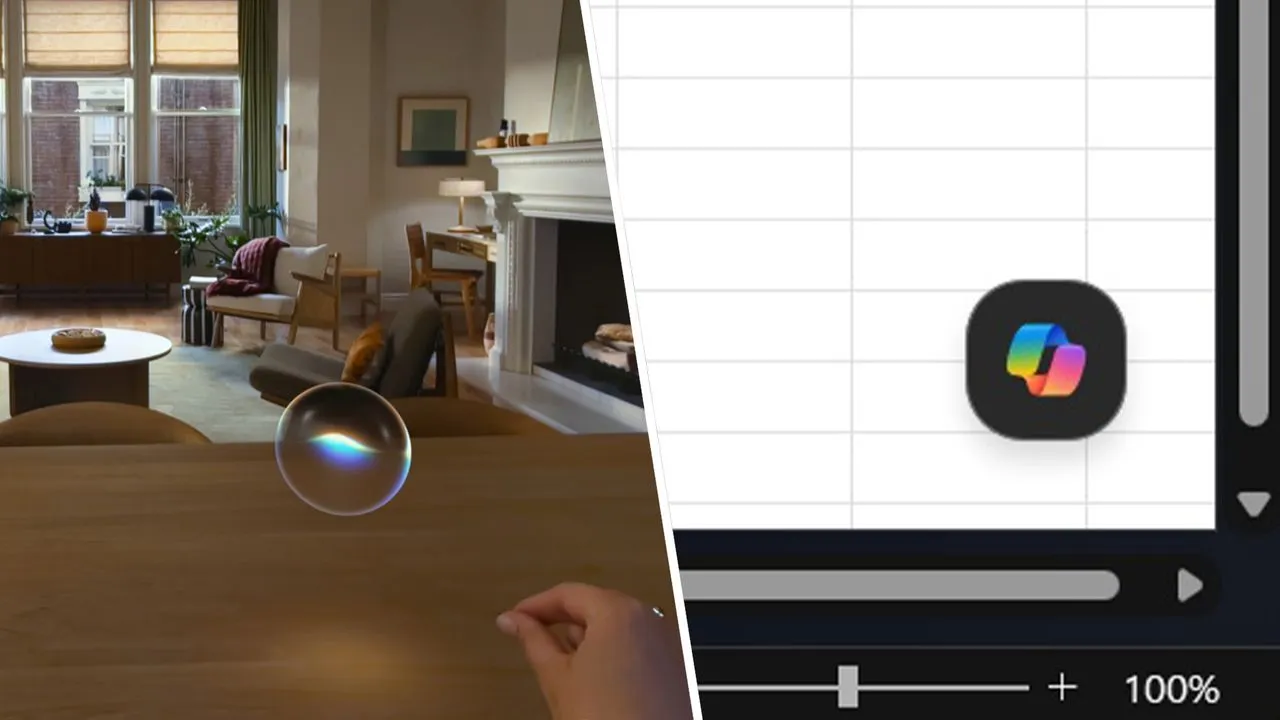
Apple is rolling out an updated, fully AI-powered Siri across its operating systems, with developers already able to access it, and visionOS getting the most striking interface. For decision-makers, the Siri orb highlights a fast-growing risk in enterprise AI: UI friction can erase AI’s benefits before users ever “try the feature.”
AI is getting bolted onto everything these days, whether apps and operating systems want it or not. That makes the user interface the real battlefield, not the model, not the marketing slides. And in that fight, Apple’s new Siri interface for visionOS is acting like a neon sign that points at a simple truth: in virtual and augmented reality, UI decisions change how the entire environment feels.
Later this year, an updated, fully AI-powered version of Siri will make its way to all of Apple’s operating systems, though developers can already access it. On visionOS, the software that powers the Apple Vision Pro, the interface is not subtle at all. Instead of a standard overlay or a static icon, Siri appears as a glowing ball you can move around in the virtual world, demonstrated in a post on X by Brad Lynch, project manager at EOZ VR. The first detail that makes it stick is also the weirdly important one: the orb casts environmental lighting, so surfaces and objects in the scene appear “lit” by the Siri AI interface.
To understand why that matters, you have to picture what happens when UI lives inside a 3D space. With traditional 2D interfaces, a button can hover over content and still feel coherent, because the screen itself is the frame. In visionOS windows, however, visual cues like shadows and lighting are part of the illusion. The clip Lynch shared reportedly shows that visionOS windows appear flat and unnatural because they cast no shadows or light. Against that backdrop, the Siri orb’s environmental lighting effect becomes more than aesthetics. It’s a cue that the interface is part of the world you are interacting with, not a separate layer floating on top.
Apple’s effort is also being judged in a direct comparison the industry is already having with Google and Microsoft. On one side, Apple is presenting an interface that, at minimum, tries to make the experience feel consistent with the environment. On the other, Google and Microsoft are using “unaccommodating” approaches for their AI assistants, specifically Gemini and Copilot. If you open a recent version of Excel, the source says you get a Copilot button that hovers over the spreadsheet. You cannot move the icon yourself, and you can only “dock” it to the edge of the window. Even then, it overlaps cells, and the only way to solve the problem is to disable Copilot entirely through File > Options > Copilot.
That is where the bigger stakes live for executives. Enterprise software is already full of feature creep. Add an AI layer that users cannot control, and you create a new kind of friction that is very hard to undo. The source also notes a contrast with Google’s products: Gemini icons “festoon every application,” and first-run instructions routinely pop up, even if you frequently acknowledge or dismiss reminders. Whether the goal is onboarding, accessibility, or surface-area for adoption, the result is the same from a user’s perspective: extra steps, extra clutter, and the feeling that the AI is interrupting the work instead of helping it.
Now, to be clear, the source is not arguing that Apple’s Siri orb is a miracle of design or coding. It is making a narrower point, and it’s a point that translates directly to product strategy. The interface “puts the user’s experience first, over everything else,” while Google and Microsoft, as characterized by the source, have been less attentive to that same experience. In other words, Apple is not just shipping AI. Apple is shaping the interaction model: where the assistant lives, how it behaves, and how it visually communicates without fighting the user’s task.
There is also a second-order implication here for companies that build on top of these platforms. Developers get early access to Siri’s AI capabilities, but the user-facing wrapper matters just as much as the underlying intelligence. A glowing, movable orb is a radical UI choice for visionOS, but it’s also a clue that the assistant is being designed as an ambient presence, not a modal intrusion. In VR and AR, that difference can decide whether users feel in control or constantly managed.
Finally, the regulatory and procurement angle is worth taking seriously, even if this specific story does not mention regulators directly. In many enterprises, AI features get evaluated not only on accuracy or safety, but on usability, user control, and the risk of disruptive behavior in critical workflows. If Copilot overlays hamper spreadsheet use, or Gemini prompts keep reappearing no matter how often users dismiss them, that can affect internal adoption and budgeting. The strategic stakes are simple: AI that users can tolerate and control becomes a platform advantage. AI that annoys users becomes an IT ticket.
Peer companies, board members, and product leaders should take the lesson from Apple’s Siri orb literally. UI is not a “nice to have” layer. It is the interface between AI ambition and daily work. In a world where AI is getting shoehorned into every operating system and app, the winners will be the teams that treat the interface as product strategy, not decoration.
This story's Key Insights and Take-aways are locked.
Create a free account to unlock Executive Actions for one credit.
Register to UnlockAlways free for Executives Club members. Join the Club
More in Technology

OpenAI says 10,000 agents cracked a 90-year math problem in 88 hours
The company's claim is audacious, but one mathematician is pushing back. Here's what it means for AI-driven discovery.

Meta still serves child sexual abuse ads on Instagram in India - BBC report
A new report following the BBC Eye investigation says the ads are still there - what it signals for every platform with a self-serve ad engine.

White House yanks 'Build the Wall' game after Tetris Company copyright warning
The administration's arcade game vanished in hours - and the takedown playbook every brand can learn from.