
Dharmendra Pradhan resigns on Saturday after mass exam-paper leak protests demand his dismissal
The education minister stepped down after public fury over irregular exams, including leaks that forced more than 2 million to re-sit.
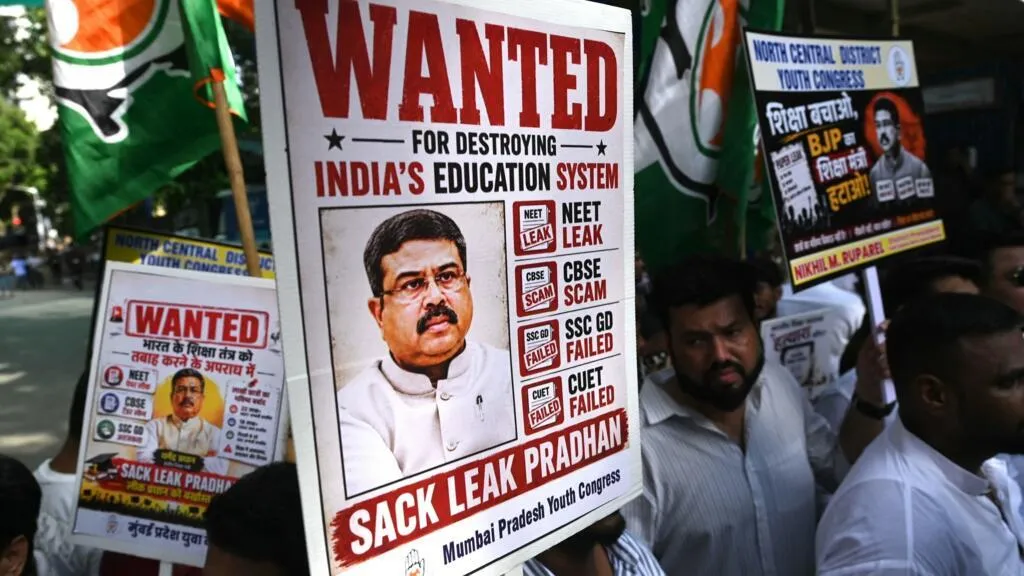
India's Education Minister Dharmendra Pradhan resigned on Saturday after mass protests calling for his dismissal. The fallout highlights how exam irregularities, including leaked medical entrance questions, are eroding trust in India's university testing system.
India's Education Minister Dharmendra Pradhan resigned from his post on Saturday, after mass protests erupted calling for his dismissal. The immediate trigger was a public reckoning over exam irregularities, including the leaking of a medical entrance question paper.
And it was not a small, theoretical failure. The source says the leak forced more than two million candidates to re-sit the test. That detail matters because re-sits are time and money for students, and they are reputational damage for the institutions that run testing. When millions have to redo high-stakes exams, the protest pressure stops being abstract and becomes existential.
To understand why this became a minister-level resignation, you have to look at what these exams do in India. University and professional admissions systems are built on tests that sort candidates at massive scale. That means the credibility of the exam is the product. If enough people believe the process was compromised, even honest scores stop carrying the same meaning. So the protests were not only about one wrong paper or one bad day. They were about whether the testing system is fair, secure, and competent.
The source links the unrest to “a series of exam irregularities.” That phrasing is doing heavy lifting. One irregularity can be handled as an operational incident, investigated, corrected, and contained. A series reframes the story as a governance problem: repeated failures can signal weak controls, flawed processes, and insufficient accountability. In that world, resignations are less about punishment and more about restoring a “permission to operate” with the public.
The medical entrance leak is especially consequential because it hits a highly competitive pathway with major downstream effects. If a question paper leaks, the advantage shifts instantly to anyone who had access, even if the rest of the exam remains intact. The immediate response in the source was a re-sit for more than two million candidates. That is a drastic mitigation step, and it points to the severity: the system appears to have concluded that the integrity of the original test could not be guaranteed.
But re-sits have second-order costs that often outlast the headlines. For candidates, they mean delays in education and career timelines, plus the administrative burden of participating again. For institutions, they mean higher operating complexity and the risk that public trust never fully returns, even after a redo. For regulators and policymakers, they create political pressure that is hard to manage through technical fixes alone, because people are not protesting a spreadsheet. They are protesting the belief that the rules were broken.
In this type of crisis, the minister’s role becomes a proxy for the entire testing ecosystem. That includes the government’s oversight of exam administration, the integrity measures meant to prevent leaks, and the accountability mechanisms used when irregularities are detected. When protests demand the minister’s dismissal, it is effectively a demand for visible responsibility at the top. Pradhan’s resignation, as reported, answers that demand directly.
There is also an institutional lesson here for executives and boards in adjacent sectors. Whenever an organization runs high-stakes evaluation, the integrity of inputs becomes the foundation for the credibility of outputs. When credibility fractures, remediation costs expand quickly. A leak is a security incident; a series of leaks is a governance crisis; and a system-level crisis can trigger leadership churn. In other words, the operational failure migrates into leadership risk.
For decision-makers watching from other regulated domains, the strategic stake is straightforward. Systems that score people, rank people, or gatekeep opportunity rely on trust as an asset. That trust is expensive to build and easy to lose. When protests can mobilize at scale and force re-sits for more than two million candidates, the political and reputational tail risk becomes central, not peripheral. In this case, the headline outcome was a resignation. The deeper implication is that integrity lapses can force entire institutions, and their leadership, into emergency mode, even if they are only trying to manage one bad exam cycle.
This story's Key Insights and Take-aways are locked.
Create a free account to unlock Executive Actions for one credit.
Register to UnlockAlways free for Executives Club members. Join the Club
More in Politics

LA County: DOJ's 20,000 'noncitizen' voter list is 'unreliable,' includes U.S.-born
Preliminary review by Los Angeles County election officials finds errors in the federal list, raising the stakes for voter roll integrity ahead of November.

Trump's $1.5B Pentagon chip investment lands in North Carolina
A $1.5 billion defense infusion for North Carolina chipmaking signals a new era of Pentagon-backed reshoring - here's what it means for the industry.

Nigeria confirms first Ebola case in Abuja, a woman just off a Uganda flight
Health Minister Muhammad Ali Pate says the patient flew in from Uganda, putting Africa's latest outbreak on Nigeria's doorstep.