
India’s “cockroach” party stops protests after minister resigns, ending pressure campaign
A protest pause tied to a resignation signals how quickly Indian political leverage can pivot when officials exit.
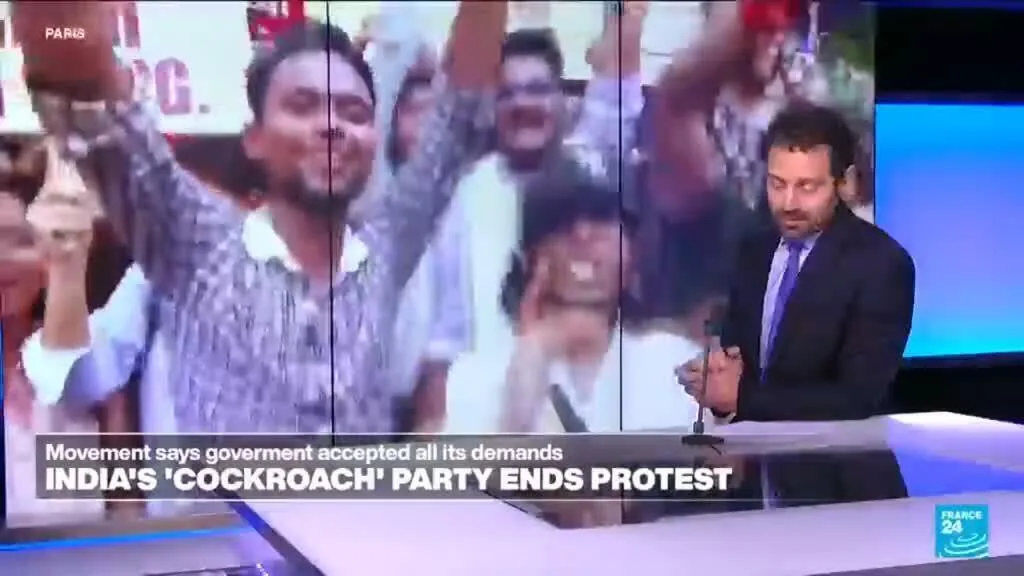
India’s so-called “cockroach” party, whose protests had been escalating, said it would end the demonstrations after a minister resigned. For decision-makers watching Indian governance and protest dynamics, it shows how fast political pressure can reprice and realign after leadership changes.
India’s political pressure cooker showed another fast turn: the party dubbed the “cockroach” party said it would end its protest after a minister resigned. The move matters because it frames protest leverage as something that can be withdrawn the moment officials step down, rather than something that necessarily grinds on until a broader package of demands is met.
The headline fact is straightforward. The “cockroach” party announced that it was ending its protest after the resignation of a minister. That sequence tells you the protest was not operating in a vacuum. It was aiming at a specific political outcome tied to accountability, and once the resignation landed, the party chose to stop rather than escalate further.
To understand why this matters beyond the street, it helps to remember how protests function in many democracies, including India. Protest movements rely on timing and signaling. They want to change what politicians think is likely, not just what people feel. A resignation is a concrete signal. It changes incentives inside ministries, forces immediate recalculations for political leadership, and can shift media attention. When protesters back down right after that signal, it usually means the movement believes it extracted the key concession it was targeting.
There is also an important governance angle. Minister resignations are not just symbolic. They can trigger internal reviews, reshuffle authority, and affect how policy decisions get made in the days after the exit. Even if the resignation is framed as voluntary, the fact that it happens under protest pressure can still ripple through the system. Staffers and allies take notes. So do opponents. In the next political cycle, leaders assess how costly a controversy becomes in public, and how quickly it can escalate into a leadership problem.
For executives and boards, the second-order implication is less about the protesters themselves and more about volatility in the environment where decisions get executed. In any country, but especially one with intense political and media scrutiny, governance shocks can move faster than policy can be drafted. When leadership changes happen in response to public pressure, companies often face delayed approvals, sudden changes in regulatory attention, and shifting stakeholder expectations. None of that requires a direct relationship between a company and a protest. It only requires that regulators and ministries reallocate focus after a resignation.
And then there is the media and narrative layer. Naming a party as “cockroach” is the kind of label that spreads because it is memorable. Labels affect how audiences interpret legitimacy and seriousness. When protesters are covered through a vivid moniker, it can harden public perceptions both for supporters and critics. That can influence whether protests are treated as routine political theater or as a genuine threat to stability. In fast-moving political stories, the narrative can become its own accelerant.
The fact that the party chose to end the protest after the minister resigned also suggests a strategy around resource allocation. Protests can be expensive in political capital and human time. If the party’s leadership believes the resignation has satisfied the central objective, continuing would risk diminishing returns. Instead, stopping allows them to claim effectiveness, bank momentum for later, and avoid giving opponents time to regroup while the movement remains in the spotlight.
So what should decision-makers take from this? It is a reminder that protest outcomes in politics can be immediate. Leadership exits can be triggered by pressure, and pressure campaigns can also end quickly once a targeted outcome is achieved. If you are running a business or advising a board, your job is not to predict every political twist. It is to build governance readiness for the kind of short-notice changes that come when ministries respond to public demands.
In practice, that means staying alert to signals that a government is adjusting course, including resignations and other leadership churn. It also means thinking about how quickly regulatory attention can shift in the wake of a political event. The strategic stakes are simple: volatility tends to be hardest on those who assume the news cycle will be slow. This story suggests the opposite. When the minister resigned, the “cockroach” party ended its protest. The system responded to pressure. And the people watching were likely left with a clearer sense of what pressure can achieve, and how quickly it can stop.
This story's Key Insights and Take-aways are locked.
Create a free account to unlock Executive Actions for one credit.
Register to UnlockAlways free for Executives Club members. Join the Club
More in Politics

LA County: DOJ's 20,000 'noncitizen' voter list is 'unreliable,' includes U.S.-born
Preliminary review by Los Angeles County election officials finds errors in the federal list, raising the stakes for voter roll integrity ahead of November.

Trump's $1.5B Pentagon chip investment lands in North Carolina
A $1.5 billion defense infusion for North Carolina chipmaking signals a new era of Pentagon-backed reshoring - here's what it means for the industry.

Nigeria confirms first Ebola case in Abuja, a woman just off a Uganda flight
Health Minister Muhammad Ali Pate says the patient flew in from Uganda, putting Africa's latest outbreak on Nigeria's doorstep.