
Miguel Almiron becomes first to get a red for covering his mouth at World Cup
Paraguay's Miguel Almiron was sent off for covering his mouth to speak to an opponent, in the Turkey match.
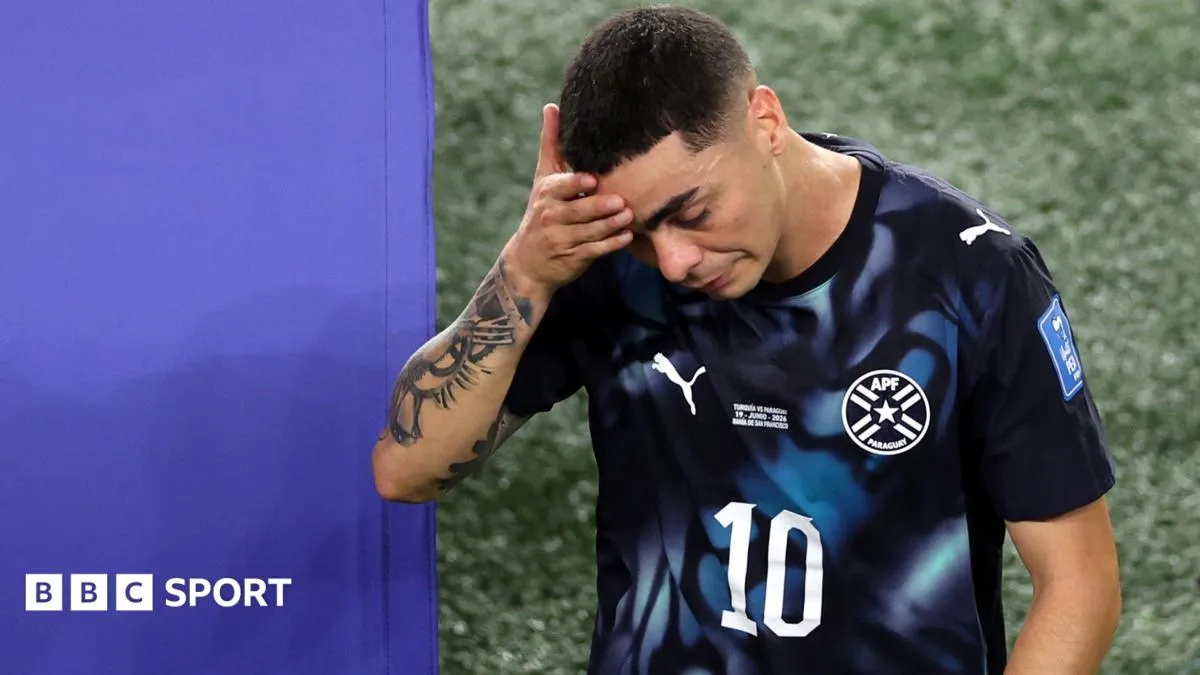
Paraguay's Miguel Almiron became the first player shown a red card for covering his mouth while speaking to an opponent during the World Cup match against Turkey. For decision-makers watching governance and enforcement, the incident signals how quickly match rules can be applied when referees treat conduct as sanctionable.
Miguel Almiron became the first player to be shown a red card for covering his mouth while speaking to an opponent. The World Cup match was against Turkey, and it happened as Almiron communicated with a player across the pitch, using the gesture of covering his mouth.
That is the key detail: this was not a late tackle or violent play. It was a communication-related action that referees treated as something worthy of the sport's harshest penalty. The BBC Sport report frames it as a first, which matters because “firsts” in enforcement tend to set precedent, at least in how players and teams prepare for what can be sanctioned in front of millions.
To understand why a gesture can carry the weight of a red card, you have to zoom out to how officiating works at major tournaments. The World Cup is not only about talent. It is also about consistency, optics, and a rulebook that covers more than what happens with your feet. In high-stakes matches, referees and match officials typically operate with a strong emphasis on controlling the game environment, including confrontational behavior and anything that can be read as unsporting. When an action is interpreted as communicating in a way that violates the expected code, the decision can escalate quickly.
This is where teams feel the second-order effects. Players who have worked their way into the World Cup often do so by being repeatable, disciplined, and tactically reliable. But gestures and micro-behaviors are part of how emotion and intensity express themselves in real time, especially when teams are under pressure. A red card for covering a mouth to speak does not just remove one player from that moment. It changes the rest of the match and forces a reshuffle on the fly, affecting substitutions, shape, and risk tolerance. Even if the on-pitch impact is limited in duration, the disciplinary label sticks, influencing how future confrontations are managed by both teams.
Boards, coaches, and sporting directors also have to think about the incentive structure created by high-visibility punishments. In many industries, when regulators enforce a gray area harshly the first time, organizations respond by tightening internal controls. Football teams do not have compliance departments in the corporate sense, but they do have preparation. They can quickly adjust player education, define what behaviors are “safe,” and coach players on how to communicate without triggering sanctions. The incident being described as “the first” tells you the enforcement boundary is now more widely understood, even if the underlying rule interpretation has always existed.
There is also a reputational layer. A red card draws attention to the player and can become the dominant story of a match. When the reason is unusual, the coverage becomes about “what exactly counts” and “why did the referee see it that way.” That attention can pressure governing bodies and refereeing standards teams to clarify or reinforce guidance, especially if other players or teams interpret the signal differently. In other words, one moment can lead to a broader conversation about what officials are looking for and how players should behave in competitive interactions.
From a strategic perspective, this matters beyond one match, because it influences how other squads approach proximity, confrontation, and communication. At the World Cup level, matches are so condensed and moments so scrutinized that teams often manage not only tactics but also the “behavioral surface area” of the game. When enforcement reaches a new category, opponents can exploit it by escalating pressure in ways that force mistakes, not with physical contact, but with conduct. Even if teams do not want to think this way, the competitive math changes when a previously ordinary behavior can turn into a dismissal.
The simplest way to frame the stakes is this: Miguel Almiron did something that drew a red card, and he became the first player to do so for this specific action. For executives and decision-makers connected to sport, the lesson is about governance in motion. Rules do not live only in documents. They live in interpretation on the day, in the hands of officials, at the speed of a decision in real time. When that interpretation hits something unexpected, it forces everyone to re-evaluate what they consider routine behavior on the biggest stage.
This story's Key Insights and Take-aways are locked.
Create a free account to unlock Executive Actions for one credit.
Register to UnlockAlways free for Executives Club members. Join the Club
More in Entertainment

Netflix’s Man on Fire turns vengeance into a weekend binge built for Jack Ryan fans
A popular novel gets the TV treatment: John Creasy’s pursuit is nonstop action plus serious emotional fuel.

Famke Janssen says Marvel “made a mistake” excluding her from Avengers: Doomsday
With the Dec. 18 release locked in, the X-Men actor calls out what it means for legacy cast returns and brand trust.

Prime Video’s Ballard hands Maggie Q the lead, and the detective thriller is already expanding
A standalone spin-off of Bosch turns toxic-masculinity scrutiny into a case you can’t stop watching.