
Richard Carapaz solos to win Stage 18, 45 seconds clear of Jorgenson
A late attack in Ecuadorian Richard Carapaz's solo breakaway reshuffles the standings before another 3,000m mountain test.
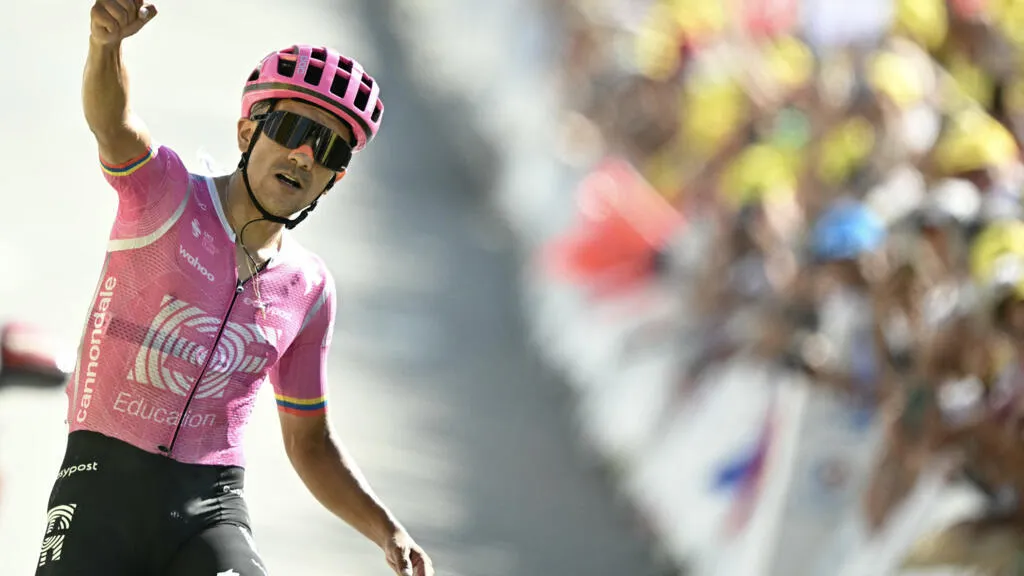
Ecuadorian cyclist Richard Carapaz won Stage 18 after a decisive attack in the closing stages, finishing ahead of Mauro Schmid and Matteo Jorgenson. For decision-makers watching performance under pressure, it is a clear example of how race tactics map to risk management, timing, and endurance capital.
Richard Carapaz turned Stage 18 into a one-man movie, winning after a decisive attack in the closing stages and leaving the rest of the field chasing. He crossed the line ahead of Switzerland’s Mauro Schmid and the American Matteo Jorgenson, who finished 45 seconds behind Carapaz.
That 45-second gap matters more than it sounds because it was earned at the precise moment rivals typically stop saving energy and start gambling. Carapaz’s move in the late race forced everyone else to respond instead of choosing their own plan. In other words, the breakaway was not just a display of strength, it was a timing decision that converted momentum into separation.
Stage 18 delivered a classic endurance sports lesson: solo acceleration is only terrifying when it is perfectly timed. Breakaways rarely succeed on pure willpower alone. They succeed when the attacker attacks when the peloton’s ability to organize a chase is at its lowest, when fatigue has already removed the “cheap” options and left teams with fewer tactical tools. Carapaz’s late-stage attack did exactly that. Once he had the advantage, the rest of the race became about damage control, not strategy design.
The finishing order also hints at how different rider profiles get rewarded. Carapaz finished first, with Schmid second and Jorgenson third, and the spread between first and third was 45 seconds. That implies Carapaz did not merely outlast the others. He created an outcome where rivals could not fully recover, even with the race context that usually makes it easier to close gaps when someone attacks early or during easier terrain.
And now the sport keeps raising the temperature. Today, riders face another mountain stage with over 3,000 metres of elevation gain. This matters because elevation gain is not a minor detail. For teams and athletes, it is the physical equivalent of an audit: it reveals who managed energy well, who is carrying fatigue, and who can sustain power when the “flat” time is gone for good.
When a race immediately follows a decisive late move, the second-order effects can be just as consequential as the stage result itself. A solo winner can look like a victory lap, but it also signals that the riders behind likely absorbed the cost of responding. If you had to bridge to a gap at the wrong moment, that cost does not disappear. It transfers into the next climbs, where the body is already rationing resources and the margins shrink to milliseconds of effort.
There is also a broader implication that decision-makers can recognize outside cycling. In many competitive environments, the hardest problems are time-sensitive. The late attack mirrors a real-world playbook: wait until others are committed, then act when coordination becomes expensive. That is what Carapaz did, and it is why the stage ended with a clear, measurable separation rather than a photo finish. Numbers like “45 seconds” become governance of the narrative, showing that the tactic produced a repeatable, quantifiable result.
Finally, the next mountain stage forces a reckoning of a different kind. With over 3,000 metres of elevation gain, the race will test whether Carapaz’s Stage 18 move was not just effective, but sustainable across consecutive pressure points. For rivals including Mauro Schmid and Matteo Jorgenson, the question is no longer whether they can chase, but whether they can do it again, and do it efficiently, after absorbing the same late-race shock.
For executives and operators, the takeaway is straightforward. When pressure peaks, timing beats strength alone. When terrain shifts, fatigue becomes a strategic constraint. And when the next climb arrives immediately after a solo attack, the only edge left is how well you protected your energy while everyone else spent theirs responding.
This story's Key Insights and Take-aways are locked.
Create a free account to unlock Executive Actions for one credit.
Register to UnlockAlways free for Executives Club members. Join the Club
More in Politics

LA County: DOJ's 20,000 'noncitizen' voter list is 'unreliable,' includes U.S.-born
Preliminary review by Los Angeles County election officials finds errors in the federal list, raising the stakes for voter roll integrity ahead of November.

Trump's $1.5B Pentagon chip investment lands in North Carolina
A $1.5 billion defense infusion for North Carolina chipmaking signals a new era of Pentagon-backed reshoring - here's what it means for the industry.

Nigeria confirms first Ebola case in Abuja, a woman just off a Uganda flight
Health Minister Muhammad Ali Pate says the patient flew in from Uganda, putting Africa's latest outbreak on Nigeria's doorstep.