
SpaceX’s first days: Musk’s rocket maker outranks Meta and Broadcom by market value
After a new public listing, SpaceX quickly becomes a top-tier value story, reshuffling how investors and peers think about risk and payoff.
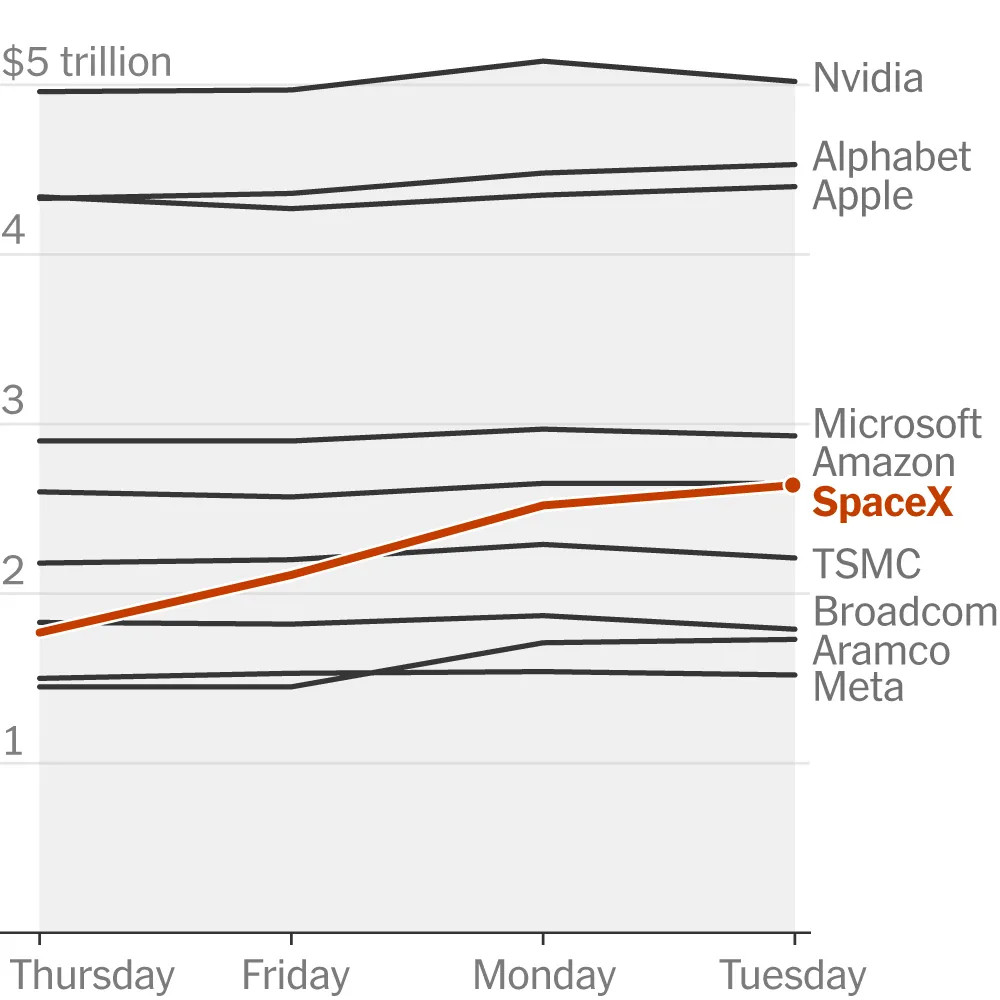
Elon Musk's newly listed rocket maker, SpaceX, climbed to become one of the world’s most valuable companies in its first few days of trading. For decision-makers, the rapid valuation shift signals how capital markets are currently pricing space and execution risk versus established tech and industrial giants.
SpaceX, Elon Musk’s newly listed rocket maker, became one of the world’s most valuable companies within its first few days of trading. The surprising part is the benchmark: in that early window, its market value moved beyond companies like Meta and Broadcom, according to the comparison in The New York Times.
For investors, this matters because market value is not just a scoreboard, it is a forecast of expectations. When a newcomer in a capital-intensive industry can outrank mature, widely held businesses in the valuation pecking order, it tells you where the market’s appetite is right now. The first trading days are where headlines are made, but they are also where the initial institutional positioning forms: early buyers, index constructors, and long-only funds begin translating “future potential” into present pricing.
To understand why the comparison to Meta and Broadcom is so loaded, you have to remember what those companies represent in the market. Meta is a scaled digital platform with enormous cash-generating reach, while Broadcom is tied to semiconductors and enterprise infrastructure, where the business model is different but the market expectation is also grounded in long-established cycles. SpaceX is different. It is a rocket and space operator, which historically has been treated by markets as a harder-to-model category because cash flows depend on launches, contracts, technology development, and regulatory and safety frameworks.
That is why the “first few days” phrasing is important. A newly listed company does not have a long trading history that smooths volatility. Instead, you get a compressed market experiment: how quickly do traders, and then larger allocators, mark the company’s worth relative to global peers? In the early days, price discovery can move fast because there is less consensus and less reference pricing. So the fact that SpaceX quickly joined the top tier suggests that the initial investor base is comfortable with the risk profile, or at least willing to pay for the upside now rather than later.
There is also a regulatory and market-structure angle that executives should clock. Space is not the same kind of business as software. It is subject to licensing, safety standards, launch permissions, and oversight that evolve as the industry matures. Even without diving into specific regulatory actions in this particular report, the general point remains: space activity is constrained by rules and practical limits that can affect schedules and costs. That friction tends to increase uncertainty, which usually pushes valuation discounts higher. But SpaceX’s early market standing implies either (1) investors believe execution can clear those hurdles efficiently, or (2) they believe the company’s trajectory is strong enough that uncertainties are being priced as manageable.
Board-level implications follow quickly. When a company like SpaceX leaps over recognizable incumbents like Meta and Broadcom, it pressures peers and analysts to reconsider the “opportunity set” for future value. In practice, capital markets often treat new listings as a proxy for where money wants to go next. If the market is willing to assign top-tier value to a space-focused company this early, it can make it harder for other boardrooms to argue for patience without measurable milestones. It also changes what “growth” looks like to investors: they may increasingly reward demonstrable execution progress, even in messy, regulated domains.
Executives at companies considering partnerships, financing, or even competitive positioning against space-adjacent ventures should also read this as a signal about narrative power. The market does not only value revenue. It values what investors think will become the dominant technical and commercial pathway. In that sense, SpaceX’s rapid rise is a reminder that capital is not neutral. It flows toward stories that combine scale, capability, and a credible route to profitable volume. If you are running a business where outcomes depend on building hard capabilities, this is a moment to watch, because sentiment can harden quickly into valuation benchmarks that are difficult to dislodge later.
Finally, the strategic stake is straightforward: when SpaceX is priced higher than major legacy names in its first days, that shapes expectations for the next months of trading. It can attract additional attention, tighten competition for capital among similar high-growth categories, and raise the bar for follow-on performance. For decision-makers watching valuation signals across tech, industrials, and deep-tech, the takeaway is not just that SpaceX is valuable. It is that the market is willing, right now, to reorder the ranking of who counts as a “must own” future story.
This story's Key Insights and Take-aways are locked.
Create a free account to unlock Executive Actions for one credit.
Register to UnlockAlways free for Executives Club members. Join the Club
More in Business

Anthropic’s Levant Alpöge cracks the Jacobian conjecture after 87 years
A Harvard valedictorian used Claude to hit a 1939 breakthrough, but the missing “why” is the real problem.

Uber buys Delivery Hero for nearly $15B, vaulting to top food delivery outside China
The deal doubles Uber's dual-services footprint and pushes a ride-and-eats bundling play into 50 more markets.

Epic and Google drop settlement bid, forcing rival Android app stores by July 22
Google told the court it is ready to carry third-party app stores starting Wednesday, July 22.