
Spain’s 2026 World Cup win becomes a politics-and-media reckoning, not just football
Robbie Knock says Spain’s “diligent” performance beat fortune, while refereeing controversy and Messi’s farewell shape how it’s remembered.
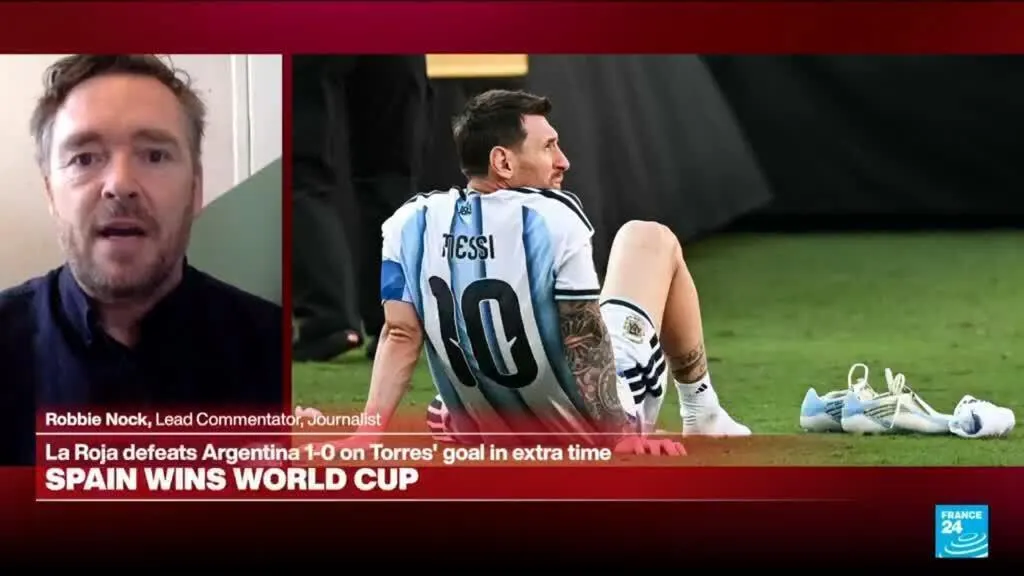
Robbie Knock, lead commentator and sports journalist, frames the expanded 2026 North American World Cup as a mix of tactical superiority, political and entertainment entanglement, and institutional scrutiny. He also situates the tournament as the closing chapter of Lionel Messi’s international career, with dignity in defeat reinforcing his legacy.
Robbie Knock, the lead commentator and sports journalist, says the expanded 2026 FIFA World Cup will be remembered for more than Spain’s triumph on the pitch. In his telling, the tournament became enmeshed in politics, entertainment, and institutional scrutiny at the same time it delivered a defining endgame for one of football’s biggest careers: Lionel Messi’s international farewell.
And that is the crux of the story. Knock argues Spain’s victory came from tactical superiority rather than fortune. But he also acknowledges that controversial refereeing decisions complicated how the tournament was perceived, pulling public debate toward officiating even while the on-field narrative leaned toward disciplined planning. If you are trying to understand why sports moments now play like political and media events, that tension matters.
To see why, zoom out from the final whistle to how modern mega-events get interpreted. The “expanded” format signals a bigger stage and more visibility. With more teams, more matches, and more audiences, football does not just entertain. It becomes a content engine and a governance test, with institutions under the microscope and audiences primed to debate legitimacy, fairness, and control. Knock’s point is not that politics replaces football. It is that football increasingly sits next to politics, entertainment, and oversight, because the sport is too large to stay purely athletic in public conversation.
Then there is the other layer: the framing war between “process” and “luck.” Knock says Spain’s win was the product of tactical superiority rather than fortune. That distinction is subtle, but it has huge downstream effects for how people talk about teams and organizations. When you say tactics, you elevate coaching, preparation, and execution under pressure. When you say fortune, you imply outcomes that are less replicable. In business terms, it is the difference between a performance you can rebuild and a result you can only hope for.
But Knock also makes room for why the narrative may not be clean. He points to controversial refereeing decisions as a factor that complicated perceptions of the tournament. This is where institutional scrutiny enters the frame. Officiating is one of the fastest ways legitimacy can be challenged, because fans do not treat it as a minor detail. They treat it as the referee between competence and credibility, especially in a high-stakes competition with global attention. When calls become disputed, the debate spills beyond the pitch into broader arguments about standards, accountability, and the integrity of competition.
Now add the Messi chapter. Knock presents Messi’s expected international farewell as the conclusion of a defining era in world football. The way he ties this to dignity in defeat is especially important: he emphasizes that dignity in defeat may ultimately reinforce rather than diminish Messi’s legacy. In other words, the legacy conversation is not only about trophies or outcomes. It is also about how the sport frames its endings. For executives and boards operating in sports-adjacent ecosystems, that is a reminder that narratives can carry long half-lives. A farewell match can become a brand moment that outlasts results, because audiences remember conduct, tone, and the arc of a career.
If you are mapping implications for decision-makers, consider how these threads reinforce each other. Spain’s tactical story provides one kind of lesson: disciplined execution scales. The officiating controversies provide another kind of lesson: legitimacy is fragile, and public trust depends on perceived fairness. Messi’s farewell provides yet another lesson: cultural significance, not just competitive outcomes, can define how an era is archived.
There is a final second-order implication embedded in Knock’s framing. When a tournament is simultaneously a sporting contest and a cultural event under institutional scrutiny, it attracts stakeholders with different priorities. Broadcasters and entertainment partners chase engagement. Politicians and commentators chase symbolism. Regulators and institutions face scrutiny over governance and process. The result is that football becomes a high-velocity environment where small decisions, like officiating calls, can reverberate far beyond the match itself. That is the “why it matters” for anyone in leadership: the scoreboard is only one scoreboard. Reputation, legitimacy, and narrative control are the other three, and they all get graded in public.
This story's Key Insights and Take-aways are locked.
Create a free account to unlock Executive Actions for one credit.
Register to UnlockAlways free for Executives Club members. Join the Club
More in Politics

LA County: DOJ's 20,000 'noncitizen' voter list is 'unreliable,' includes U.S.-born
Preliminary review by Los Angeles County election officials finds errors in the federal list, raising the stakes for voter roll integrity ahead of November.

Trump's $1.5B Pentagon chip investment lands in North Carolina
A $1.5 billion defense infusion for North Carolina chipmaking signals a new era of Pentagon-backed reshoring - here's what it means for the industry.

Nigeria confirms first Ebola case in Abuja, a woman just off a Uganda flight
Health Minister Muhammad Ali Pate says the patient flew in from Uganda, putting Africa's latest outbreak on Nigeria's doorstep.