
Trump calls himself ‘oversensitive,’ then targets Anderson Cooper and Kaitlan Collins
At the rescheduled White House Correspondents' Dinner, Trump mixed self-admission with sharp insults, raising more questions than laughs.
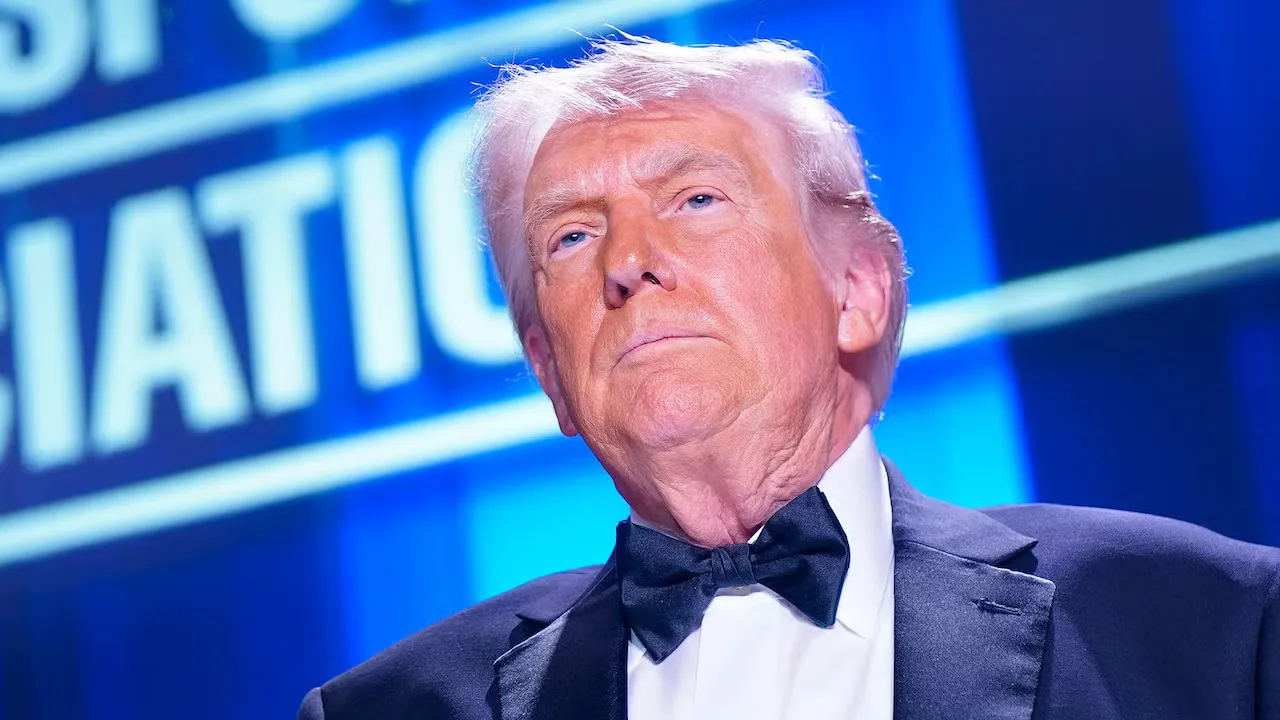
President Donald Trump used the rescheduled White House Correspondents' Dinner at the Waldorf Astoria hotel to address his relationship with the press, then insulted journalists including Anderson Cooper and CNN's Kaitlan Collins. For decision-makers, the speech is another signal that press relations, access disputes, and media credibility fights remain central to the administration’s political strategy.
President Donald Trump did not just show up to the rescheduled White House Correspondents' Dinner on Friday, July 24. He used the moment to admit he may be sensitive to press coverage, then immediately turned around and insulted major journalists, including Anderson Cooper and CNN’s Kaitlan Collins.
In the speech, Trump told the crowd at the Waldorf Astoria hotel in Washington, D.C., “But I’m probably being a little bit oversensitive.” He added, “Sometimes, I really do think that some of you don't like me,” and then offered a specific claim about the tone of coverage, saying he reads a report stating he gets “93 percent negative publicity.” The president framed that as a mystery: “How the hell did I win the election by so much? Think of it. I don't think that's true.” He also described the press crowd as “the largest group of Trump Derangement Syndrome” in one room.
That self-assessment was the first jolt. The second was the way he went straight from it into direct name-calling. Trump said he is “not a fan of Lawrence O'Donnell,” but claimed he does like Anderson Cooper because “he’s covered me well for many years,” saying Cooper “went bad as soon as I went for politics.” Trump then contrasted Cooper and O'Donnell, saying O'Donnell “never liked him” and “never thought he had any talent,” while also claiming O'Donnell was “still making a living.” Trump’s comments continued with a jab at television outlets, describing a “contest for who had the lowest ratings and the lowest IQ on television,” which he attributed to Don Lemon “I think.”
The speech also flowed into other cultural and political figures, underscoring that this was not a tight “press only” moment. Trump quipped about the April shooting that derailed the original dinner, praising the press corps’ response, but the pleasantries did not last. He criticized Bette Midler and Jane Fonda for protesting a UFC fight held on the White House lawn, calling it “between the two of them of the UFC,” and then mocked Bruce Springsteen, saying, “What the hell happened to that guy? He looks like hell.” Those remarks matter because they show a broader pattern: the White House communications playbook in this period treats culture coverage and political coverage as part of the same audience battle.
Then Trump zeroed in on Kaitlan Collins, turning the speech into a very pointed rebuttal to the event’s own awards. He addressed her win at the White House Correspondents' Dinner on Friday and claimed the recognition was illegitimate. “I want to personally congratulate CNN's Kaitlan Collins on receiving her award,” he told the audience. “It was all about me. It’s a fake. She shouldn't get the award. It was a fake.” He added, “But I didn't mind. I said, Kaitlan, congratulations. But it was fake. There's no question about it.” He then attacked her demeanor and appearance, saying she “never smiles,” telling her: “You ever smile? Smile. You have a nice position. You're at CNN fake news. You should be a happy person. So smile, Kaitlan. Just smile.”
Collins was not left alone in the room. After Trump concluded his address, WHCA President Weijia Jiang took the stage and defended Collins, telling the crowd the CNN host had “a beautiful smile.” That exchange is a small but telling governance moment. The WHCA is supposed to be the connective tissue between the White House press corps and the public, and in this case, its president publicly pushed back on Trump’s framing rather than letting it sit as a one-sided narrative.
For context, the dinner itself had already been disrupted. The dinner originally got underway in April before a shooting scare forced organizers to halt the event. The White House Correspondents' Association later rescheduled the remainder for Friday, July 24, and it returned under heightened security more than three months later. Trump’s appearance also landed at an unusually tense time for Washington journalism and came as his administration remains in an increasingly adversarial relationship with the news media, with legal battles involving news organizations including The New York Times and BBC, disputes over White House press access, and repeated attacks on major outlets. The speech reportedly marked the first time he appeared at the dinner while president after boycotting it in his first term and first year of his second.
So what is the stake for executives, investors, and boards watching from the sidelines? This is not “just a speech.” It is a signal about how the White House expects media to behave and how it plans to respond when it does not. When a president frames coverage as “93 percent negative” and describes press attention in personal, identity-driven terms, it tends to harden the incentives for outlets: defend credibility aggressively, or be pulled into the administration’s narrative on its terms. That can spill beyond journalism into regulation and corporate risk. Companies that rely on media goodwill, public-sector customers, or sensitive government relationships often end up inside the blast radius of these credibility wars, even when they are not the target. For peers navigating communications, compliance, and government exposure, the lesson is straightforward: in this White House environment, press relations are a live wire, not a background condition.
This story's Key Insights and Take-aways are locked.
Create a free account to unlock Executive Actions for one credit.
Register to UnlockAlways free for Executives Club members. Join the Club
More in Politics

LA County: DOJ's 20,000 'noncitizen' voter list is 'unreliable,' includes U.S.-born
Preliminary review by Los Angeles County election officials finds errors in the federal list, raising the stakes for voter roll integrity ahead of November.

Trump's $1.5B Pentagon chip investment lands in North Carolina
A $1.5 billion defense infusion for North Carolina chipmaking signals a new era of Pentagon-backed reshoring - here's what it means for the industry.

Nigeria confirms first Ebola case in Abuja, a woman just off a Uganda flight
Health Minister Muhammad Ali Pate says the patient flew in from Uganda, putting Africa's latest outbreak on Nigeria's doorstep.