

Uganda says Ebola-free, but Kenya and Nigeria cases may trace to its airport
Health officials are investigating whether infected travelers crossed paths at Uganda's main airport, even as the country insists it has no active cases.

Ugandan health officials say the country has no active Ebola cases, but infections in Kenya and Nigeria have prompted a probe into whether patients crossed paths at Uganda's main airport. For regional governments and airlines, the investigation could revive travel restrictions and expose gaps in airport screening.
Uganda says it has no active Ebola cases, but the discovery of infections in Kenya and Nigeria is forcing a fresh look at how the virus might have moved. Health officials are now investigating whether Ebola patients from those two countries crossed paths at Uganda's main airport, according to Deutsche Welle. The probe comes as conflicting accounts cloud the source of at least one infection, leaving a key question unanswered: did the airport become a transmission point?
The stakes are immediate. Uganda's main airport, Entebbe International, is a regional hub for East Africa, connecting smaller cities to international routes. If the investigation finds a link, it would mean the virus slipped through screening despite Uganda's insistence that it has no active cases. That would not only undermine Uganda's public health messaging but also raise concerns for Kenya and Nigeria, two of Africa's largest economies and busiest travel destinations.
For context, Ebola is a severe viral illness that spreads through direct contact with bodily fluids. Outbreaks have historically been concentrated in Central and West Africa, with the 2014-2016 epidemic in West Africa killing more than 11,000 people. Airport screening has become a standard defense, with temperature checks and health questionnaires designed to catch symptomatic travelers. But Ebola's incubation period can stretch up to 21 days, meaning a traveler can pass through a checkpoint before symptoms appear. That makes airports a vulnerable point in the containment chain, especially when multiple countries are involved.
The conflicting accounts mentioned in the report highlight how difficult it is to trace transmission chains. If one patient's infection source is unclear, officials cannot rule out that they encountered another infected traveler at a common point, such as an airport terminal. That ambiguity is precisely what makes the investigation significant. It is not just about one case; it is about whether the region's screening infrastructure can be trusted. A single missed case can unravel months of containment work, and the uncertainty here is already complicating the public health response.
For Kenya and Nigeria, the implications are economic as well as medical. Both countries rely heavily on air travel for trade, tourism, and business connectivity. A confirmed airport transmission could trigger travel advisories, flight cancellations, and stricter entry requirements from other nations. That would hit airlines, hotels, and logistics companies, and it would complicate the post-pandemic recovery that many African economies are still pursuing. The tourism sector in Kenya, for example, is a major source of foreign exchange, and any perception of an Ebola risk could deter visitors.
For Uganda, the stakes are reputational. The government has said there are no active Ebola cases, and it will want to defend that claim. But if the investigation finds that Uganda's airport was the point of contact, the country would face intense scrutiny over its screening protocols. That could affect foreign investment and tourism, both of which are sensitive to public health perceptions. Even if the link is not confirmed, the mere possibility can linger in the minds of international partners and travelers.
The investigation also underscores a broader lesson for regional health systems. Viruses do not respect borders, and a single airport can become a chokepoint for disease spread. Coordinated surveillance across countries is essential, but it is often underfunded and fragmented. The fact that officials in multiple countries are now involved suggests they recognize the need for a joint response, even as the source of the infection remains unclear. This case is a reminder that health security is only as strong as the weakest link in the chain.
For executives and policymakers watching this story, the takeaway is that public health events can quickly become economic and political events. A single unresolved case can trigger a cascade of responses, from travel bans to investor caution. The coming days will show whether the investigation confirms a link or clears Uganda's airport, but the uncertainty itself is already a cost. Companies with exposure to East African travel should monitor the situation closely and prepare contingency plans, because the next update could change the risk calculus overnight.
This story's Key Insights and Take-aways are locked.
Create a free account to unlock Executive Actions for one credit.
Register to UnlockAlways free for Executives Club members. Join the Club
More in Politics

LA County: DOJ's 20,000 'noncitizen' voter list is 'unreliable,' includes U.S.-born
Preliminary review by Los Angeles County election officials finds errors in the federal list, raising the stakes for voter roll integrity ahead of November.

Trump's $1.5B Pentagon chip investment lands in North Carolina
A $1.5 billion defense infusion for North Carolina chipmaking signals a new era of Pentagon-backed reshoring - here's what it means for the industry.
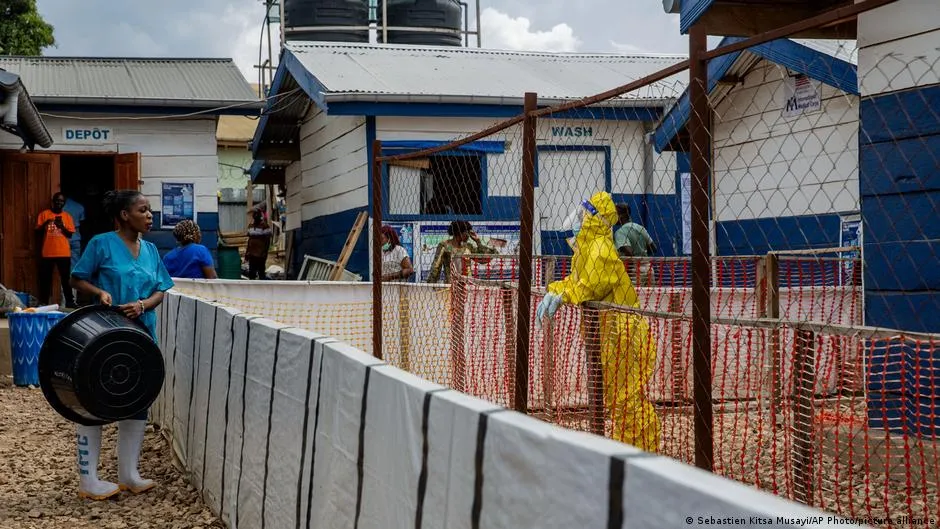
Nigeria confirms first Ebola case in Abuja, a woman just off a Uganda flight
Health Minister Muhammad Ali Pate says the patient flew in from Uganda, putting Africa's latest outbreak on Nigeria's doorstep.