
Zelensky fires Oleksandr Syrsky, appoints Mykhailo Drapaty as commander-in-chief
A sudden leadership shake-up follows street protests, with Zelensky replacing a Soviet-trained top commander.
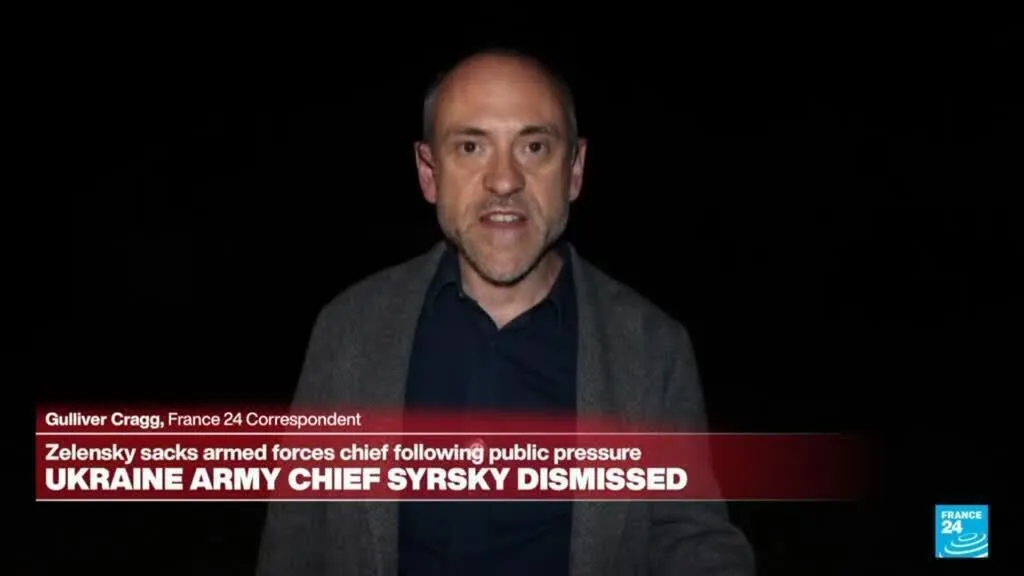
President Volodymyr Zelensky said Major General Mykhailo Drapaty will replace Oleksandr Syrsky as Ukraine's commander-in-chief after firing Syrsky. For decision-makers, the shift signals how quickly political pressure can reorder military command.
President Volodymyr Zelensky said on Tuesday that Major General Mykhailo Drapaty will take over as Ukraine's commander-in-chief after firing Soviet-trained top commander Oleksandr Syrsky. The move is not being framed as a slow, internal personnel process. It is being framed as a direct response to protest pressure that rose into public view a week earlier.
France 24 correspondent Gulliver Cragg links the decision to street action, saying the firing was “a victory for the protestors who took to the streets a week ago, when Zelensky fired Fedorov.” Cragg adds that protestors' “main demand was that Syrsky be fired.” Zelensky’s choice of Drapaty, Cragg says, is also part of the logic of the replacement: “Drapaty was the one Fedorov wanted to see in that position to replace Syrsky.”
This matters because command structure during war is supposed to be about continuity, competence, and speed. When the top job changes quickly, it sends a signal beyond the battlefield. It tells the chain of command, the political class, and the public that performance and loyalty to the current leadership agenda can be judged publicly, not just internally. Even the language used in coverage highlights that public protest can become a forcing function.
From a governance perspective, Zelensky’s announcement compresses the time between political mobilization and executive action. The claim that protestors got their central demand met, and that this follows an earlier firing tied to the same protest cycle, implies a pattern: Zelensky is willing to use personnel moves as a form of political accountability. In practical terms, that can reduce uncertainty for some stakeholders, because the administration appears to respond decisively. But it can also introduce churn for others, because frequent leadership changes can disrupt planning rhythms and priorities, especially in roles where implementation requires deep familiarity.
To understand why this is second-order important, look at what “commander-in-chief” means in an operating system built on hierarchy. Ukraine’s command structure depends on consistent operational intent, stable reporting lines, and trust that decisions are not going to flip abruptly. When a Soviet-trained commander like Syrsky is removed, the impact is more than symbolic. It can be interpreted as a change in approach, not just a change in personnel, even if the source text does not spell out the operational rationale.
Then there is the political meaning of Drapaty’s appointment. According to Cragg, Drapaty was the individual “Fedorov wanted to see in that position to replace Syrsky.” That detail matters because it connects the dots between at least two leadership decisions, one involving the firing of Fedorov and this later firing of Syrsky. Whether you view it as coalition alignment or as the administration responding to a preferred candidate, the implication is that preferences inside the leadership orbit can become outcome-determining.
In business terms, it is similar to what happens when boards and CEOs shift management in response to sustained pressure, not just quarterly results. You get a new person in the seat, but you also get a new message about what the organization values now. In a wartime setting, that message lands in the most sensitive place possible: top military command. For executives and investors watching from the outside, the lesson is that political legitimacy and public trust are not separate from operations. They can directly alter the staffing and execution pipeline.
Strategically, peers in similar roles should treat this as a reminder that legitimacy pressures can become execution pressures. If protestors can get Zelensky to fire a top commander and follow it with a fast appointment, then other high-accountability institutions can expect that the “social license” to lead might be tested in real time. For boards, advisors, and operators, the key stake is the same: can your leadership system absorb sudden personnel changes without losing momentum? If not, the organization becomes vulnerable to disruptions that have nothing to do with technical performance, and everything to do with public expectation.
This story's Key Insights and Take-aways are locked.
Create a free account to unlock Executive Actions for one credit.
Register to UnlockAlways free for Executives Club members. Join the Club
More in Politics

LA County: DOJ's 20,000 'noncitizen' voter list is 'unreliable,' includes U.S.-born
Preliminary review by Los Angeles County election officials finds errors in the federal list, raising the stakes for voter roll integrity ahead of November.

Trump's $1.5B Pentagon chip investment lands in North Carolina
A $1.5 billion defense infusion for North Carolina chipmaking signals a new era of Pentagon-backed reshoring - here's what it means for the industry.

Nigeria confirms first Ebola case in Abuja, a woman just off a Uganda flight
Health Minister Muhammad Ali Pate says the patient flew in from Uganda, putting Africa's latest outbreak on Nigeria's doorstep.